UK Water Privatization and Sewage Pollution Crisis Lessons
Source:The Hindu ↗
Why It Matters
The UK's water crisis serves as a critical case study for UPSC aspirants regarding the privatization of essential public services. It illustrates how private ownership without stringent regulatory oversight can lead to severe environmental degradation and chronic infrastructure deficit, offering lessons for India's own urban infrastructure management, public-private partnerships, and environmental governance.
Summary
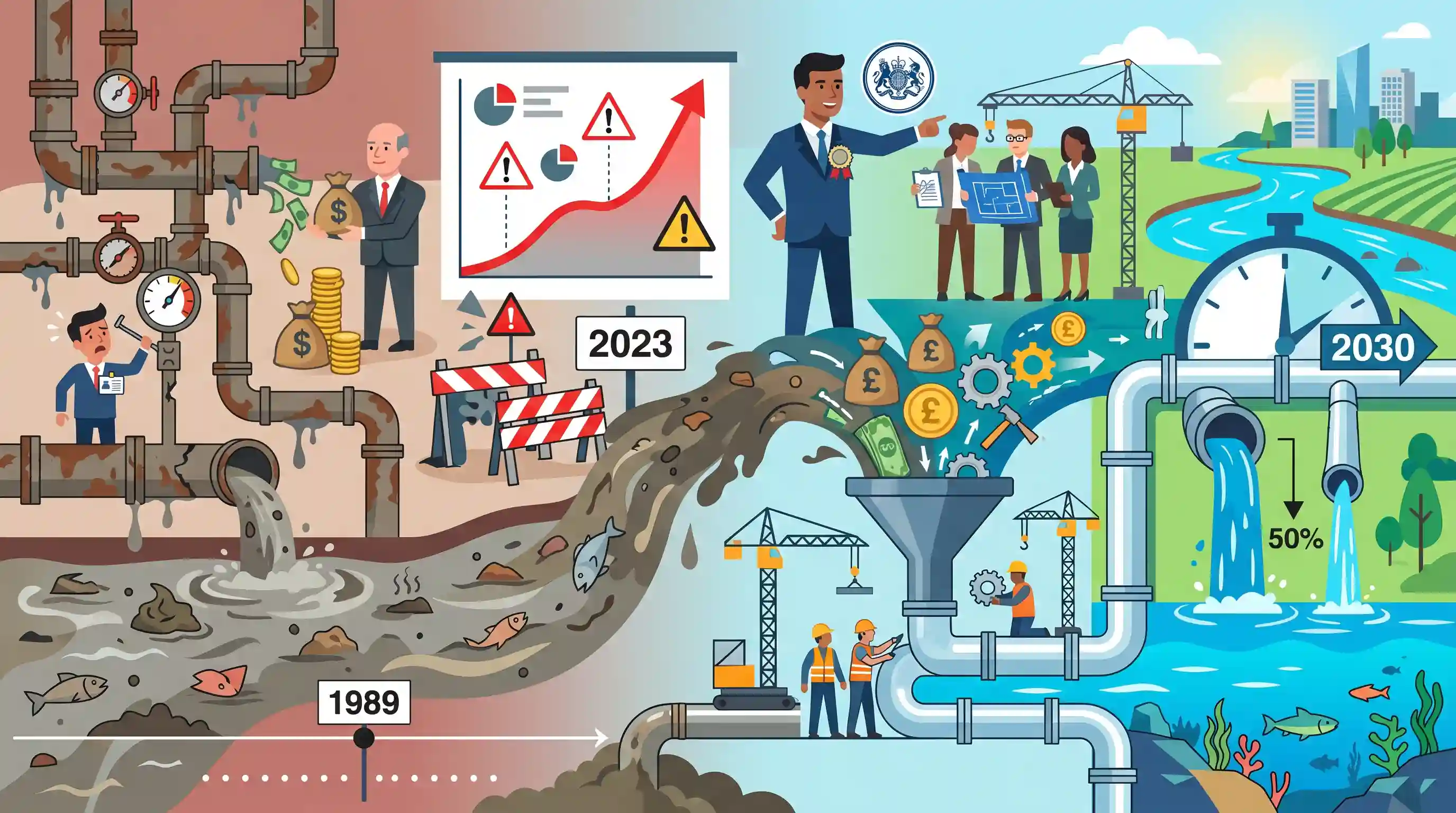
The United Kingdom has pledged to cut sewage pollution by 50% by 2030 amid a crisis caused by decades of underinvestment and regulatory failure in its privatized water sector. Since privatization in 1989, water companies have been accused of prioritizing investor dividends over maintaining the UK's Victorian-era sewerage network, leading to a 60% increase in severe contamination incidents in 2023. Acknowledging that the regulator, Ofwat, has failed, the government announced an Independent Water Commission to overhaul the sector and attract the £290 billion estimated necessary for long-term infrastructure upgrades.
Key Points
- The UK government has committed to halving sewage pollution caused by privatized water companies by 2030, following a 60% surge in serious contamination incidents in 2023.
- The UK's water companies, privatized in 1989, have faced severe criticism for discharging raw sewage into rivers and seas while prioritizing payouts to investors over infrastructure maintenance.
- The country's aging Victorian-era sewerage system suffers from chronic underinvestment, with estimates suggesting that £290 billion ($388 billion) in investment is needed over the next 25 years.
- Environment Secretary Steve Reed stated that the sector's regulatory body, Ofwat, is 'clearly failing'.
- An 'Independent Water Commission', chaired by former Bank of England official Jon Cunliffe, will conduct the largest systemic review of the sector since its privatization to drive reform.
Important Terms
Ofwat

The Water Services Regulation Authority in England and Wales; an independent body responsible for economic regulation, pricing, and service standards in the water sector.
UPSC context
GS2 (Regulatory Bodies) – useful for comparative analysis of utility regulation and accountability in essential service delivery.
Independent Water Commission (UK)
An expert-led body established in 2024 to recommend fundamental reforms to the UK water sector, focusing on investment, regulation, and environmental health.
UPSC context
GS2 (Governance/Institutional Reform) – demonstrates how governments restructure oversight mechanisms to address systemic failure.
Privatization
The transfer of ownership or operations from the government to the private sector, often to improve efficiency through competition and capital investment.
UPSC context
GS3 (Economic Development) – relevant for debating the trade-off between private profit and public service in utility management.
Regulatory Failure
A governance breakdown where a regulatory agency fails to oversee a sector effectively, leading to outcomes that harm public interest or environmental safety.
UPSC context
GS2 (Governance/Accountability) – evaluates the effectiveness of independent regulators and the need for stronger oversight in critical sectors.
Legacy Infrastructure
Physical systems, like the UK’s Victorian-era sewers, that remain operational despite being outdated and unable to handle modern population or environmental demands.
UPSC context
GS3 (Urbanization/Environmental Pollution) – highlights the challenges of modernizing urban systems to achieve Sustainable Development Goals (SDG 6).
Prelims Trap
"The UK's sewage crisis is primarily attributed to the chronic inefficiency of state-owned water monopolies."
The UK water sector was privatized in 1989. The current crisis stems from private monopolies prioritizing investor dividends over infrastructure upgrades, making it a privatization failure.
Static Concepts Connected
What constitutes 'Regulatory Capture' in public utility governance?
- Definition: A government failure where a regulatory agency advances the commercial or political concerns of the industry it regulates, instead of protecting the public interest.
- Manifestations: Weak penalties for violations, revolving-door appointments between the regulator and industry, and allowing corporations to prioritize dividends over infrastructure investments.
What is the structural framework for urban sewage management in India?
- Constitutional Mandate: Under the 12th Schedule (74th Constitutional Amendment), public health, sanitation, conservancy, and solid waste management are the responsibility of Urban Local Bodies (ULBs).
- Capacity Gap: India generates over 72,000 million liters per day (MLD) of sewage, but installed treatment capacity is barely 31%, leaving the rest to pollute rivers.
- Regulatory Authority: The Central Pollution Control Board (CPCB) sets effluent discharge standards under the Water (Prevention and Control of Pollution) Act, 1974.
Cross-Topic Patterns
PPP failures in Essential Utilities
The UK's water privatization failure provides a counter-narrative for Mains answers assessing India's push for Public-Private Partnerships in power DISCOMs and municipal water distribution.
Legacy Urban Infrastructure deficits
Similar to the UK's collapsing Victorian-era sewers, India's colonial-era drainage networks in coastal metros like Mumbai are primary drivers of recurring urban flooding and untreated effluent discharge.

Mains GS2/GS3 question evaluating the PPP model in basic utilities (water/power) is highly probable, citing global regulatory failures.
Linked PYQs · 3
Linked PYQs · 3
- 2024MainsGS3
Industrial pollution of river water is a significant environmental issue in India. Discuss the various mitigation measures to deal with this problem and also the government's initiatives in this regard.
- 2018MainsGS2
“Policy contradictions among various competing sectors and stakeholders have resulted in inadequate 'protection and prevention of degradation' to environment.” Comment with relevant illustrations.
- 2015MainsGS2
For achieving the desired objectives, it is necessary to ensure that the regulatory institutions remain independent and autonomous. Discuss in the light of the experiences in recent past.
