Tanakpur to Nanded Rail Service Inaugurated for Religious Tourism
Source:newsonair ↗
Why It Matters
Understanding infrastructural advancements, regional connectivity, and regional geography (specifically Uttarakhand's Terai and Kumaon zones) is crucial for state-level civil service examinations like UKPSC PCS, which frequently ask about local transport developments, geographic belts, and district-level facts.
Summary
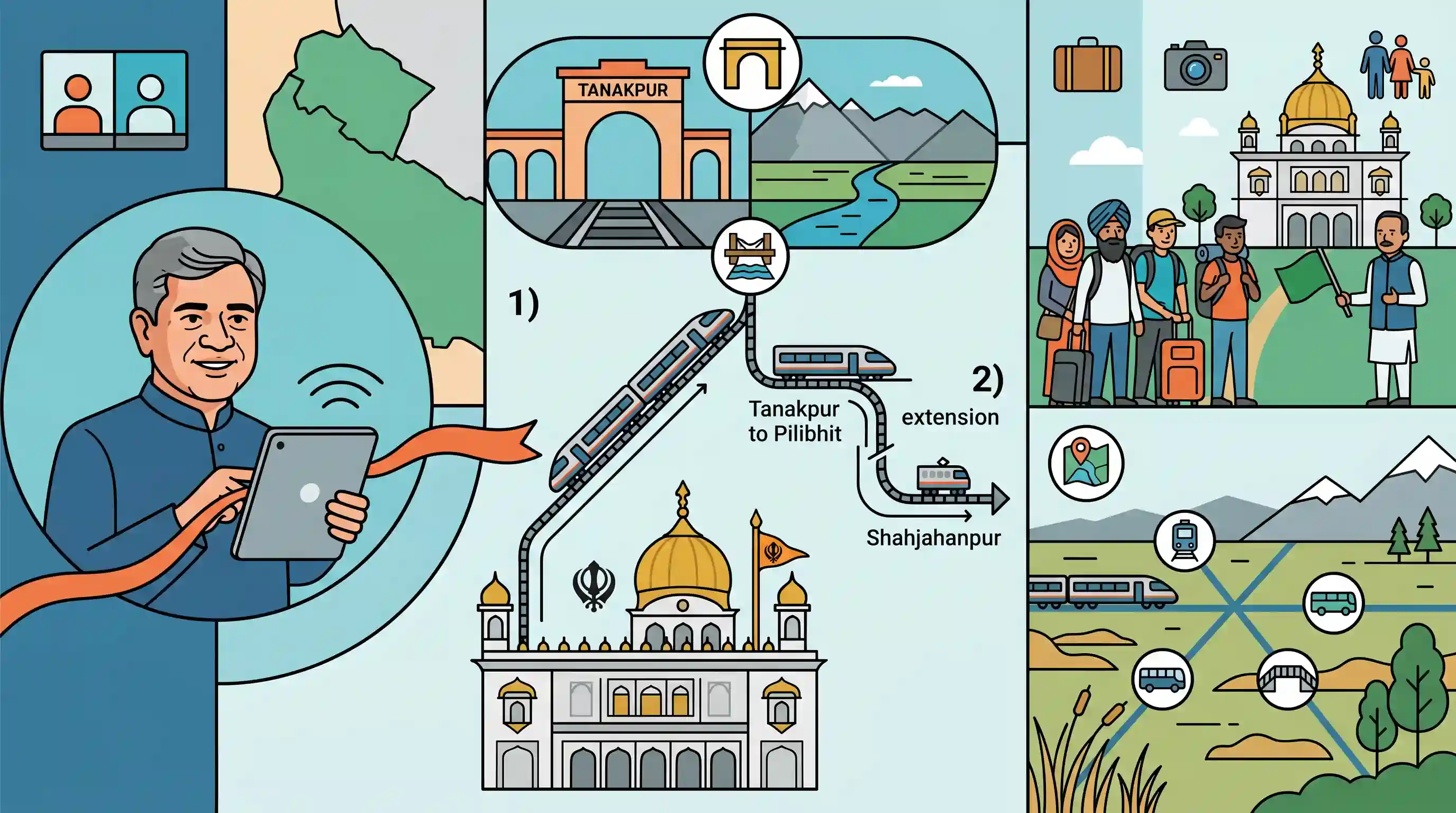
Union Railways Minister Ashwini Vaishnaw virtually inaugurated a new train service between Tanakpur (Uttarakhand) and Hazur Sahib Nanded (Maharashtra), alongside the extension of the Tanakpur-Pilibhit rail line to Shahjahanpur. The physical flag-off at Tanakpur Station in Champawat district was led by Ministers Ravneet Singh Bittu and Ajay Tamta. This train service will significantly enhance religious tourism and improve connectivity for the Terai region of Uttarakhand.
Key Points
- Union Railways Minister Ashwini Vaishnaw virtually inaugurated a new train service connecting Tanakpur in Uttarakhand to Hazur Sahib at Nanded in Maharashtra.
- Additionally, the existing Tanakpur-Pilibhit rail service was officially extended up to Shahjahanpur in Uttar Pradesh.
- The physical flagging-off ceremony took place at the Tanakpur Railway Station in Uttarakhand's Champawat district, attended by Minister of State for Railways Ravneet Singh Bittu and Minister of State for Road Transport and Highways Ajay Tamta.
- The new Tanakpur-Nanded Express is a major boost to religious tourism, specifically connecting Sikh pilgrims in Uttarakhand's Terai region with the holy shrine of Hazur Sahib in Nanded.
- This rail connectivity addresses a long-standing demand of the residents of the Terai and Kumaon regions of Uttarakhand.
Important Terms
Terai Region

A lowland, damp, and fertile belt in northern India and southern Nepal, situated south of the Sivalik Hills where underground streams from the Bhabar region re-emerge.
UPSC context
GS Paper I (Geography): Indian physical geography, geomorphology of the Indo-Gangetic plains, and agricultural land-use patterns.
Takht Sri Hazur Sahib
One of Sikhism's five holy seats of temporal authority (Takhts), located in Nanded, Maharashtra, commemorating the site where the tenth Guru, Guru Gobind Singh, passed away in 1708.
UPSC context
GS Paper I (Art and Culture): Important historical sites, regional architectural styles, and Bhakti-Sufi cultural movements.
Pilibhit Tiger Reserve
A protected area in Uttar Pradesh located along the Indo-Nepal border, forming part of the Terai Arc Landscape, famously awarded the global TX2 award for doubling its tiger population.
UPSC context
GS Paper III (Environment & Biodiversity): Protected area networks, species conservation initiatives, and transboundary wildlife corridors.
Terai Arc Landscape
A transboundary conservation corridor stretching over 800-900 km across India and Nepal, characterized by rich biodiversity, critical tiger reserves, and recognized as a UN World Restoration Flagship.
UPSC context
GS Paper III (Environment): Wildlife corridors, international ecological conservation efforts, and ecosystem restoration.
Panch Takhts
The five temporal thrones or seats of high spiritual and administrative authority in Sikhism, which guide the community's religious affairs and preserve its historical customs.
UPSC context
GS Paper I (Art and Culture): Major Indian religions, religious institutions, and socio-religious reform history.
Prelims Trap
All five temporal seats (Takhts) of Sikhism are geographically situated within the modern state of Punjab.
Only three of the five Takhts (Akal Takht, Keshgarh Sahib, Damdama Sahib) are in Punjab. Patna Sahib is in Bihar and Hazur Sahib is in Maharashtra.
Static Concepts Connected
What are the Five Takhts of Sikhism and their locations?
- Supreme seat: Akal Takht in Amritsar (Punjab) is the oldest and supreme seat of spiritual-temporal authority.
- Other Punjab Takhts: Keshgarh Sahib (Anandpur Sahib, birthplace of Khalsa) and Damdama Sahib (Talwandi Sabo) are in Punjab.
- Out-of-state Takhts: Patna Sahib (Bihar, birthplace of Guru Gobind Singh) and Hazur Sahib (Nanded, Maharashtra) lie outside Punjab.
How do Bhabar and Terai regions differ geographically?
- Bhabar belt: A porous, pebble-heavy tract at the Shiwalik foothills where streams disappear underground.
- Terai tract: A swampy, clayey zone south of Bhabar where streams re-emerge, featuring high fertility and biodiversity.
Cross-Topic Patterns
Sikh Heritage & Deccan-North Connectivity
Rail networks bridging northern Terai to Nanded link early modern Sikh history (Guru Gobind Singh's Deccan migration) with modern religious tourism corridors.
Medieval Kumaon & Temple Architecture
Champawat's history as the early Chand dynasty capital links regional Himalayan political shifts to Nagara-style stone architecture like the Baleshwar Temple.

The five Sikh Takhts (locations & historical patronage) paired with Outer Himalayan physiography (Bhabar-Terai) is a high-yield 2026 GS-1 theme.
Linked PYQs · 2
Linked PYQs · 2
- 2025UKPSC_PRELIMSGS1
Which of the following is the correct order of the following physiographic regions of Uttarakhand from south to north direction?
- 2024UKPSC_PRELIMSGS1
UTDB is established in Uttarakhand to promote:
