Lucknow Clean Plant Center and VB-GRAM Launch for UP Agriculture
Source:newsonair ↗
Why It Matters
UPPSC frequently tests facts regarding agricultural initiatives, central and state schemes in Uttar Pradesh, and administrative statistics (e.g., housing beneficiaries and horticulture centers). The new VB-GRAM mission represents a major shift in rural employment frameworks.
Summary
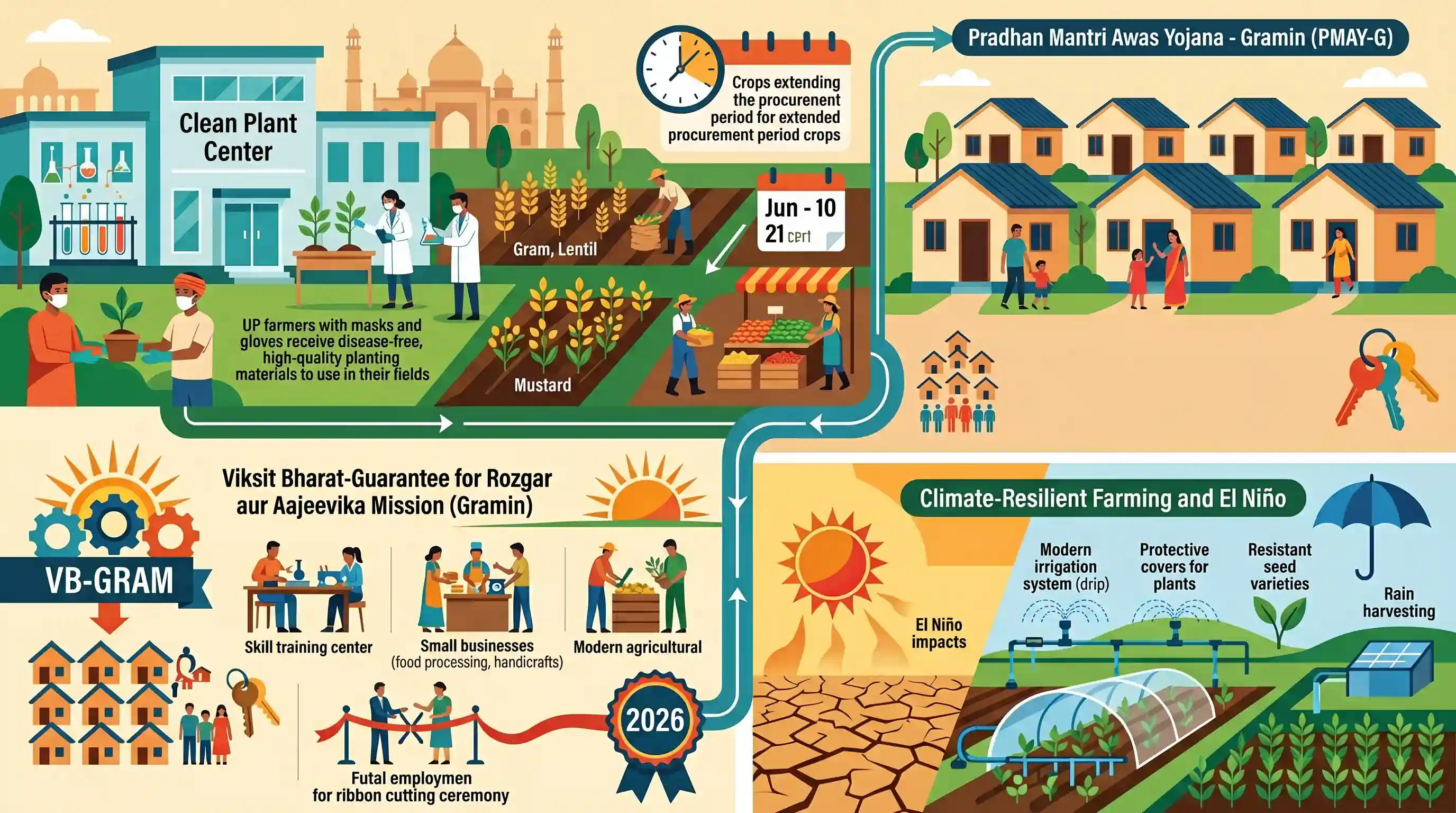
Union Minister Shivraj Singh Chouhan announced the establishment of a Clean Plant Center in Lucknow to provide disease-free, high-quality planting material to UP farmers. During a high-level review of UP's agricultural roadmap, he extended the procurement period for gram, lentil, and mustard, cleared the path for 6.18 lakh PMAY-G beneficiaries, and highlighted the launch of the 'Viksit Bharat-Guarantee for Rozgar aur Aajeevika Mission (Gramin)' (VB-GRAM) scheduled for July 2026. The meeting also addressed climate-resilient agricultural strategies to counter potential El Niño impacts.
Key Points
- Establishment of a Clean Plant Center (CPC) in Lucknow to accelerate UP's horticulture sector by providing disease-free, high-quality planting material.
- Approval for the extension of the government procurement period for Rabi crops including gram, lentil, and mustard in Uttar Pradesh.
- Handover of a list of 6,18,482 eligible beneficiaries under the next phase of the Pradhan Mantri Awas Yojana (Gramin) (PMAY-G).
- Stressed the effective launch of the Viksit Bharat-Guarantee for Rozgar aur Aajeevika Mission (Gramin) (VB-GRAM) in July 2026, with directions to immediately settle pending MGNREGA dues.
- Review of preparedness plans against El Niño conditions in Uttar Pradesh, focusing on water conservation, crop management, and climate-resilient practices.
Important Terms
Clean Plant Programme (CPP)

A central sector scheme approved in 2024 to establish state-of-the-art centers providing certified, disease-free, high-quality propagation material to growers, boosting horticultural yield, quality, and export potential.
UPSC context
GS-3 (Agriculture). Tests knowledge of technological interventions in crop productivity, disease-free seed propagation, and horticultural exports.
Viksit Bharat-Guarantee for Rozgar aur Aajeevika Mission (Gramin) (VB-GRAM)
A statutory rural employment scheme launching in July 2026 under the VB-GRAM Act 2025, guaranteeing at least 125 days of unskilled manual work annually per registered rural household.
UPSC context
GS-2 (Welfare Schemes) & GS-3 (Employment). Tests understanding of social security reforms and rights-based rural livelihood governance.
Pradhan Mantri Awas Yojana (Gramin) (PMAY-G)
A centrally sponsored welfare scheme that provides financially assisted pucca houses with basic amenities to homeless and resource-poor households in rural India.
UPSC context
GS-2 (Welfare Schemes). Tests understanding of inclusive growth, basic rural infrastructure provisioning, and target-based development schemes.
Mahatma Gandhi National Rural Employment Guarantee Scheme (MGNREGS)
A rights-based wage employment scheme under the 2005 Act that historically guaranteed 100 days of unskilled work yearly per household before transitioning into the VB-GRAM framework in 2026.
UPSC context
GS-2 (Welfare Schemes) & GS-3 (Employment). Tests historical perspective on rural safety nets, wage employment dynamics, and public work assets.
Prelims Trap
VB-GRAM G retains the original MGNREGA model of 100% Central funding for unskilled wages, only sharing material costs on a 60:40 basis.
VB-GRAM G replaces the old model with a uniform 60:40 Centre-State sharing ratio across all components, including unskilled wages, materials, and administrative costs.
Static Concepts Connected
What are the core objectives and features of India's Clean Plant Programme (CPP)?
- Disease-Free Material: Ensures supply of virus-free, certified disease-free planting stock to boost domestic orchard productivity and export quality.
- Quarantine Reduction: Slashes import quarantine timelines for exotic elite germplasm from 24 months down to just 6 months.
- Co-funding Model: Implemented by the National Horticulture Board and ICAR with 50% financial assistance from the Asian Development Bank.
What structural reforms distinguish VB-GRAM G from the erstwhile MGNREGA?
- Expanded Days: Raises the statutory minimum rural employment guarantee from 100 days to 125 days annually.
- Shared Wage Fiscal: Changes the funding architecture to a 60:40 ratio between Centre and States for all wage and material costs.
- Farm Protection: Permits a 60-day agricultural blackout period to prevent rural labor shortages during peak sowing and harvesting.
Cross-Topic Patterns
Plant biosecurity and WTO SPS compliance
Shorter quarantine cycles at Clean Plant Centers balance domestic biosecurity with India’s commitments under the WTO Sanitary and Phytosanitary Measures agreement.
Rural fiscal federalism under VB-GRAM
Shifting to a 60:40 funding ratio for unskilled wages tests the fiscal headroom of weaker states, redefining Centre-state dynamics in welfare administration.

The transition from MGNREGA to VB-GRAM G and its fiscal impact on state budgets is a prime candidate for a 2026 GS-III comparison.
Linked PYQs · 3
Linked PYQs · 3
- 2023UPPSC_PRELIMSGS1
Which of the following Scheme/Programme is not the Central Government Programme and it is Uttar Pradesh Government's Programme?
- 2024UPPSC_PRELIMSGS1
Arrange the following schemes launched by the Government of India in chronological order and choose the correct answer from the codes given below : 1. Integrated Rural Development Programme 2. Swarnjayanti Gram Swarozgar Yojana 3. National Rural Employment Guarantee Act 4. Pradhan Mantri Jan-Dhan Yojana
- 2023UPPSC_PRELIMSGS1
Which of the following (Scheme - Year) is not correctly matched?
