GST Council Announces Rate Cuts on Insurance and Medicines
Source:The Hindu ↗
Why It Matters
The continuous rationalization of GST rates demonstrates the dynamic nature of India's indirect tax regime. Reductions in essential services like insurance have direct implications for social security and out-of-pocket health expenditures. Furthermore, the emphasis on passing benefits to consumers touches upon anti-profiteering mechanisms, which are crucial for inflation control and consumer welfare.
Summary
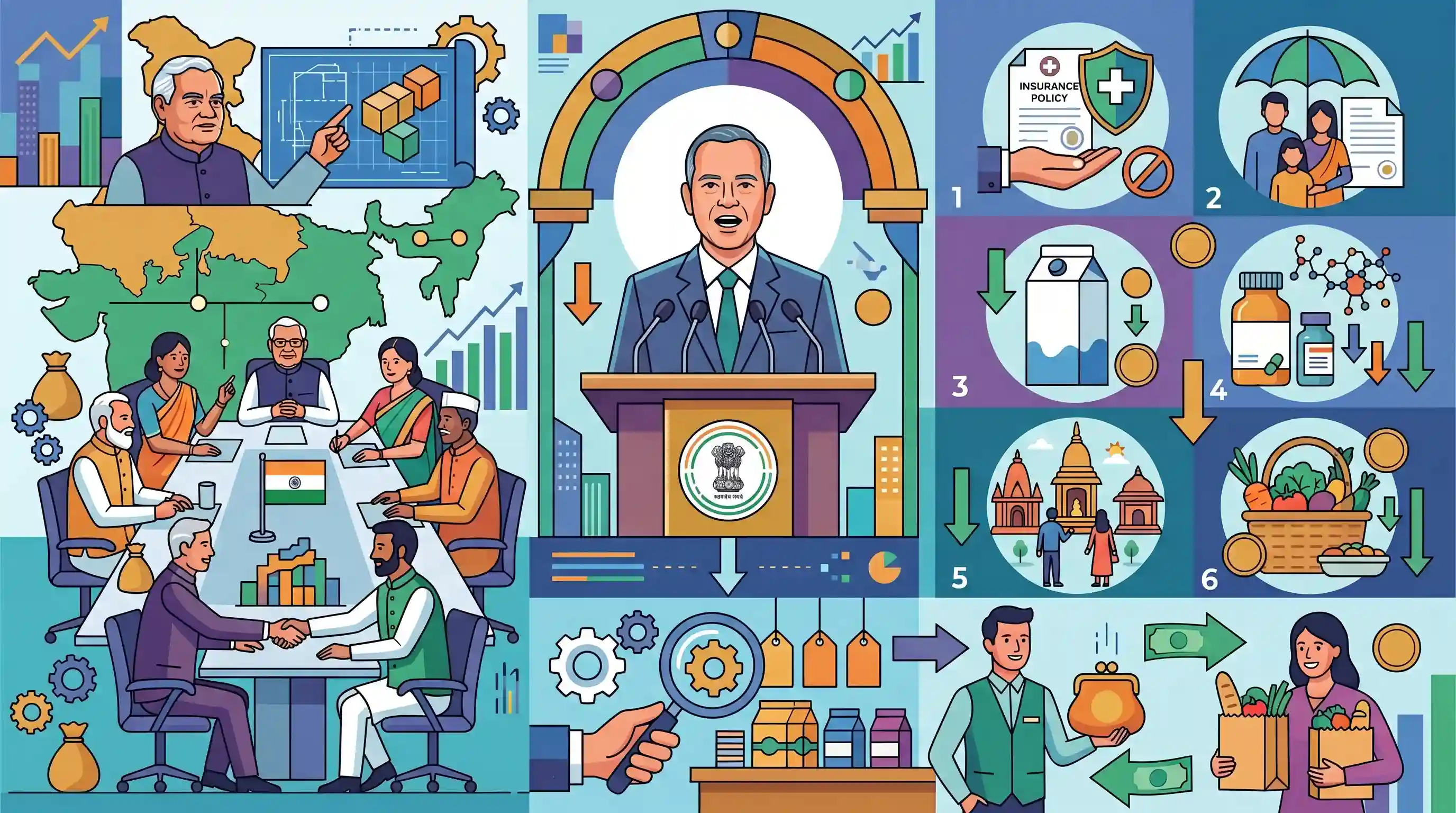
Union Minister Piyush Goyal addressed a press conference detailing the outcomes of the 55th GST Council meeting, which resulted in significant tax rate reductions on several essential items. Key relief measures include the elimination of GST on health insurance (up to Rs 5 lakh), term life insurance, pure life insurance, and UHT milk, alongside rate cuts on cancer drugs, religious tourism, and various food items. Goyal stressed that the government will closely monitor compliance to ensure businesses pass on these tax benefits directly to consumers. He also reflected on the historic journey of the GST reform, tracing it back to former Prime Minister Atal Bihari Vajpayee's vision and highlighting the Modi government's success in building consensus among states through a guaranteed 14% revenue compensation for the first five years.
Key Points
- Union Minister Piyush Goyal announced comprehensive GST rate cuts on essential goods and services, including health and life insurance, certain food items, and cancer drugs, following the 55th GST Council meeting.
- The government issued a strong directive to businesses to pass on the benefits of reduced tax rates to consumers, reflecting anti-profiteering priorities.
- GST on term life insurance, pure life insurance, and health insurance coverage up to Rs 5 lakh has been completely removed (reduced from 18% to nil).
- The new tax structure is expected to boost consumer demand and will come into effect progressively, with price reductions anticipated after September 22, 2025.
- Goyal highlighted the cooperative federalism aspect of GST, recalling the Centre's commitment to compensating states for a 14% revenue growth during the first five years of implementation.
Important Terms
Goods and Services Tax (GST)

A comprehensive, destination-based indirect tax levied on the supply of goods and services. It replaced multiple central and state taxes to create a unified national market.
UPSC context
GS Paper 3 (Indian Economy); tests understanding of indirect tax reforms, fiscal federalism, and ease of doing business.
GST Council
A constitutional body under Article 279A, chaired by the Union Finance Minister, that makes recommendations on GST rates, exemptions, and administrative rules.
UPSC context
GS Paper 2 (Polity); tests knowledge of constitutional bodies and the mechanism of cooperative federalism.
Goods and Services Tax (Compensation to States) Act
A 2017 law providing a legal guarantee to compensate states for revenue losses for five years (extended to March 2026) following GST implementation.
UPSC context
GS Paper 3 (Resource Mobilization); tests understanding of Centre-State financial relations and revenue protection mechanisms.
Group of Ministers (GoM)
Small committees of state ministers appointed by the GST Council to examine specific technical issues, such as rate rationalization or insurance taxation.
UPSC context
GS Paper 3 (Taxation Reforms); tests knowledge of the deliberative and specialized sub-structures within the GST framework.
Anti-profiteering Measures
Regulations designed to ensure that businesses pass the benefits of tax rate reductions or input tax credits directly to consumers.
UPSC context
GS Paper 3 (Indian Economy); tests awareness of consumer protection mechanisms within the taxation regime.
Prelims Trap
The GST Compensation Cess ended entirely after the initial 5-year guarantee period in 2022.
While the 14% revenue growth guarantee to states ended in 2022, the levy of the Compensation Cess was extended until March 2026 to repay pandemic-era borrowings.
Static Concepts Connected
How does the voting structure of the GST Council work under Article 279A?
- Centre's weight: The Union Government holds 1/3rd of the total weighted votes cast in the meeting.
- States' weight: All State Governments combined hold 2/3rd of the total weighted votes.
- Passage threshold: Every decision requires a 3/4th (75%) majority of the weighted votes of members present and voting.
What is the Anti-Profiteering mandate under the GST regime?
- Legal mandate: Section 171 of the CGST Act legally requires businesses to pass on tax rate cuts or Input Tax Credit (ITC) benefits directly to consumers.
- Current authority: The Competition Commission of India (CCI) currently enforces these provisions, following the dissolution of the original National Anti-profiteering Authority (NAA).
Cross-Topic Patterns
GST Compensation & Fiscal Federalism
The extension of the compensation cess highlights tension in Centre-State fiscal relations, linking GS2 federalism with GS3 resource mobilization and state debt burdens.
Tax Policy & Healthcare Access
Slashing GST on health insurance shifts it toward a 'merit good', aligning with health policy goals to reduce India's persistently high Out-of-Pocket Expenditure (OOPE).

Expect a 2026 Prelims multi-statement question combining GST Council voting rules, CCI's anti-profiteering role, and the Cess extension.
Linked PYQs · 4
Linked PYQs · 4
- 2019MainsGS3
Enumerate the indirect taxes which have been subsumed in the Goods and Services Tax (GST) in India. Also, comment on the revenue implications of the GST introduced in India since July 2017.
- 2020MainsGS3
Explain the rationale behind the Goods and Services Tax (Compensation to States) Act of 2017. How has COVID-19 impacted the GST compensation fund and created new federal tensions?
- 2017PrelimsGS1
What is/are the most likely advantages of implementing 'Goods and Services Tax (GST)'? 1. It will replace multiple taxes collected by multiple authorities and will thus create a single market in India. 2. It will drastically reduce the 'Current Account Deficit' of India and will enable it to increase its foreign exchange reserves. 3. It will enormously increase the growth and size of economy of India and will enable it to overtake China in the near future. Select the correct answer using the code given below:
- 2018PrelimsGS1
Consider the following items : 1. Cereal grains hulled 2. Chicken eggs cooked 3. Fish processed and canned 4. Newspapers containing advertising material Which of the above items is/are exempted under GST (Goods and Services Tax)?
