Bihar Governor to Represent India at Khamenei Funeral
Source:indiatoday ↗
Why It Matters
This development highlights the intersection of constitutional authorities (the Governor of Bihar) taking on unique diplomatic assignments, alongside the MoS for External Affairs, to represent India's diverse cultural sentiments on the global stage. It highlights India-Iran strategic bilateral relations and the geopolitical significance of the Middle East, making it highly relevant for BPSC polity, geography, and international relations.
Summary
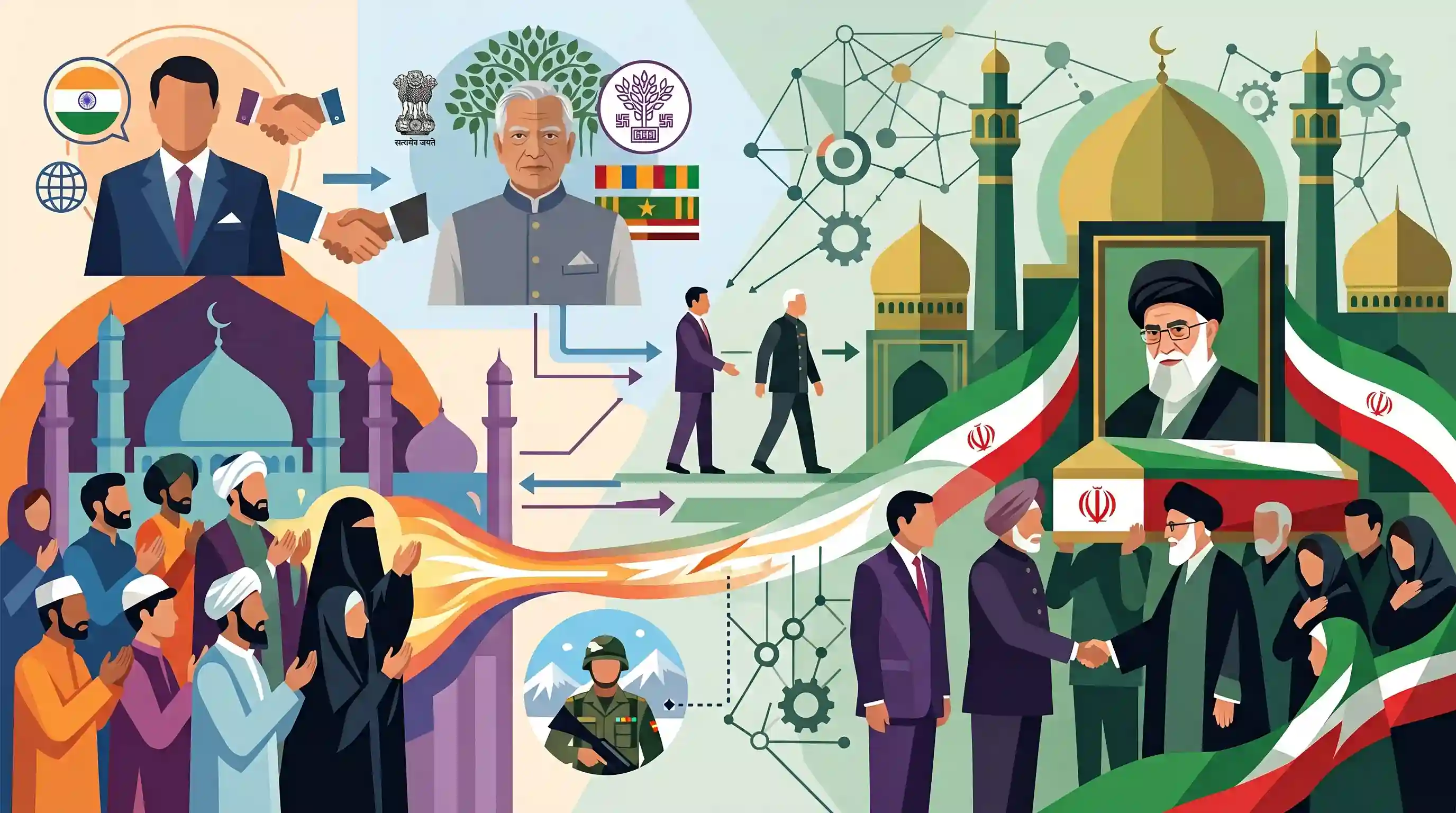
Union Minister of State for External Affairs Pabitra Margherita and Bihar Governor Lieutenant General Syed Ata Hasnain (retd) will travel to Tehran to represent India at the funeral of Iran's late Supreme Leader Ayatollah Ali Khamenei. Governor Hasnain, a former military commander in Kashmir, will also convey the condolences of India's Shia community, highlighting India's diplomatic and cultural engagement with Iran.
Key Points
- India is sending a high-level delegation to Tehran to attend the funeral of Iran's late Supreme Leader, Ayatollah Ali Khamenei, to convey condolences on behalf of the Indian government and its citizens.
- The delegation is composed of Pabitra Margherita, the Union Minister of State for External Affairs, and Lieutenant General (retd) Syed Ata Hasnain, the current Governor of Bihar.
- Governor Syed Ata Hasnain is a decorated retired military commander who has served in Kashmir and will represent the sentiments of India's significant Shia Muslim community at the event.
- Despite a formal invitation being extended to the Indian Prime Minister, the decision to send a high-level representative delegation highlights India's balanced approach to Middle Eastern diplomacy and its strategic ties with Iran.
Important Terms
India-Iran Relations

The bilateral partnership between India and Iran, historically rooted in civilisational and cultural ties, and currently driven by energy security, regional connectivity (e.g., Chabahar Port, INSTC), and strategic interests in West Asia.
UPSC context
GS Paper II (Bilateral relations involving India's interests); tests India’s strategic autonomy and West Asian diplomatic balancing.
Governor (India)
The chief executive head of a state in India, appointed by the President under Article 155, who acts as a nominal constitutional head of the state and as an agent of the Central Government.
UPSC context
GS Paper II (Indian Constitution, State Executive); tests understanding of federalism, constitutional powers, and the dual role of the Governor.
Ministry of External Affairs
The Government of India's cabinet-level agency responsible for managing the country’s foreign relations, formulating foreign policy, overseeing diplomatic missions abroad, and administering passport, visa, and consular services.
UPSC context
GS Paper II (Structure and functioning of the Executive); tests knowledge of foreign policy formulation and India's global diplomatic machinery.
Shia Community in India
The second-largest denomination of Muslims in India, who share deep historical, religious, and cultural ties with Iran, serving as an important bridge in India's cultural diplomacy and bilateral ties with West Asia.
UPSC context
GS Paper I (Indian Society) and GS Paper II (Cultural Diplomacy); tests understanding of India's religious diversity and its geopolitical utility.
Supreme Leader of Iran
The highest political and religious authority in the Islamic Republic of Iran, who holds absolute power over the state's military, judiciary, and foreign policy, establishing the nation's ultimate ideological and strategic direction.
UPSC context
GS Paper II (International Relations); tests understanding of West Asian political structures and their impact on global geopolitics and bilateral engagements.
Prelims Trap
The Governor of a State is constitutionally prohibited from performing external diplomatic functions or representing the Union on foreign soil.
No constitutional provision debars the Union from utilizing a Governor's stature for international representation, especially to convey cultural or religious solidarity.
Static Concepts Connected
What are the constitutional immunities and appointment rules of a State Governor?
- Appointment mechanism: Appointed by the President by warrant under hand and seal (Article 155), holding office during the President's pleasure (Article 156).
- Criminal immunity: Under Article 361, enjoys absolute immunity from criminal proceedings and cannot be arrested or imprisoned during their official tenure.
- Civil proceedings: No civil proceedings can be initiated for personal acts during their term without serving a prior two-month notice.
What makes Chabahar Port strategically significant for India's West Asian policy?
- Bypassing Pakistan: Provides direct sea-to-land transit access to landlocked Afghanistan and Central Asia, eliminating dependence on Pakistani overland routes.
- INSTC gateway: Serves as a crucial node for the International North-South Transport Corridor, linking India directly to Russia and Europe.
- Geostrategic counterweight: Acts as an essential strategic counterweight to China's presence at the Gwadar port in Pakistan.
Cross-Topic Patterns
Executive dualism and diplomatic assignments
Explores how constitutional functionaries like State Governors, representing the Union's federal executive, are occasionally deployed for cultural or strategic diplomatic outreach.
Chabahar and Eurasian transit corridors
Connects bilateral diplomatic overtures to long-term infrastructure plays like the INSTC, which bypass geopolitical barriers to access landlocked Central Asian markets.

Strategic West Asia connectivity (Chabahar) and energy security (Hormuz) will likely be tested via multi-statement geographic-security MCQs.
Linked PYQs · 3
Linked PYQs · 3
- 2018BPSC_PRELIMSGS1
The Governor of a State is appointed by
- 2025BPSC_PRELIMSGS1
Strait of Hormuz connects -
- 2024-EBPSC_PRELIMSGS1
Who decides the disqualification of members of State Legislative Assembly, for matters other than those in the tenth schedule of the Constitution?
