Ministry of Women and Child Development scheme implementation review
Source:ddindia ↗
Why It Matters
State-specific reviews of centrally sponsored schemes are crucial for WBCS aspirants to track regional implementation bottlenecks and progress, particularly focusing on vulnerable groups like women and children. Familiarity with specific portals (Poshan Tracker, PMMVY) and sub-schemes (Mission Vatsalya, One Stop Centre) is often tested.
Summary
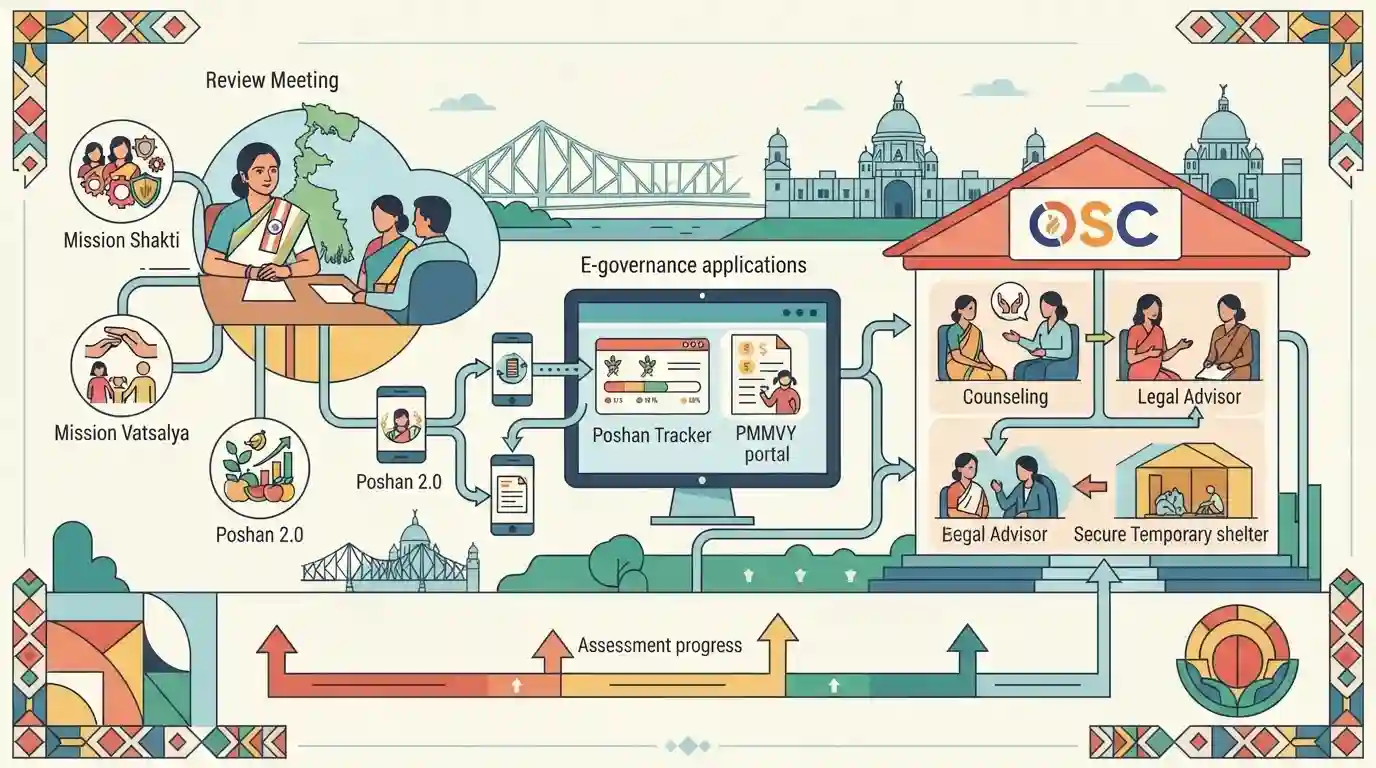
Union Minister for Women and Child Development Annpurna Devi held a review meeting in Kolkata to assess the progress of MWCD schemes in West Bengal, including Mission Shakti, Mission Vatsalya, and Poshan 2.0. She emphasized leveraging digital platforms like the Poshan Tracker and PMMVY portal for better service delivery and visited a One Stop Centre providing comprehensive support to women affected by violence.
Key Points
- Union Minister Annpurna Devi reviewed the implementation of Ministry of Women and Child Development (MWCD) schemes in West Bengal.
- Discussions focused on realizing women-led development via centrally sponsored schemes like Mission Shakti, Mission Saksham Anganwadi, Poshan 2.0, and Mission Vatsalya.
- Digital platforms like Poshan Tracker and PMMVY portal were highlighted for tracking delivery of services down to the Anganwadi level.
- The minister also visited the One Stop Centre (OSC) in South 24 Parganas, which offers legal, medical, and psychological support to women affected by violence.
Important Terms
Mission Shakti

An umbrella scheme by the Ministry of Women and Child Development consisting of Sambal (safety) and Samarthya (empowerment) to promote women-led development and comprehensive security.
UPSC context
Highly relevant for WBCS Mains Paper IV (Governance) and Paper V (Economy), as it frames India's current women empowerment initiatives.
Poshan 2.0 (Saksham Anganwadi and Poshan 2.0)
A centrally sponsored flagship initiative aimed at addressing malnutrition in children, adolescent girls, pregnant women, and lactating mothers through supplementary nutrition and digital governance tools.
UPSC context
Crucial for WBCS Mains Paper IV & V; tests knowledge of human capital development, health indicators, and central welfare schemes.
Mission Vatsalya
A centrally sponsored child protection and welfare scheme that promotes family-based non-institutional care, rehabilitation, and emergency outreach for vulnerable children in India.
UPSC context
Important for WBCS Mains Paper IV (Social Sector) focusing on child rights, protection mechanisms, and Juvenile Justice Act compliance.
Pradhan Mantri Matru Vandana Yojana (PMMVY)
A maternity benefit scheme offering financial support (conditional cash transfer) to pregnant and lactating mothers, offsetting wage loss and promoting better health-seeking behavior.
UPSC context
Tests knowledge of Direct Benefit Transfer (DBT) and maternal health schemes; critical for WBCS Paper IV and V.
Prelims Trap
PMMVY provides a ₹6,000 maternity benefit for the birth of a second child.
PMMVY 2.0 provides the ₹6,000 benefit for a second child ONLY if the infant is a girl, explicitly designed to counter female foeticide.
Static Concepts Connected
How is 'Mission Shakti' structurally divided to promote women's empowerment?
- Sambal Sub-scheme: Focuses on the safety and security of women. Includes One Stop Centres (OSC), Women Helplines, and Beti Bachao Beti Padhao.
- Samarthya Sub-scheme: Focuses on the economic empowerment of women. Includes Pradhan Mantri Matru Vandana Yojana (PMMVY), Palna (creches), and Shakti Sadan.
What is the primary mandate and functioning of Mission Vatsalya?
- Statutory Backup: It is the umbrella scheme for child protection services, acting as the primary vehicle to implement the Juvenile Justice (Care and Protection of Children) Act, 2015.
- Financial Support: Provides a monthly grant of ₹4,000 per child to support non-institutional, family-based care arrangements like foster care and sponsorship.
- Funding Model: It is a Centrally Sponsored Scheme with a predefined cost-sharing ratio between the Centre and States (usually 60:40).
Cross-Topic Patterns
CSS implementation and Federal Friction
Union reviews of MWCD schemes in states like West Bengal intersect with broader polity debates over the branding, funding patterns, and state-level compliance of Centrally Sponsored Schemes.
E-Governance and Welfare Leakage Prevention
The emphasis on the Poshan Tracker and PMMVY portals connects women's welfare directly to e-governance, DBT (Direct Benefit Transfer), and the JAM trinity framework to eliminate ghost beneficiaries.

Expect a multi-statement question distinguishing the sub-schemes of Mission Shakti (Sambal vs Samarthya) and PMMVY 2.0's girl-child clause.
Linked PYQs · 2
Linked PYQs · 2
- 2021WBCS_PRELIMSGS1
Family Income Ceiling for Kanyashree Scheme is not applicable if
- 2020WBCS_PRELIMSGS1
Arundhoti Swarna Yojana by Assam Govt. starting from 1st January 2020 aims to
