Cooperative-led platform model for gig economy workers welfare
Source:The Hindu ↗
Why It Matters
The initiative represents a pivotal shift in the gig economy by introducing the cooperative model to the platform ecosystem. For UPSC, it connects the dots between GS2 (Cooperatives as development actors) and GS3 (Gig economy, employment, and social security for platform workers), showcasing an indigenous policy solution to the global challenge of algorithmic exploitation of gig workers.
Summary
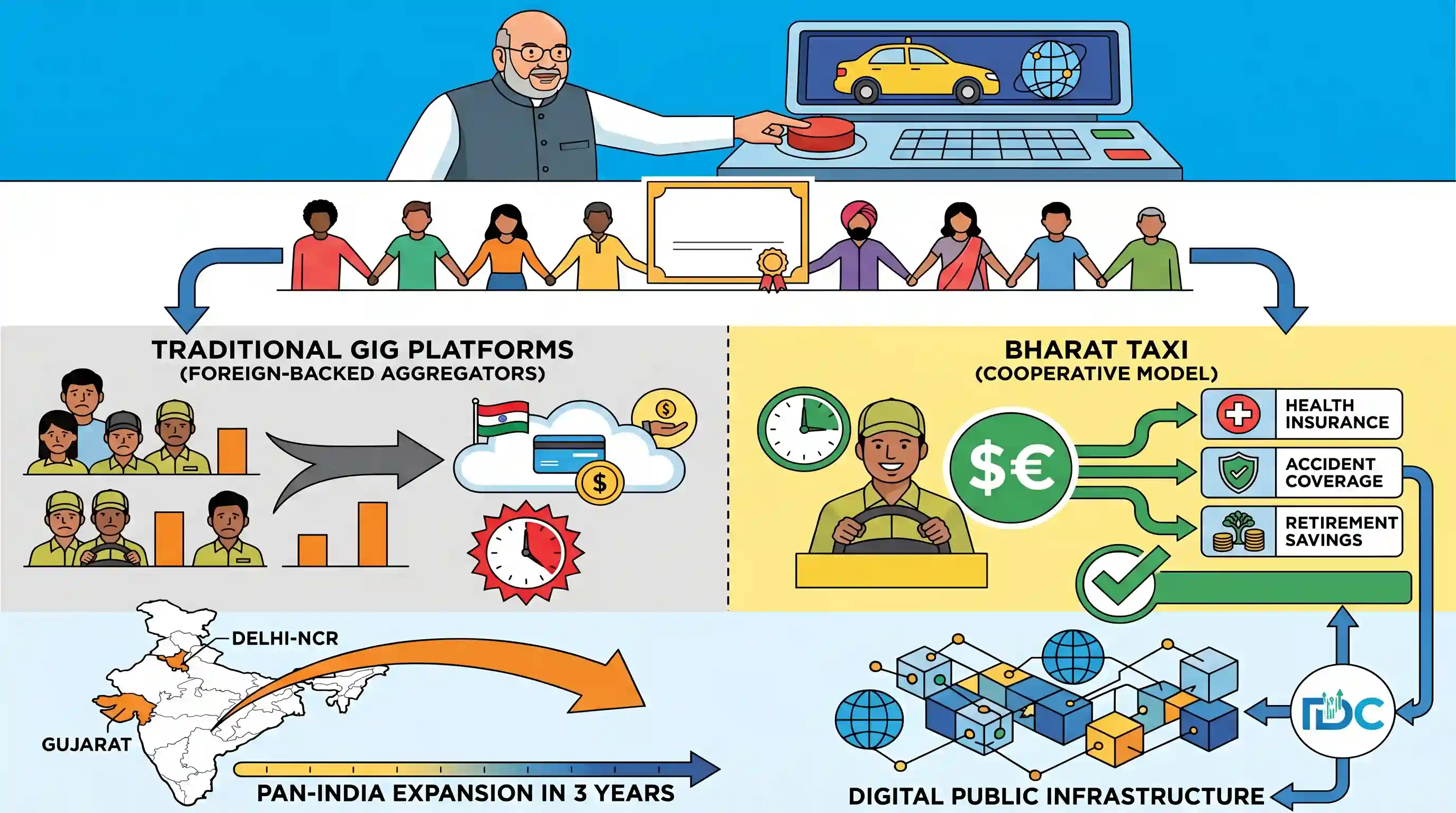
Union Minister Amit Shah has launched 'Bharat Taxi', India's first cooperative-led ride-hailing platform. Promoted by eight leading cooperative societies and registered under the Multi-State Cooperative Societies Act, 2002, the initiative aims to challenge foreign-backed aggregators by offering a zero-commission and surge-free model. Unlike traditional gig economy platforms, Bharat Taxi prioritizes the welfare of its drivers, termed 'Sarathis', by providing them with 100% of their ride earnings along with comprehensive social security benefits such as health insurance, accident coverage, and retirement savings. Initially introduced in Delhi-NCR and Gujarat, the platform is set for a pan-India expansion within three years and plans future integration with the ONDC ecosystem.
Key Points
- Bharat Taxi is India's first cooperative-led ride-hailing platform, registered under the Multi-State Cooperative Societies Act, 2002.
- The platform operates on a zero-commission and surge-free model, allowing drivers (designated as 'Sarathis') to retain full fare earnings.
- It is backed by eight major cooperative societies including Amul, IFFCO, and NAFED, providing an indigenous alternative to foreign-backed aggregators like Uber and Ola.
- It addresses critical vulnerabilities of the gig economy by extending social security benefits to drivers, including health insurance, accident insurance, and retirement savings.
- Currently launched in Delhi-NCR and Gujarat, it aims for a nationwide rollout over three years and integration into the ONDC ecosystem.
Important Terms
Multi-State Cooperative Societies Act, 2002

A 2002 federal law governing cooperatives operating across multiple states, ensuring functional autonomy, democratic management, and regulation by the Central Registrar of Cooperative Societies.
UPSC context
GS Paper II (Governance) and Paper III (Economy); tests knowledge of cooperative legislation, federalism, and member-driven economic models.
Ministry of Cooperation
A Union Ministry formed in 2021 to provide a dedicated administrative, legal, and policy framework for strengthening the cooperative movement in India.
UPSC context
GS Paper II; tests awareness of institutional reforms and the 'Sahkar se Samriddhi' (Prosperity through Cooperation) vision.
Bharat Taxi
India's first cooperative-led ride-hailing platform launched in 2026, offering a zero-commission model where drivers (Sarathis) are stakeholders and receive 100% of ride earnings.
UPSC context
GS Paper III (Economy/Employment); a case study for indigenous alternatives to foreign-backed aggregators and cooperative-led solutions.
ONDC (Open Network for Digital Commerce)
A government-backed initiative to democratize digital commerce by moving from platform-centric models to an open-network model, enabling interoperability between buyers and sellers.
UPSC context
GS Paper III; tests knowledge of Digital Public Infrastructure (DPI), market competition, and indigenization of technology.
Gig Economy
A labor market characterized by short-term contracts or freelance work facilitated by digital platforms; workers typically lack traditional employer-employee protections like insurance or pensions.
UPSC context
GS Paper III (Employment/Social Justice); tests understanding of evolving labor dynamics and the vulnerabilities of the unorganized workforce.
Code on Social Security, 2020
A major labor reform that recognizes 'gig workers' and 'platform workers' for the first time, proposing a social security fund for their welfare.
UPSC context
GS Paper III (Labour Laws); tests knowledge of social safety nets and the formalization of the informal economy.
Prelims Trap
Regulated by respective State Governments as Cooperatives fall under the State List.
While 'Cooperative Societies' is a State subject (Entry 32), multi-state cooperatives fall under the Union List (Entry 44) and are regulated by the Central Registrar.
Static Concepts Connected
How does jurisdiction over Multi-State Cooperatives differ from State Cooperatives?
- State List: Cooperatives confined to a single state fall under Entry 32 of the State List.
- Union List: Cooperatives operating in multiple states fall under Entry 44 of the Union List.
- Regulatory Body: They are registered and regulated by the Central Registrar of Cooperative Societies (CRCS), not state bodies.
How does the Code on Social Security 2020 distinguish gig and platform workers?
- Gig Worker: Broad category for individuals earning an income outside traditional employer-employee relationships.
- Platform Worker: A subset of gig workers who specifically use online platforms/apps to access clients for services.
- Social Security Fund: The Code mandates ride-hailing aggregators to contribute 1-2% of their annual turnover to a dedicated fund.
Cross-Topic Patterns
DPI and Platform Democratization
Bharat Taxi's planned ONDC integration reflects a broader policy push to use Digital Public Infrastructure (DPI) to break foreign aggregator monopolies in urban mobility and e-commerce.
Cooperatives in the Digital Economy
Traditionally restricted to agriculture (IFFCO) and dairy (Amul), the cooperative governance model is now evolving to solve urban service sector failures and gig worker exploitation.

Expect a hybrid prelims question linking MSCS Act jurisdiction (Union List) with platform worker definitions under the 2020 Labour Code.
Linked PYQs · 3
Linked PYQs · 3
- 2021MainsGS1
Examine the role of 'Gig Economy' in the process of empowerment of women in India.
- 2021PrelimsGS1
With reference to Urban Cooperative Banks' in India, consider the following statements : 1. They are supervised and regulated by local boards set up by the State Governments. 2. They can issue equity shares and preference shares. 3. They were brought under the purview of the Banking Regulation Act, 1949 through an Amendment in 1966. Which of the statements given above is/are correct?
- 2014MainsGS3
In the villages itself no form of credit organization will be suitable except the cooperative society. -All India Rural Credit Survey. Discuss this statement in the background of agricultural finance in India. What constraints and challenges do financial institutions supplying agricultural finance face? How can technology be used to better reach and serve rural clients?
