Swachh Bharat Diwas Special Gram Sabha Initiatives In Gujarat
Source:aninews ↗
Why It Matters
Illustrates the convergence of national flagship sanitation campaigns (Swachh Bharat Mission) with grassroots democratic institutions like Gram Sabhas, reflecting decentralized governance and public participation in rural development.
Summary
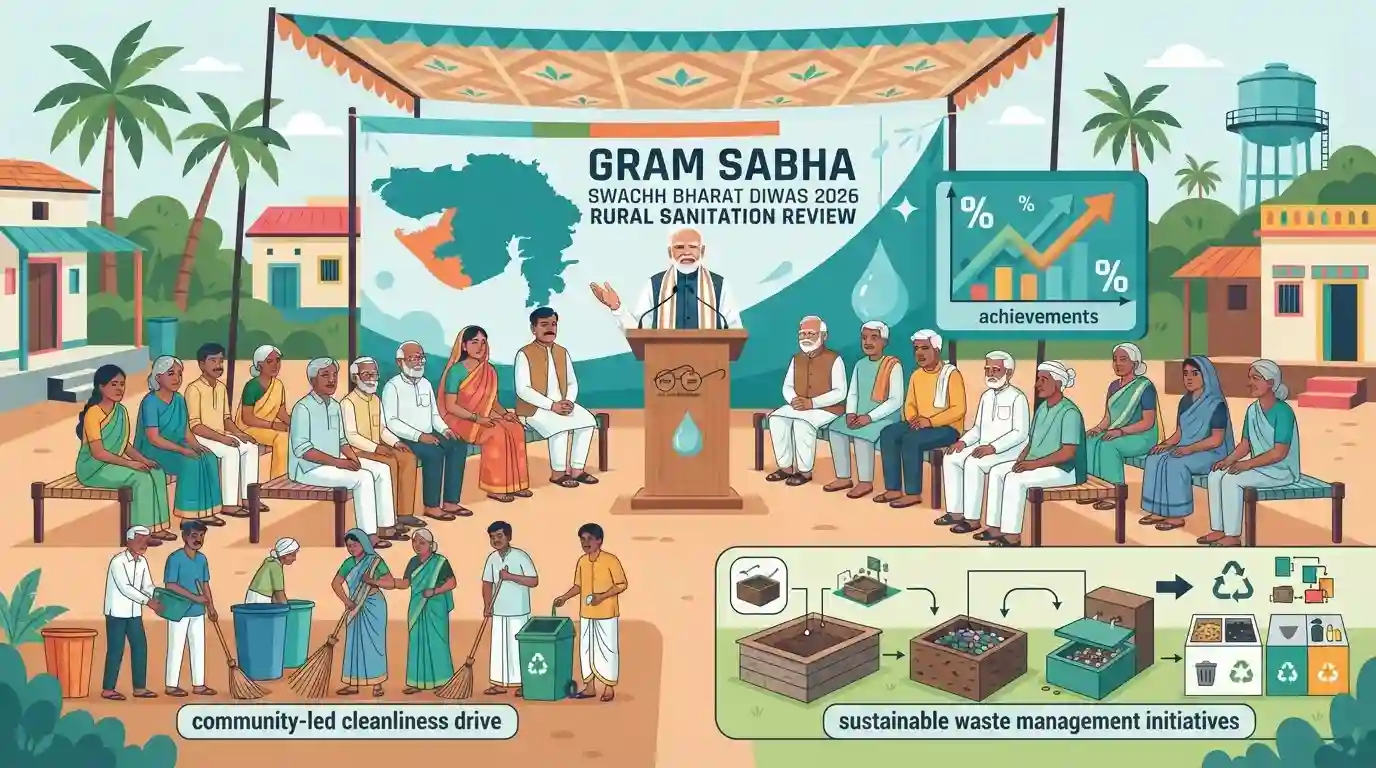
On Swachh Bharat Diwas 2026, the Union Jal Shakti Minister participated in a special Gram Sabha in Gujarat to review and promote rural sanitation achievements, community-led cleanliness drives, and sustainable waste management initiatives under the Swachh Bharat Mission.
Key Points
- The Union Jal Shakti Minister led a special Gram Sabha in Gujarat on the occasion of Swachh Bharat Diwas (October 2).
- The event highlighted grassroots sanitation efforts, rural cleanliness campaigns, and community participation under the Swachh Bharat Mission.
- Emphasized the critical role of local self-government institutions (Gram Panchayats and Gram Sabhas) in maintaining Open Defecation Free (ODF) plus status and managing solid and liquid waste in rural areas.
Important Terms
Swachh Bharat Mission

A nationwide flagship campaign launched by the Government of India in 2014 to eliminate open defecation and improve solid and liquid waste management across rural and urban areas.
UPSC context
Important for GS Paper II (Government Policies & Interventions) and GS Paper III (Environment & Sanitation), testing welfare scheme delivery.
Swachh Bharat Diwas
The annual observance held on October 2nd to commemorate the birth anniversary of Mahatma Gandhi and celebrate nationwide progress and commitments under the Swachh Bharat Mission.
UPSC context
Relevant for General Studies (Governance and Current Events), testing awareness of national commemorative days tied to social development policies.
Ministry of Jal Shakti
The Union ministry in India formed in 2019 by merging the Ministry of Water Resources and the Ministry of Drinking Water and Sanitation, handling water management and SBM-Gramin.
UPSC context
Crucial for GS Paper II (Ministries and Departments, Polity), examining institutional frameworks for rural water supply and sanitation governance.
Government of Gujarat
The sub-national state administration responsible for policy implementation, decentralized governance, and executing central welfare initiatives such as sanitation and waste management across Gujarat.
UPSC context
Core for GPSC/State Civil Services examinations, testing administrative structures, state policy implementation, and local governance frameworks.
Static Concepts Connected
What are the constitutional provisions and statutory roles of a Gram Sabha under the Panchayati Raj system?
- Constitutional Basis: Article 243A empowers the Gram Sabha to exercise such powers and perform such functions at the village level as the Legislature of a State may by law provide.
- Core Functions: Acts as the cornerstone of direct democracy in rural areas, approving beneficiary lists, social audits, and development plans.
- Mandatory Meetings: Mandated to hold periodic meetings (such as on national days like Republic Day, Independence Day, and Gandhi Jayanti) to ensure transparency and community participation.
Cross-Topic Patterns
Panchayati Raj and Decentralized Welfare Delivery
Gram Sabhas function as both the foundational pillar of decentralized local self-government under Article 243A and the primary implementing agency for national welfare schemes like SBM-G and Jal Jeevan Mission.
ODF Plus Transition and Rural Sanitation Finance
The transition from ODF to ODF Plus (Model) requires institutionalizing liquid and solid waste management, directly testing the administrative capacity of rural local bodies.

Expect statement-based questions combining 73rd Constitutional Amendment powers of Gram Sabhas with SBM-G ODF Plus criteria.
Linked PYQs · 2
Linked PYQs · 2
- 2026GPSC_PRELIMSGS1
Consider the following statements regarding the 'Gram Sabha' and reservation provisions in Panchayati Raj Institutions: 1. Gram Sabha is the foundational unit of the Panchayati Raj system, consisting of all adult voters of the village. 2. In Panchayat, it is mandatory to reserve seats for Scheduled Castes and Scheduled Tribes in proportion to their population. 3. Reserving the post of Chairperson for women in Panchayats depends on the discretion of the State Government; it is not mandatory. 4. It is constitutionally mandatory to hold new elections before the five-year term of the Panchayats expires. Which of the above statements are correct?
- 2025GPSC_PRELIMSGS1
Which of the following statements is/are correct regarding the G-SAFAL scheme?
