Maritime Security and Cybersecurity Strategies for Strategic Outposts
Source:The Hindu ↗
Why It Matters
The article highlights India's strategic pivot toward fortifying the Andaman and Nicobar Islands as a crucial maritime security and geopolitical outpost. It provides actionable government approaches to combating cybercrime and demonstrates the role of Parliamentary Consultative Committees in executive oversight on internal security matters.
Summary
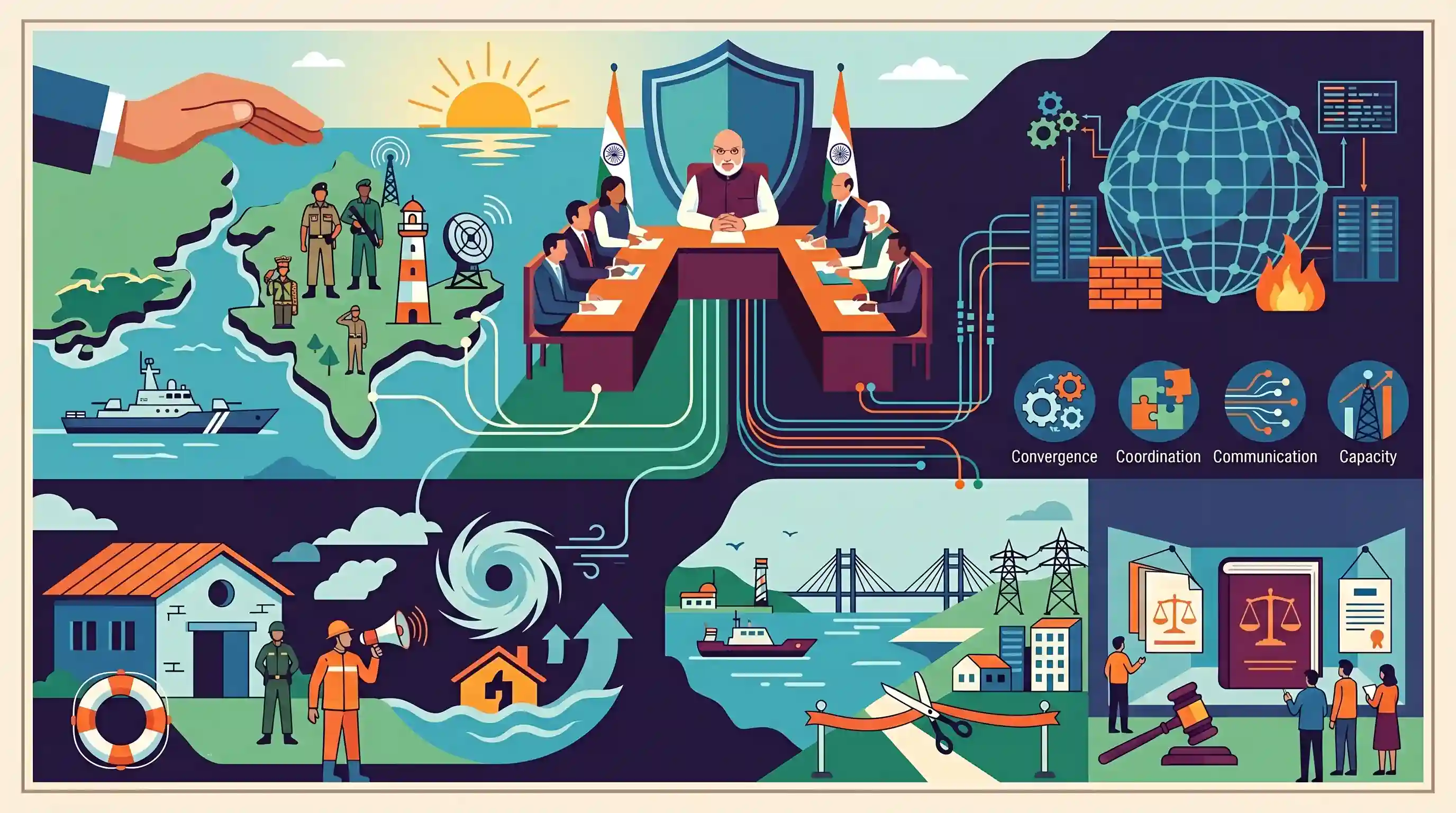
Union Home Minister Amit Shah chaired a Parliamentary Consultative Committee meeting of the Ministry of Home Affairs in the Andaman and Nicobar Islands, primarily focusing on national security, disaster management, cybersecurity, and infrastructure. Recognizing the strategic importance of the island chain, the meeting addressed challenges related to maritime security and border management. Shah outlined a four-pronged approach—convergence, coordination, communication, and capacity—to tackle rising cybercrime threats. The event also featured the inauguration of an exhibition on the 'Naveen Nyaya Sanhita' (new criminal laws) and the foundation-laying for various development projects in Sri Vijaya Puram.
Key Points
- Union Home Minister Amit Shah chaired a Parliamentary Consultative Committee meeting in Andaman and Nicobar Islands to review national security, disaster management, and regional infrastructure.
- Discussions underscored the immense strategic importance of the Andaman and Nicobar Islands for securing India's maritime borders and enhancing coastal security.
- A comprehensive four-pronged strategy was emphasized to combat cybercrime: convergence, coordination, communication, and capacity building.
- The Home Minister laid the foundation stones for several developmental projects in Sri Vijaya Puram (formerly Port Blair).
- An exhibition on 'Naveen Nyaya Sanhita' was inaugurated to raise awareness about the newly enacted criminal justice laws.
Important Terms
Bharatiya Nyaya Sanhita (BNS)

India’s new criminal code replacing the colonial Indian Penal Code (IPC). It modernizes definitions, introduces offences like mob lynching and terrorism, removes sedition, and emphasizes justice over punishment through provisions like community service.
UPSC context
GS Paper II/IV. Tests knowledge of legal reforms, criminal justice overhaul, and the transition from punitive to restorative justice models.
Parliamentary Consultative Committee
Informal bodies constituted by the Ministry of Parliamentary Affairs for discussions between Ministers and MPs. Unlike Standing Committees, they are voluntary, non-reporting, and serve as forums for direct interaction on departmental programs and implementation.
UPSC context
GS Paper II (Polity). Tests understanding of parliamentary oversight mechanisms and the distinction between formal standing committees and informal consultative bodies.
Ministry of Home Affairs (MHA)
The Union ministry nodal for maintaining internal security, border management, and center-state relations. It oversees Central Armed Police Forces and serves as the cadre-controlling authority for the Indian Police Service (IPS).
UPSC context
GS Paper II/III. Essential for topics on internal security architecture, disaster management, and the administrative framework of Indian federalism.
Naveen Nyaya Sanhita
A collective or descriptive term for India's reformed criminal laws (BNS, BNSS, BSA). It symbolizes the paradigm shift from colonial-era retributive laws to a modern, justice-centric, and indigenized legal framework.
UPSC context
GS Paper II. Relevant for questions on legal indigenization and the government's efforts to decolonize India’s judicial and penal frameworks.
Maritime Security
The protection of national interests at sea, including territorial waters and Exclusive Economic Zones. It involves securing Sea Lines of Communication (SLOCs), countering piracy, and managing coastal borders against infiltration.
UPSC context
GS Paper III (Internal Security). Key for topics on coastal security, IOR strategy, and integrated border management challenges.
Prelims Trap
"Parliamentary Consultative Committees are constituted by the Speaker and chaired by a nominated Member of Parliament."
Consultative Committees are constituted by the Ministry of Parliamentary Affairs, not the Speaker/Chairman, and are chaired by the Minister-in-charge.
Static Concepts Connected
How do Parliamentary Consultative Committees differ from Standing Committees?
- Constitution: Standing Committees are formed by the Speaker/Chairman. Consultative Committees are formed by the Ministry of Parliamentary Affairs.
- Chairperson: Standing Committees are chaired by an MP. Consultative Committees are chaired by the Minister-in-charge of the respective Ministry.
- Nature of Work: Standing Committees formally examine Bills, grants, and budgets. Consultative Committees provide an informal forum for policy discussions.
What makes the Andaman & Nicobar Islands strategically vital for India?
- Maritime Chokepoints: Proximity to the Strait of Malacca allows India to monitor and secure critical global Sea Lanes of Communication (SLOCs).
- EEZ Expansion: The island chain provides India with an additional 300,000 sq km of Exclusive Economic Zone under UNCLOS.
- Tri-Service Command: It hosts India's first and only joint tri-service command (ANC), acting as a crucial military and observation outpost in the Indo-Pacific.
Cross-Topic Patterns
Chola Naval History + Modern Maritime Strategy
Renaming Port Blair to Sri Vijaya Puram revives the historical legacy of Rajendra Chola I's 11th-century naval base, linking ancient maritime dominance to modern Indo-Pacific posturing.
Cybersecurity Policy + New Criminal Laws
The MHA's 4-C cybersecurity strategy aligns directly with the digital-evidence framework (e-Sakshya) mandated under the newly enacted Bharatiya Sakshya Adhiniyam.

Expect a 2026 Polity prelims question contrasting Consultative Committees with DRSCs, paired with A&N maritime geography.
Linked PYQs · 5
Linked PYQs · 5
- 2022MainsGS3
What are the maritime security challenges in India ? Discuss the organisational, technical and procedural initiatives taken to improve the maritime security.
- 2025MainsGS3
Why is maritime security vital to protect India's sea trade? Discuss maritime and coastal security challenges and the way forward.
- 2020MainsGS3
Discuss different types of cyber crimes and measures required to be taken to fight the menace.
- 2022MainsGS3
What are the different elements of cyber security ? Keeping in view the challenges in cyber security, examine the extent to which India has successfully developed a comprehensive National Cyber Security Strategy.
- 2018PrelimsGS1
With reference to the Parliament of India, which of the following Parliamentary Committees scrutinizes and reports to the House whether the powers to make regulations, rules, sub-rules, by-laws, etc. conferred by the Constitution or delegated by the Parliament are being properly exercised by the Executive within the scope of such delegation?
