Home Ministry sets 2026 deadline for complete elimination of Naxalism
Source:The Hindu ↗
Why It Matters
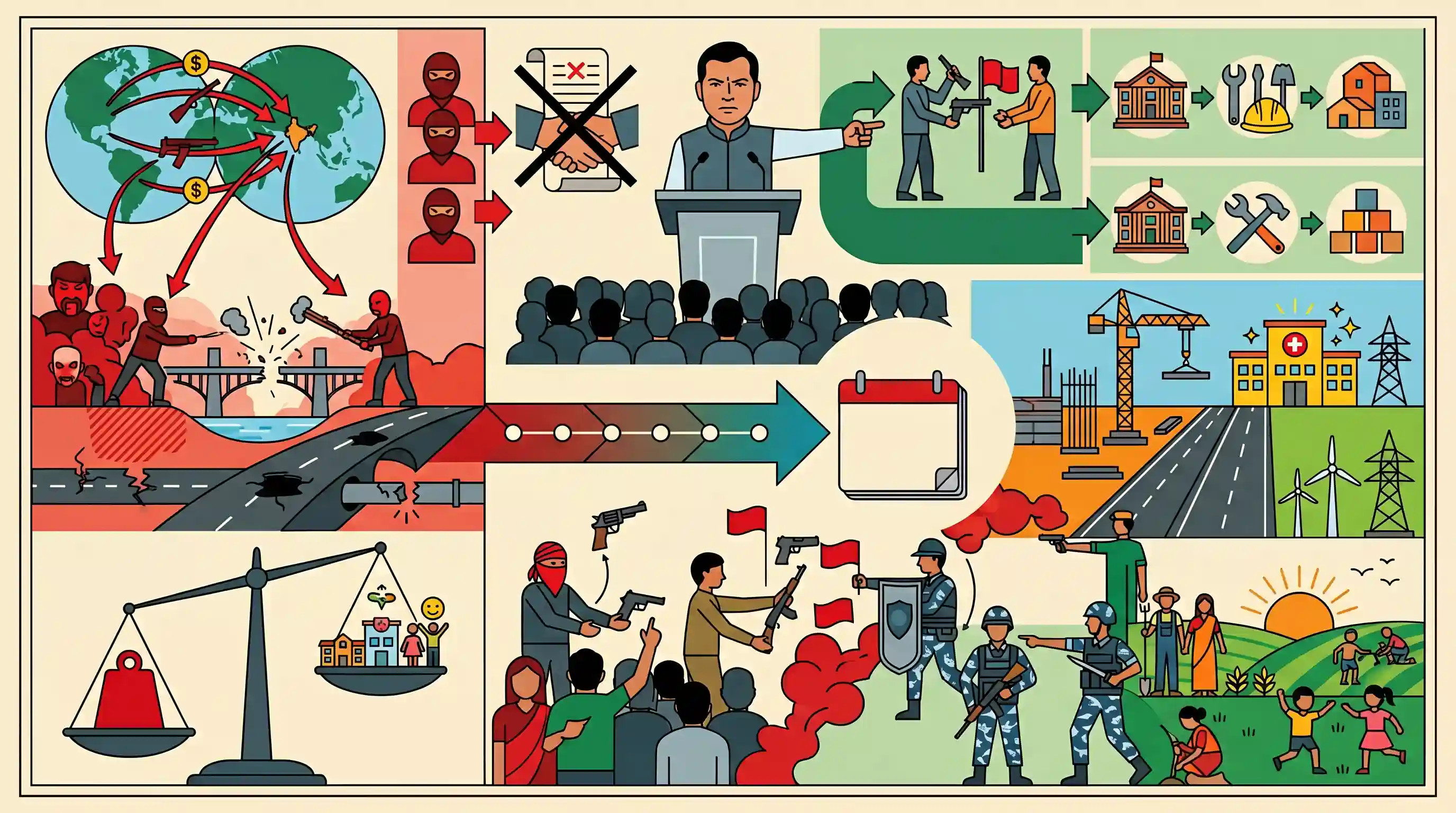
Highlights the latest official stance and multi-pronged strategy (security plus development) of the Indian government against Left Wing Extremism, specifically the insistence on unconditional surrender and a defined deadline (2026) for the total elimination of the Naxal menace.
Summary
The Union Home Minister, addressing an event in Jagdalpur, Bastar, firmly ruled out holding conditional talks with Maoist factions, demanding unconditional surrender and adherence to the government's rehabilitation policy first. The government reaffirmed its target to eradicate Left Wing Extremism (LWE) from India by March 31, 2026. Emphasizing the inverse relationship between extremism and development, the Home Minister asserted that Naxalism has deprived the tribal regions of Chhattisgarh of basic infrastructure and welfare schemes, and warned of continued stringent action by the CRPF and state police to restore peace.
Key Points
- The Indian government ruled out conditional talks with Maoists, stating that negotiations will only occur if insurgents lay down weapons and accept the surrender and rehabilitation policy.
- Union Home Minister Amit Shah reiterated the government's strict deadline to eliminate Naxalism from the country by March 31, 2026.
- Maoism was highlighted as the primary obstacle to the development of Bastar, preventing access to basic amenities like electricity, drinking water, roads, and government schemes.
- Joint security operations by Central forces like the CRPF and the Chhattisgarh Police will continue robustly against left-wing extremism if peace is not maintained.
Important Terms
Left Wing Extremism (LWE)

An armed insurgency in India, primarily motivated by Maoist ideology, aiming to overthrow the government through violent revolution. It thrives in underdeveloped, forested regions, often called the 'Red Corridor'.
UPSC context
GS Paper III (Internal Security); tests knowledge of non-state actors, security challenges, and the security-development nexus.
SAMADHAN Strategy
The Ministry of Home Affairs' 2017 comprehensive strategy to combat LWE: Smart leadership, Aggressive strategy, Motivation/training, Actionable intelligence, Dashboard-based KPIs, Harnessing technology, Action plans for theaters, and No access to financing.
UPSC context
GS Paper III (Internal Security); essential for answers on government policy frameworks and multi-pronged counter-insurgency measures.
Central Reserve Police Force (CRPF)
India's primary internal security force under the Ministry of Home Affairs, tasked with counter-insurgency operations in LWE areas, maintaining law and order, and assisting state police.
UPSC context
GS Paper III (Security Forces & Agencies); tests understanding of the mandate and roles of various Central Armed Police Forces.
Surrender and Rehabilitation Policy
A state government framework offering incentives like financial aid, land, and vocational training to Maoists who renounce violence, aimed at reintegrating them into mainstream society.
UPSC context
GS Paper III (Internal Security); focuses on conflict resolution strategies and the 'carrot and stick' approach to extremism.
CoBRA (Commando Battalion for Resolute Action)
A specialized unit of the CRPF raised in 2008 for guerrilla and jungle warfare. It is specifically trained to track and neutralize Maoist insurgents in difficult terrains.
UPSC context
GS Paper III (Internal Security/Security Forces); relevant for discussing specialized tactical responses to asymmetrical warfare.
Security-Development Nexus
The conceptual link asserting that extremism thrives in the absence of development, while security is a prerequisite for welfare; the government addresses LWE by combining security operations with infrastructure projects.
UPSC context
GS Paper III (Internal Security); core theme regarding the root causes of insurgency and integrated governance strategies.
Prelims Trap
The Central Government has exclusive jurisdiction over counter-LWE operations and surrender policies.
'Police' and 'Public Order' are State subjects. The Centre only provides Central Armed Police Forces (CAPFs) and funding; primary responsibility lies with State Governments.
Static Concepts Connected
What is the multi-pronged strategy against LWE under the National Policy and Action Plan (2015)?
- Security measures: Deployment of CAPFs, intelligence sharing, and establishing Forward Operating Bases (FOBs) deep inside Maoist core areas.
- Development interventions: Focused infrastructure creation via the Road Requirement Plan (RRP), LWE Mobile Tower Project, and Special Central Assistance for most affected districts.
- Rights & Entitlements: Strict implementation of the Forest Rights Act (2006) and PESA (1996) to address tribal grievances and land alienation.
What are the core components of the Surrender-cum-Rehabilitation Policy for LWE cadres?
- Eligibility: Targeted at prominent CPI (Maoist) cadres who surrender their weapons and renounce violence to join the mainstream.
- Financial incentives: Provides immediate grants (e.g., Rs 5 lakh for higher cadres), a monthly stipend for a fixed period, and specific cash incentives for surrendered weapons.
- Reintegration: Imparts vocational training to surrendered cadres to ensure they can secure alternative, peaceful livelihoods.
Cross-Topic Patterns
LWE and Tribal Governance (PESA/FRA)
Mains GS-3 LWE questions are closely linked to GS-2 (PESA/FRA implementation). Poor tribal governance, forest rights denial, and land alienation are the foundational breeding grounds for Maoism.
ADP addressing LWE development deficits
Many core LWE-affected districts are prioritized under the Aspirational Districts Programme to bridge the exact governance and infrastructure deficits that drive the insurgency.
Evolution of specialized counter-insurgency forces
The shift from standard policing to specialized units like CRPF's CoBRA, Andhra's Greyhounds, and setting up Forward Operating Bases (FOBs) showcases the evolution of state capacity.

Expect a GS-3 Mains question evaluating the 'National Policy and Action Plan 2015' in light of the March 2026 deadline to eliminate LWE.
Linked PYQs · 3
Linked PYQs · 3
- 2022MainsGS3
Naxalism is a social, economic and developmental issue manifesting as a violent internal security threat. In this context, discuss the emerging issues and suggest a multilayered strategy to tackle the menace of Naxalism.
- 2018MainsGS3
Left Wing Extremism (LWE) is showing a downward trend, but still affects many parts of the country. Briefly explain the Government of India's approach to counter the challenges posed by LWE.
- 2020MainsGS3
What are the determinants of left-wing extremism in Eastern part of India? What strategy should Government of India, civil administration and security forces adopt to counter the threat in the affected areas?
