Union Health Budget Allocation and Public Healthcare Spending
Source:Indian Express ↗
Why It Matters
Provides critical empirical data (health spending as % of GDP, overall budget share) and policy evaluations necessary for Mains GS-2 answers. It directly addresses the gap between the National Health Policy 2017 targets and actual budgetary allocations, which is vital for discussing structural weaknesses in India's primary healthcare, the National Health Mission, and the path towards Universal Health Coverage.
Summary
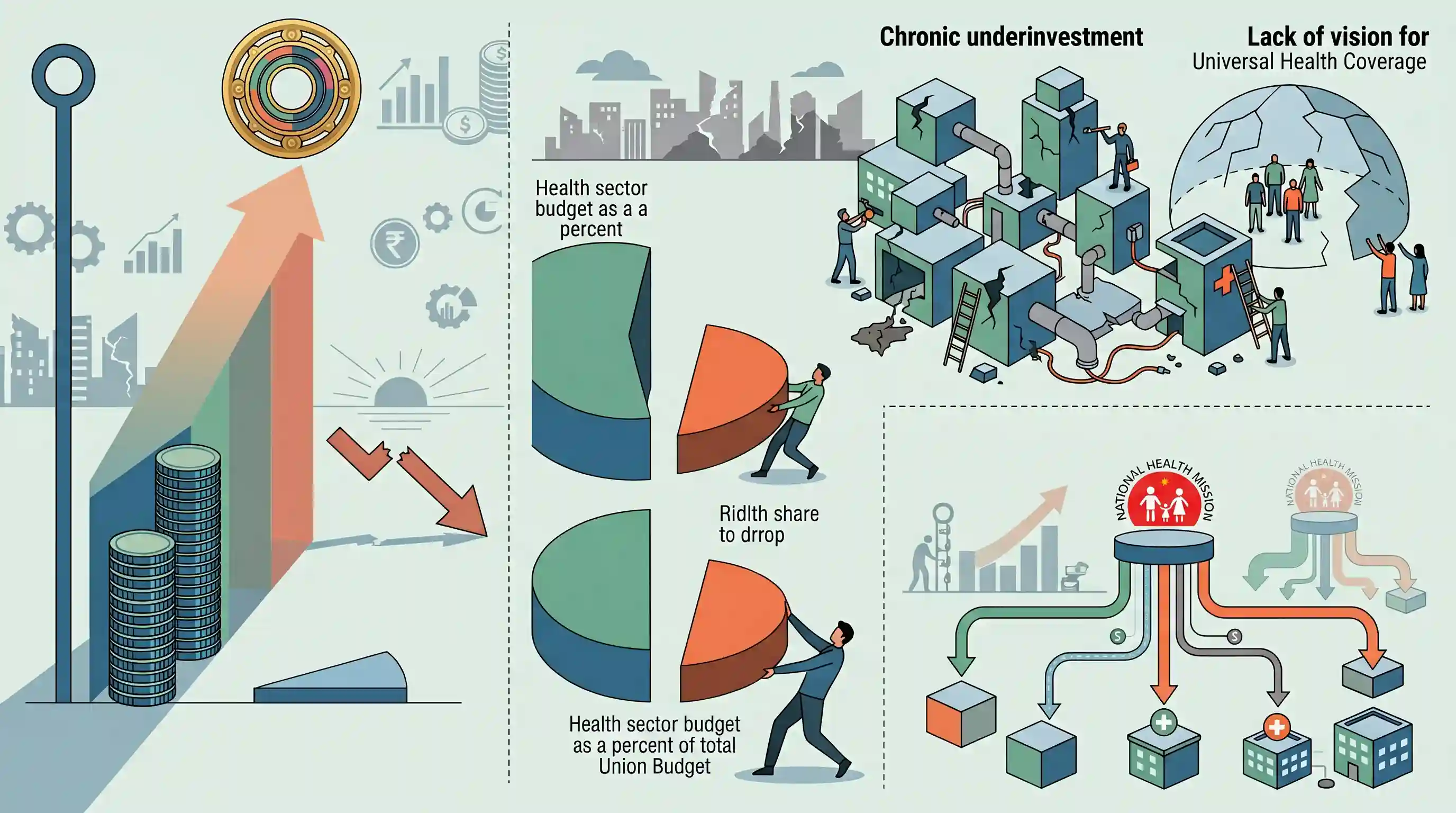
The Jan Swasthya Abhiyan (JSA) strongly criticized the Union Health Budget 2026-27 for its continued neglect of India's health sector. Despite the National Health Policy 2017's goal of increasing government health expenditure to 2.5% of GDP by 2025 (with the Centre contributing 1%), the current allocation remains starkly low at 0.27% of GDP. Activists note that the health budget's share within the overall Union Budget dropped from 2.26% to 2.07%. The critique emphasizes a lack of vision for Universal Health Coverage, chronic underinvestment in structural healthcare improvements, and a reduction in priority for both the National Health Mission and state-level healthcare transfers.
Key Points
- The health sector's share in the total Union Budget has declined from 2.26% to 2.07% in the 2026-27 budget.
- Union government health expenditure is at 0.27% of GDP, falling far short of the 1% target outlined in the National Health Policy 2017.
- The overarching goal of the 2017 National Health Policy to increase combined government health expenditure to 2.5% of GDP by 2025 has not been met.
- The budget lacks focus on primary health care, structural strengthening, or moving towards a Universal Health System, instead limiting itself to tinkering with disease-based programs.
- There are decreased transfers to states and a lowered priority for the National Health Mission.
Important Terms
National Health Policy 2017

A 2017 policy framework aiming to achieve the highest level of health and well-being for all through preventive and promotive healthcare, targeting 2.5% of GDP spending by 2025.
UPSC context
GS Paper II (Social Justice/Health). Essential for analyzing government healthcare targets and public health infrastructure goals.
National Health Mission (NHM)
India's flagship health program comprising Rural (NRHM) and Urban (NUHM) components, focused on strengthening health systems and providing universal access to equitable, affordable, and quality services.
UPSC context
GS Paper II (Welfare Schemes). Critical for evaluating primary healthcare delivery and decentralized health governance.
Universal Health Coverage (UHC)
A goal ensuring all people receive quality health services—including prevention, treatment, and rehabilitation—without suffering financial hardship, aligned with Sustainable Development Goal 3.8.
UPSC context
GS Paper II (Social Sector/Health). A core benchmark for evaluating national health schemes like Ayushman Bharat.
Jan Swasthya Abhiyan (JSA)
The Indian chapter of the People's Health Movement; a coalition of civil society organizations advocating for the Right to Health and universal access to healthcare.
UPSC context
GS Paper II (NGOs/Civil Society). Relevant for discussing public accountability and pressure groups in health policy.
Health Expenditure as % of GDP
A fiscal indicator measuring total government spending on health relative to the nation's economic output; used to assess the priority given to the social sector.
UPSC context
GS Paper III (Indian Economy/Budgeting). Vital for analyzing fiscal priorities and social sector investment gaps.
Prelims Trap
"The National Health Policy 2017 mandates the Union Government to increase its health expenditure to 2.5% of GDP by 2025."
The 2.5% of GDP target by 2025 is for combined government expenditure (Centre + States). The Centre's specific target within this is only 1%.
Static Concepts Connected
What are the key quantifiable targets of the National Health Policy 2017?
- Expenditure: Increase combined government health expenditure to 2.5% of GDP by 2025.
- Life Expectancy: Increase life expectancy at birth from 67.5 to 70 by 2025.
- Mortality Rates: Reduce Under-Five Mortality to 23 by 2025 and Maternal Mortality Ratio to 100 by 2020.
- Primary Care: Shift from selective to comprehensive primary health care through Health and Wellness Centres.
How is public healthcare financing constitutionally structured in India?
- State Subject: 'Public health and sanitation' falls under the State List (Entry 6), making states the primary spenders on healthcare.
- Centrally Sponsored Schemes: The Union supplements state efforts via Centrally Sponsored Schemes like the National Health Mission, typically with a 60:40 funding ratio.
- Finance Commission Grants: The Finance Commission recommends specific grants to states to strengthen local body health infrastructure.
Cross-Topic Patterns
Fiscal Federalism & CSS Funding
Decreased central transfers for the National Health Mission highlight the tension in Centrally Sponsored Schemes, connecting health outcomes to broader Finance Commission devolution debates.
Right to Health vs Welfare Policies
JSA's advocacy connects budgetary shortfalls to the rising demand for justiciable health rights, seen recently in state-level legislation like Rajasthan's Right to Health Act.

Expect a multi-statement Prelims question contrasting NHP 2017 targets (2.5% combined GDP) with actual Union vs State fiscal health shares.
Linked PYQs · 5
Linked PYQs · 5
- 2024MainsGS2
In a crucial domain like the public healthcare system the Indian State should play a vital role to contain the adverse impact of marketisation of the system. Suggest some measures through which the State can enhance the reach of public healthcare at the grassroots level.
- 2021MainsGS2
“Besides being a moral imperative of a Welfare State, primary health structure is a necessary precondition for sustainable development.” Analyze.
- 2020MainsGS2
In order to enhance the prospects of social development, sound and adequate health care policies are needed particularly in the fields of geriatric and maternal health care. Discuss.
- 2015MainsGS2
Public health system has limitations in providing universal health coverage. Do you think that the private sector could help in bridging the gap? What other viable alternatives would you suggest?
- 2016MainsGS2
Professor Amartya Sen has advocated important reforms in the realms of primary education and primary health care. What are your suggestions to improve their status and performance?
