Pune Growth Hub allocation and metro extension funding by Union govt
Source:Indian Express ↗
Why It Matters
The development of urban 'Growth Hubs' and the expansion of metro rail networks are critical examples of how the government attempts to harness urbanization for economic growth. This provides practical case studies for UPSC Mains answers on infrastructure investment, urban mobility, and managing the rapid growth of IT/industrial cities like Pune.
Summary
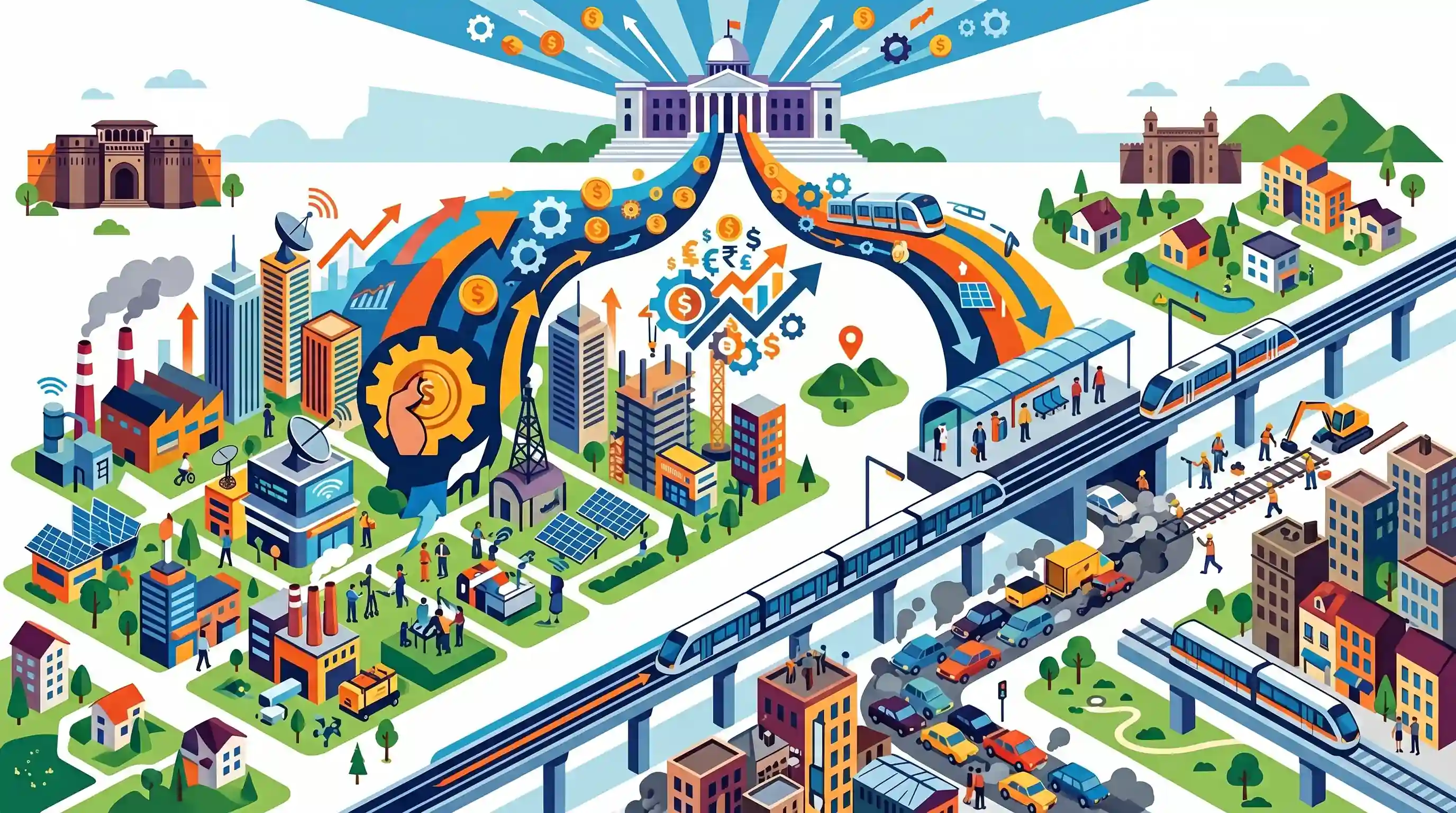
The Union Government is investing heavily in Pune's urban infrastructure, allocating Rs 5,000 crore for the creation of a 'Pune Growth Hub' to stimulate economic and industrial development. In addition, Rs 517 crore is being directed toward the extension of the Pune Metro to enhance public transit and address urban mobility challenges. These initiatives highlight the government's approach to transforming cities into engines of economic growth while attempting to manage the pressures of rapid urbanization through improved mass transit.
Key Points
- The Union Government has announced a major allocation of Rs 5,000 crore to establish a 'Pune Growth Hub' aimed at boosting regional economic activities and industrial development.
- An additional Rs 517 crore has been earmarked for the extension of the Pune Metro network to improve urban mobility and connectivity.
- These investments underscore the policy focus on enhancing urban infrastructure to support rapid urbanization and sustainable transit systems in growing metropolitan areas.
Important Terms
Pune Growth Hub

An economic region initiative supported by NITI Aayog to transform Pune into a global technology and manufacturing center through a comprehensive master plan and ₹5,000 crore central investment.
UPSC context
GS Paper III (Economic Development) & GS Paper I (Urbanization). Tests regional planning and economic growth models.
Metro Rail Policy 2017
A national framework mandating Private-Public Partnerships (PPP), Comprehensive Mobility Plans (CMP), and Unified Metropolitan Transport Authorities (UMTA) to ensure the financial viability and multimodal integration of metro projects.
UPSC context
GS Paper III (Infrastructure). Essential for policy-based questions on urban transport and financing models.
Transit-Oriented Development (TOD)
An urban planning model that promotes high-density, mixed-use development near transit stations to reduce commute distances and encourage sustainable, walkable, and compact city growth.
UPSC context
GS Paper I (Urbanization) & GS III. Focuses on spatial planning and sustainable development strategies.
Mass Rapid Transit System (MRTS)
High-capacity urban transport systems with dedicated rights-of-way, such as metro rail or BRTS, designed to move large numbers of people efficiently while reducing city congestion.
UPSC context
GS Paper III (Infrastructure). Tests understanding of transport solutions and their role in urban sustainability.
Last-Mile Connectivity
The final leg of a commuter's journey between a transit hub (like a metro station) and their home or workplace, often addressed through feeder services.
UPSC context
GS Paper III (Infrastructure). Key factor in determining the economic viability and ridership of metro projects.
Unified Metropolitan Transport Authority (UMTA)
A statutory body mandated for cities to ensure an integrated, multi-modal approach to planning, managing, and regulating all urban transport modes within a metropolitan area.
UPSC context
GS Paper II (Governance) & GS III. Tests institutional reforms for effective urban governance.
Prelims Trap
"The 'Growth Hub' city initiative is a flagship scheme launched by the Ministry of Housing and Urban Affairs (MoHUA)."
The 'Growth Hub' initiative to transform city-regions into mega economic engines is driven by NITI Aayog, not MoHUA, focusing on macro-scale economic planning.
Static Concepts Connected
What are the core pillars of the National Urban Transport Policy (NUTP)?
- People over vehicles: Prioritizes public transit and non-motorized transport, focusing on the equitable allocation of road space to move citizens rather than private cars.
- Land use integration: Emphasizes integrating transport planning with urban land use to minimize travel distances and improve access to urban livelihoods.
- Innovative financing: Supports mechanisms like Transit-Oriented Development (TOD) and land value capture to fund expensive urban mass transit infrastructure.
What are "agglomeration economies" in urban economic geography?
- Spatial concentration: The economic benefits that firms, industries, and talent obtain when locating near one another, generating high productivity in a small landmass.
- Shared externalities: Firms benefit from reduced transport/logistics costs, access to a deeper specialized labor pool, and rapid knowledge spillovers.
- Diseconomies risk: Without adequate infrastructure, concentration leads to severe congestion, pollution, and high land costs, which nullify the initial economic benefits.
Cross-Topic Patterns
NITI's Growth Hubs & Municipal Finance
Links NITI Aayog’s push for city-led economic engines with the 15th Finance Commission’s focus on performance-based urban grants and incubation of new greenfield cities.
AI mapping for municipal property tax
Leveraging AI to identify unassessed properties links urban governance (GS2) with tech (GS3), expanding municipal revenue bases without politically sensitive baseline tax hikes.

Expect a GS1/GS3 Mains question on linking NITI Aayog's 'Growth Hubs' with mass transit to prevent agglomeration diseconomies.
Linked PYQs · 2
Linked PYQs · 2
- 2021MainsGS3
“Investment in infrastructure is essential for more rapid and inclusive economic growth.” Discuss in the light of India's experience.
- 2017MainsGS1
"The growth of cities as I.T. hubs has opened up new avenues of employment, but has also created new problems." Substantiate this statement with examples.
