Protection of Kollam Marine Ecosystem from Coastal Mining Impacts
Source:The Hindu ↗
Why It Matters
Highlights the critical balance between industrial activities (coastal mining) and ecological conservation, alongside massive state interventions via PMMSY aimed at ensuring sustainable livelihoods and modernizing the marine aquaculture sector in India.
Summary
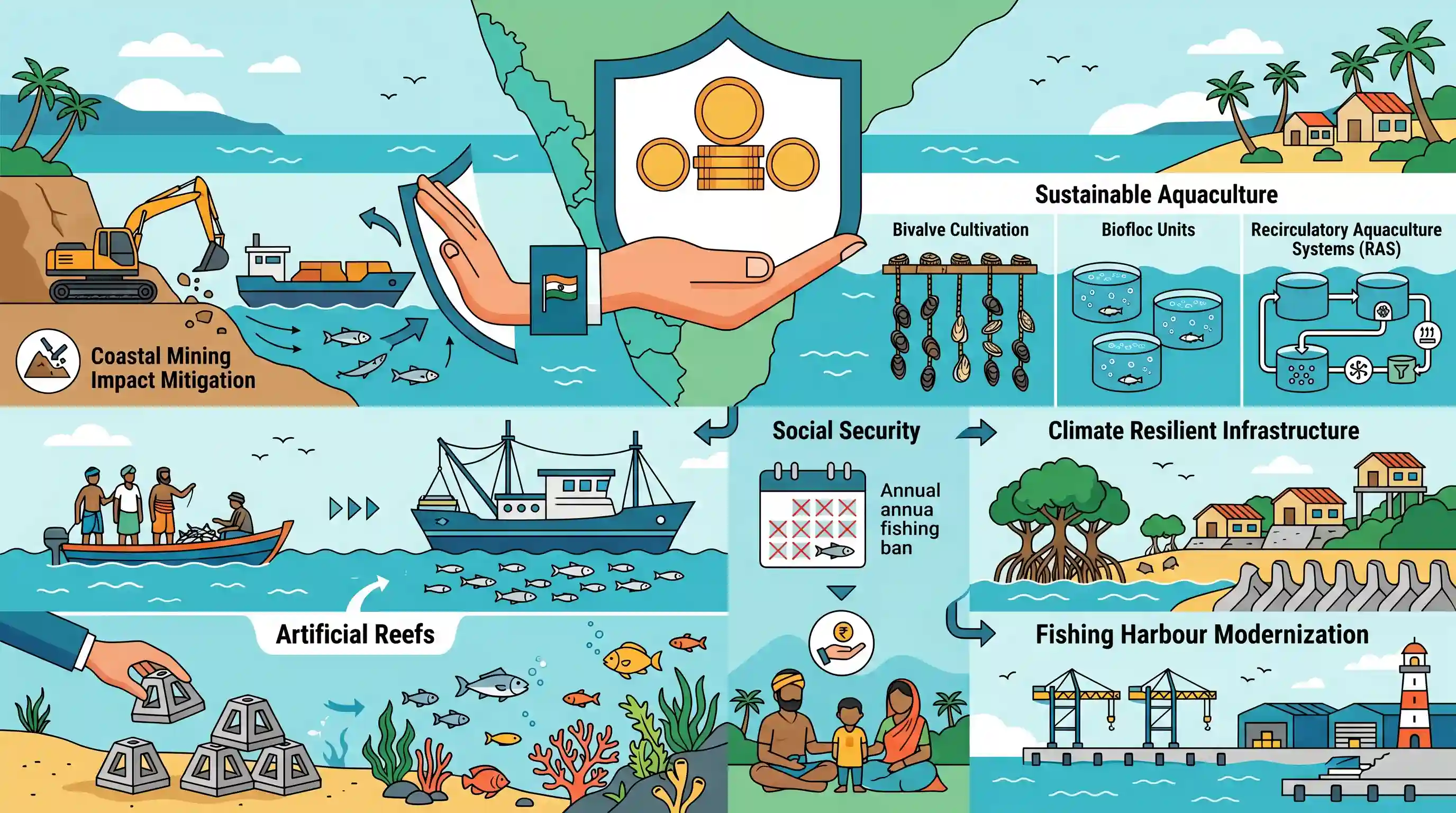
The Union Government has affirmed its commitment to protecting the marine ecosystem of Kollam, Kerala, from the adverse impacts of coastal mining. Addressing concerns over livelihood crises among traditional fishermen caused by declining fish stocks, the Centre outlined a ₹1,418.51 crore development package for Kerala under the Pradhan Mantri Matsya Sampada Yojana (PMMSY). The initiative encompasses financial assistance for deep-sea fishing vessels, the establishment of artificial reefs to boost marine biodiversity, and the promotion of sustainable methods like bivalve cultivation, biofloc units, and recirculatory aquaculture systems (RAS). Furthermore, the package integrates social security measures during the annual fishing ban and robust infrastructure modernization, including climate-resilient coastal villages and upgraded fishing harbours.
Key Points
- Stringent legal frameworks are being utilized to mitigate the impact of coastal mining on Kerala's marine ecosystem.
- The Pradhan Mantri Matsya Sampada Yojana (PMMSY) is deploying a ₹1,418.51 crore package to Kerala to rejuvenate fisheries and marine infrastructure.
- Ecological and livelihood interventions include the creation of 42 artificial reefs for marine biodiversity and extensive support for biofloc and recirculatory aquaculture systems (RAS).
- A total of 1,71,033 livelihood support packages are being distributed to traditional fishers to safeguard them during the annual fishing ban.
- Infrastructure and climate adaptation initiatives include six modern climate-resilient coastal villages, Matsya Seva Kendras, and the deployment of Sagar Mitras.
Important Terms
Pradhan Mantri Matsya Sampada Yojana (PMMSY)

A flagship scheme launched in 2020 to promote sustainable development of the fisheries sector with an investment of ₹20,050 crore over five years.
UPSC context
GS Paper III: Indian Economy and issues relating to planning, mobilization of resources, growth, development, and employment.
Blue Economy
The sustainable use of ocean resources for economic growth, improved livelihoods, and jobs while preserving the health of the ocean ecosystem.
UPSC context
GS Paper III: Conservation, environmental pollution and degradation, and environmental impact assessment.
Quilon Bank
A highly productive fishing ground and marine biodiversity hotspot off the Kollam coast, Kerala, rich in coral reefs and vital for traditional fisheries.
UPSC context
GS Paper I: Salient features of world's physical geography; GS Paper III: Environment.
Offshore Areas Mineral (Development and Regulation) Act
The legal framework governing the grant of operating rights for mineral exploration and production in India's offshore areas, significantly amended in 2023.
UPSC context
GS Paper II: Government policies and interventions for development in various sectors and issues arising out of their design and implementation.
Artificial Reefs
Man-made underwater structures designed to mimic natural reefs, promoting marine biodiversity, rejuvenating fish stocks, and providing sustainable fishing grounds.
UPSC context
GS Paper III: Science and Technology- developments and their applications and effects in everyday life; Environmental conservation.
Biofloc Technology
An eco-friendly aquaculture system that converts nitrogenous waste into protein-rich feed for fish using beneficial bacterial colonies.
UPSC context
GS Paper III: Science and Technology; Agriculture (Fisheries).
Prelims Trap
"Biofloc technology relies on continuous water exchange and autotrophic algae to manage fish waste."
Biofloc is a closed system that uses heterotrophic bacteria (not autotrophic algae) to convert organic waste into protein-rich feed, minimizing water exchange.
Static Concepts Connected
What are the major Heavy Mineral Sands (Placer deposits) found on Kerala's coast?
- Key Minerals: Ilmenite, Rutile, Zircon, Monazite, Sillimanite, and Garnet are highly abundant in the beach sands of the Kollam coast.
- Monazite significance: It contains Thorium, a radioactive element crucial for the advanced stages of India's three-stage nuclear power program.
- Strategic Regulation: Classified as 'prescribed substances' under the Atomic Energy Act, 1962; mining of these heavy minerals is strictly restricted to state-owned entities.
How do Biofloc and Recirculatory Aquaculture Systems (RAS) promote sustainable fisheries?
- Biofloc Technology: Uses heterotrophic bacteria to convert toxic ammonia from fish excreta and uneaten feed into protein-rich microbial biomass, acting as natural feed.
- RAS Technology: An indoor closed-loop farming method where water is continuously filtered; biofilters use nitrifying bacteria to detoxify ammonia into less harmful nitrates.
- Ecological Benefit: Both methods drastically reduce water/land usage, prevent nutrient runoff pollution in local water bodies, and isolate farmed species from wild pathogens.
Cross-Topic Patterns
Placer Minerals & Nuclear Program
Kollam's beach sand mining directly links to India's strategic reserves of Thorium (via Monazite), regulated as a 'prescribed substance' by the Department of Atomic Energy.
PMMSY & Blue Economy Resilience
Funding for artificial reefs and climate-resilient villages bridges the gap between traditional capture fisheries livelihoods and India's broader Blue Economy and coastal adaptation strategies.

Expect a multi-statement Prelims question comparing Biofloc and RAS technologies, specifically testing the role of nitrifying bacteria.
Linked PYQs · 2
Linked PYQs · 2
- 2019MainsGS3
Coastal sand mining, whether legal or illegal, poses one of the biggest threats to our environment. Analyze the impact of sand mining along the Indian coasts, citing specific examples.
- 2018MainsGS1
Defining blue revolution, explain the problems and strategies for pisciculture development in India.
