Great Indian Bustard Conservation Center Inaugurated in Kachchh
Source:nyayaportal ↗
Why It Matters
Important for GPSC aspirants tracking wildlife conservation projects, particularly regarding critically endangered species like the Great Indian Bustard and ecological initiatives in Gujarat's Kachchh region.
Summary
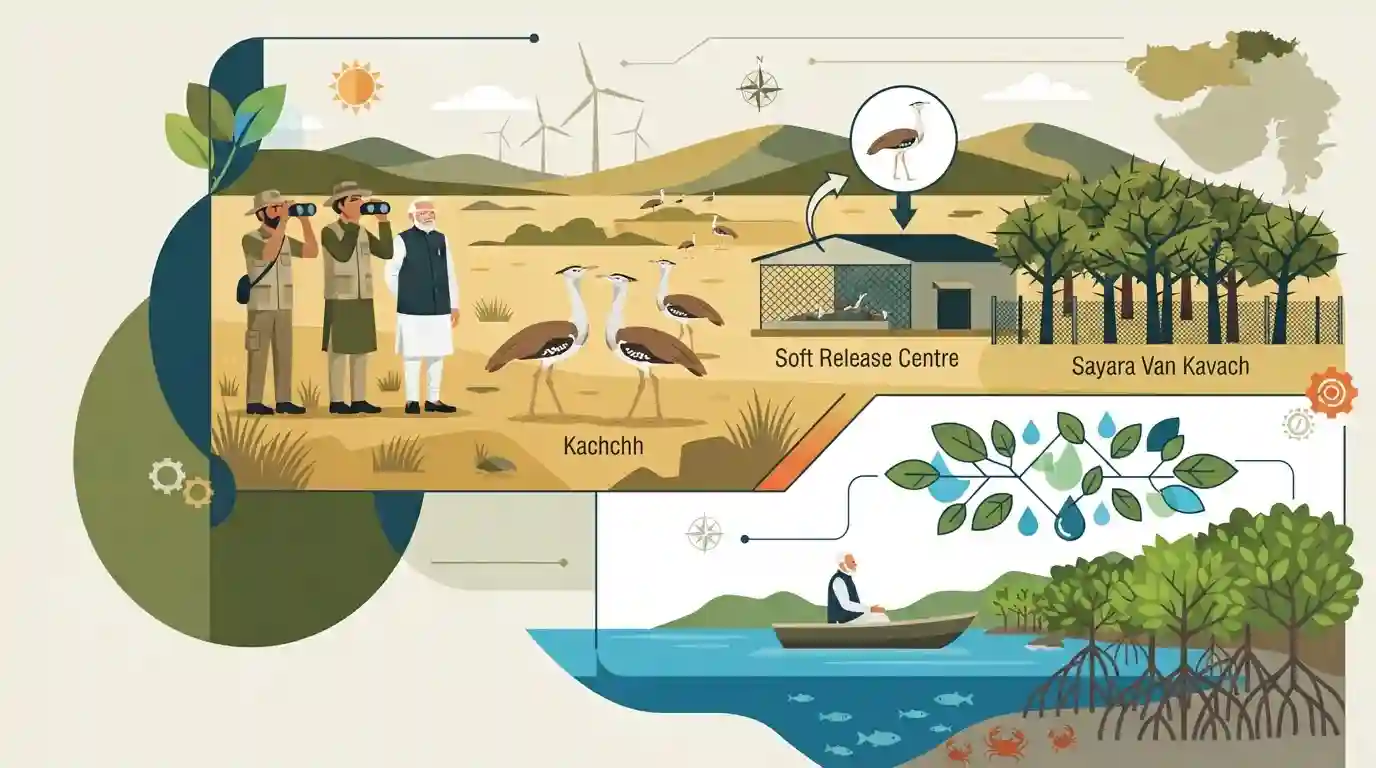
The Union Environment Minister visited the Great Indian Bustard (GIB) habitat in Kachchh, Gujarat, where he inaugurated a GIB Soft Release Centre and Sayara Van Kavach. He also reviewed coastal mangrove conservation efforts, emphasizing biodiversity and ecological restoration in Gujarat.
Key Points
- The Union Environment Minister visited the Great Indian Bustard (GIB) habitat in Kachchh, Gujarat.
- Inaugurated a GIB Soft Release Centre to aid conservation and breeding efforts for the critically endangered bird.
- Inaugurated Sayara Van Kavach to boost green cover and forest protection in the region.
- Reviewed mangrove conservation and plantation initiatives in Gujarat's coastal areas.
Important Terms
GIB Soft Release Centre

A specialized facility in Kachchh, Gujarat, designed to help captive-bred or rescued Great Indian Bustards gradually adapt to natural wild conditions before their release.
UPSC context
Important for GPSC Paper 3 (Ecology and Environment) and wildlife conservation initiatives, testing knowledge of endangered species protection and captive breeding in Gujarat.
Sayara Van Kavach
A dense multi-layered afforestation initiative in Kachchh structured under the Miyawaki method using native drought-tolerant saplings for ecological restoration.
UPSC context
Relevant for GPSC General Studies Paper 3 (Environment & Biodiversity) under forestry initiatives, green cover enhancement, and afforestation technologies in Gujarat.
Ministry of Environment, Forest and Climate Change
The central government ministry responsible for planning, promoting, and coordinating environmental and forestry policies and wildlife conservation projects across India.
UPSC context
Crucial for GPSC Paper 2 and Paper 3 regarding national environmental governance, administrative frameworks, and ministerial mandates in India.
Gujarat Forest Department
The state-level administrative body tasked with forest management, wildlife protection, habitat restoration, and implementation of afforestation programs across Gujarat.
UPSC context
Tests governance and state-specific implementation under GPSC Paper 1 (Polity/Administration) and Paper 3 (Environment & Geography of Gujarat).
Static Concepts Connected
What is the conservation status and primary habitat of the Great Indian Bustard (GIB) in India?
- IUCN Status: Critically Endangered under the IUCN Red List, with very few remaining individuals in the wild.
- Legal Protection: Protected under Schedule I of the Wild Life (Protection) Act, 1972, affording it the highest level of legal protection.
- Natural Habitat: Found primarily in Rajasthan and Gujarat (Kachchh region), favoring arid and semi-arid grasslands.
What are the key ecological and protective functions of mangrove ecosystems along Gujarat's coastline?
- Coastal Defense: Act as natural bio-shields against cyclones, storm surges, and coastal erosion along the long coastline of Gujarat.
- Marine Nursery: Provide critical nursery grounds for diverse marine species, crustaceans, and coastal birds, supporting local fisheries.
- Carbon Sequestration: Serve as efficient carbon sinks (blue carbon), sequestering atmospheric carbon at rates much higher than terrestrial forests.
Cross-Topic Patterns
GIB Conservation and Gujarat Mangrove Ecosystems
The GIB conservation measures in Kachchh link directly with the Wildlife Protection Act, 1972 (Schedule I species protection) and state-level eco-restoration frameworks like MISHTI for mangroves.

GIB habitat in Kachchh, Schedule I status under WLPA 1972, and Gujarat mangrove distribution are high-yield areas for GPSC prelims.
Linked PYQs · 1
Linked PYQs · 1
- 2026GPSC_PRELIMSGS1
The 'Great Indian Bustard (GIB)' (Ghorad) is frequently seen in the news in the context of wildlife conservation efforts in western India. Consider the following statements regarding this species: 1. Currently, the highest surviving wild population of the Great Indian Bustard in India is located in the semi-arid grasslands of Gujarat. 2. It is a long-distance migratory bird that travels from Central Asia to the Indian subcontinent to escape harsh winters. Which of the above statement(s) is/are correct?
