Defence Modernization and Strategic Autonomy at Chanakya Dialogue
Source:The Hindu ↗
Why It Matters
The article highlights the official government perspective on India's defence strategy, explicitly linking internal/external security threats (information warfare, maritime pressure, cross-border terrorism) to the need for defence indigenization (Aatmanirbhar Bharat) and strategic autonomy. This directly serves as fodder for GS3 Security and GS2 International Relations answers.
Summary
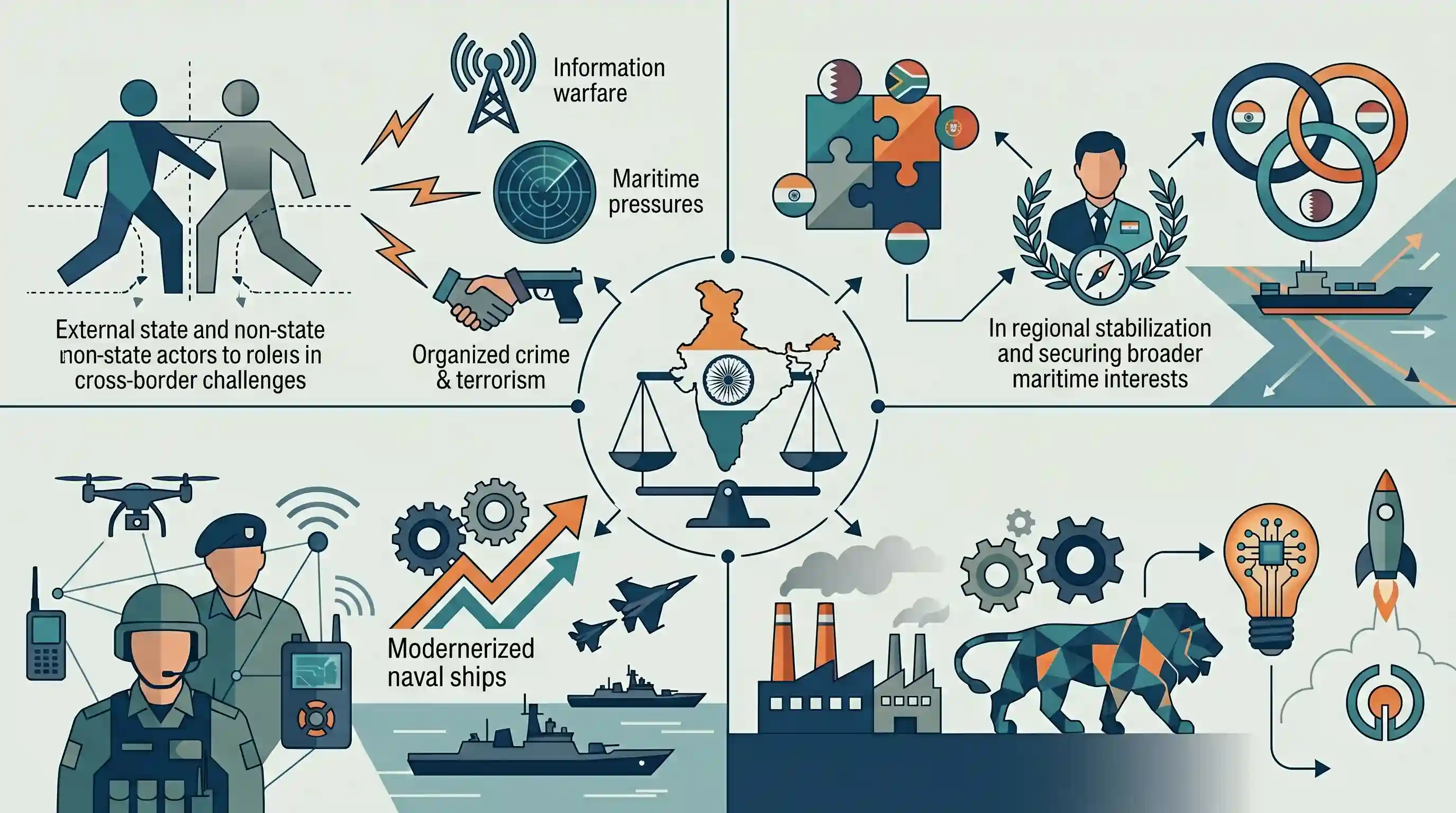
Speaking at the Chanakya Defence Dialogue 2025 in New Delhi, Defence Minister Rajnath Singh outlined India's evolving strategic posture and defence imperatives. He emphasized India's strategic autonomy and its role as a balanced, responsible global voice amidst a changing world order. Singh highlighted that the changing character of war—characterized by cross-border terrorism, maritime pressures, and information warfare—demands comprehensive reforms and military modernization. Central to this vision is 'Aatmanirbharta' (self-reliance) in defence manufacturing, supported by investments in deep-tech and start-ups. Furthermore, he noted that the Armed Forces' mandate has broadened to include regional stabilization, disaster relief, and securing broader maritime interests.
Key Points
- India positions itself as a voice of balance and responsibility, maintaining strategic autonomy in a rapidly changing global order.
- New security challenges necessitate military reforms, driven by threats such as cross-border terrorism, attempts to alter the status quo, maritime pressures, and information warfare.
- Comprehensive national power requires 'Aatmanirbharta' (self-reliance) in defence, achieved through modernizing the Armed Forces, reforming procurement, and investing in deep-tech R&D and start-ups.
- The role of the Armed Forces has expanded beyond traditional border defence to include stabilizing regions, disaster relief, securing maritime interests, and strengthening global partnerships.
Important Terms
Viksit Bharat

Long-term vision to transform India into a developed nation by 2047, focusing on economic growth, modern infrastructure, and inclusive development.
UPSC context
GS Papers 2 & 3; crucial for understanding governance goals, economic planning, and India’s long-term developmental trajectory.
Strategic Autonomy
The ability of a nation to pursue its national interests and independent foreign policy without being constrained by external pressures or formal alliances.
UPSC context
GS Paper 2 (International Relations); essential for analyzing India’s "multi-alignment" strategy and its role in a multipolar global order.
Aatmanirbhar Bharat (Defence)
"Self-reliant India" initiative aimed at indigenizing defense manufacturing, reducing import dependency, and fostering a domestic defense industrial ecosystem through policy reforms.
UPSC context
GS Paper 3 (Security/Economy); tests knowledge of "Make in India," indigenization of technology, and strategic security independence.
Information Warfare
Strategic use of information and communication technologies (propaganda, misinformation, cyber-attacks) to manipulate perceptions or gain military/political advantage over an adversary.
UPSC context
GS Paper 3 (Security); relevant for understanding modern hybrid warfare, non-traditional security threats, and challenges to internal stability.
Deep-Tech
Advanced technologies based on substantial scientific or engineering innovation—such as AI and Quantum Computing—requiring extensive R&D to address complex problems.
UPSC context
GS Paper 3 (Science & Tech); highlights the role of startups and innovation in military modernization and technological sovereignty.
Chanakya Defence Dialogue
An annual strategic forum organized by the Indian Army and CLAWS to discuss national security, defense reforms, and emerging geopolitical challenges.
UPSC context
GS Papers 2 & 3; relevant for tracking official defense postures, civil-military fusion, and regional security initiatives.
Maritime Security
Measures to protect maritime interests, including sea lanes, resources, and sovereignty against threats like piracy or territorial encroachment.
UPSC context
GS Papers 2 & 3; central to India’s "SAGAR" vision and its strategic role in the Indo-Pacific region.
Prelims Trap
Strategic Autonomy requires India to remain strictly non-aligned and avoid multi-lateral security dialogues.
Modern Strategic Autonomy embraces proactive "multi-alignment" (e.g., Quad, SCO) to maximize national interest, replacing the older isolationist Non-Alignment doctrine.
Static Concepts Connected
How does 'Strategic Autonomy' differ from traditional 'Non-Alignment'?
- Non-Alignment: Historically meant maintaining strict, equal distance from Cold War military blocs and avoiding alliance politics altogether.
- Strategic Autonomy: A modern, proactive approach involving multi-alignment and issue-based partnerships without binding treaty constraints to maximize national interest.
- Practical Execution: Allows India to actively engage in security dialogues like the Quad while simultaneously maintaining independent defense ties with Russia.
What are the key policy tools driving 'Aatmanirbharta' in India's defence sector?
- Positive Indigenisation Lists: Phased import embargoes on hundreds of specific weapon systems and platforms to guarantee domestic procurement and manufacturing.
- iDEX Initiative: Innovations for Defence Excellence (iDEX) funds startups and MSMEs to develop cutting-edge, deep-tech military solutions.
- FDI Liberalisation: Foreign Direct Investment limit was raised to 74% via the automatic route to encourage domestic joint ventures and technology transfers.
Cross-Topic Patterns
Net Security Provider + SAGAR Doctrine
The Armed Forces' expanded mandate into regional stabilization and HADR missions directly operationalizes India's SAGAR doctrine in the Indian Ocean Region.
Deep-Tech + Defence Indigenisation
The shift toward multi-domain warfare (cyber, space, information) forces tight integration between GS-3 Science & Tech and GS-3 Internal Security via dual-use deep-tech startups.

Expect a GS-3 Mains question linking India's deep-tech defence startup ecosystem (iDEX) with its evolving multi-domain warfare strategy.
Linked PYQs · 5
Linked PYQs · 5
- 2025MainsGS3
Why is maritime security vital to protect India's sea trade? Discuss maritime and coastal security challenges and the way forward.
- 2022MainsGS3
What are the maritime security challenges in India ? Discuss the organisational, technical and procedural initiatives taken to improve the maritime security.
- 2025MainsGS3
Terrorism is a global scourge. How has it manifested in India? Elaborate with contemporary examples. What are the counter measures adopted by the State? Explain.
- 2021MainsGS3
Keeping in view India's internal security, analyse the impact of cross-border cyber attacks. Also discuss defensive measures against these sophisticated attacks.
- 2014MainsGS3
Foreign Direct Investment (FDI) in the defence sector is now set to be liberalized. What influence this is expected to have on Indian defence and economy in the short and long run?
