India US Interim Trade Deal Safeguards Farmers and MSMEs
Source:The Hindu ↗
Why It Matters
This interim deal serves as a crucial case study for GS-2 and GS-3 on how India navigates complex bilateral trade negotiations—balancing the need for export market access with the absolute necessity of protecting domestic agriculture, MSMEs, and ensuring food security by restricting GM imports.
Summary
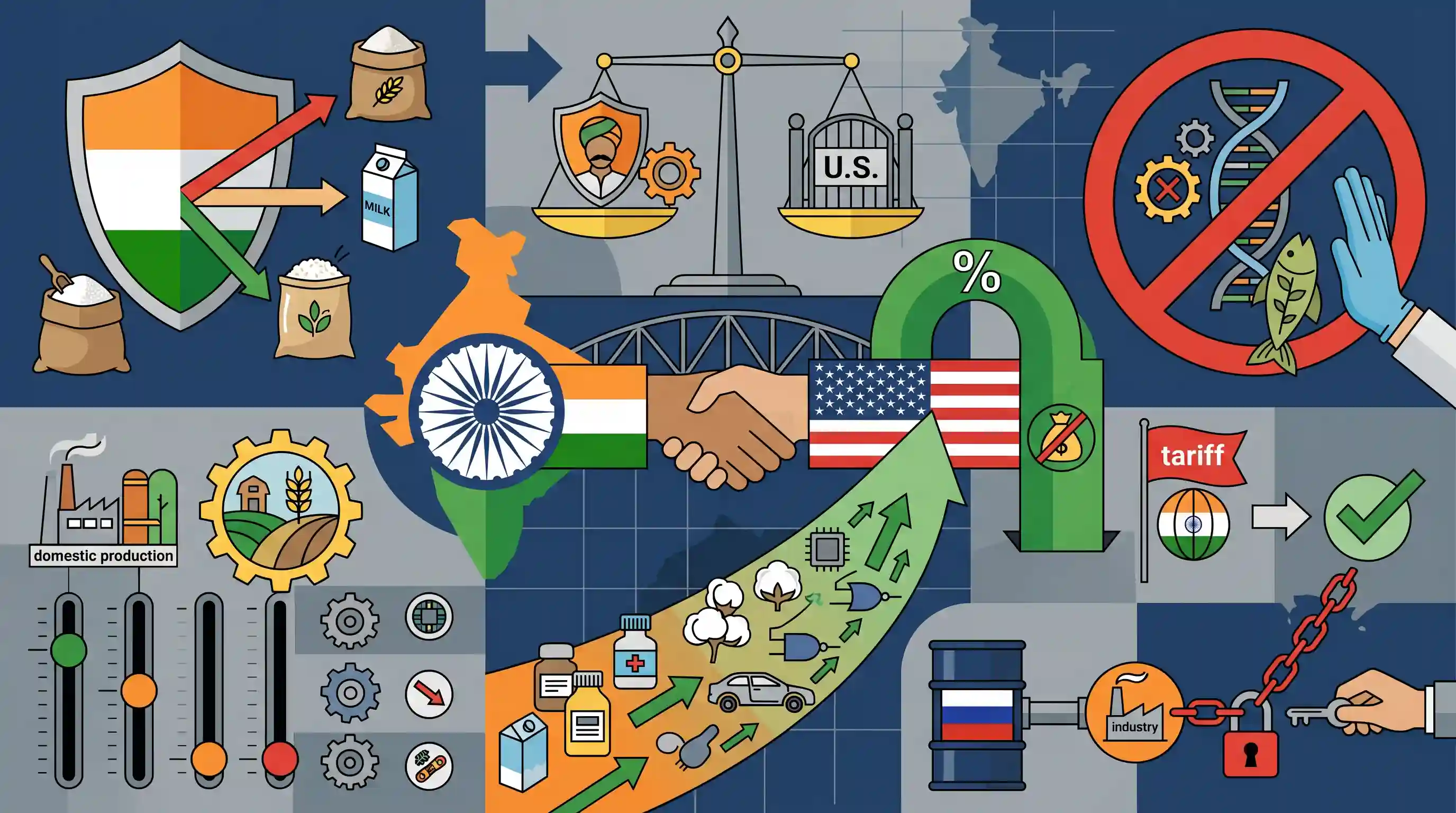
Union Commerce Minister Piyush Goyal announced that the new India-U.S. interim trade agreement safeguards the interests of Indian farmers and MSMEs by maintaining protections on sensitive agricultural products and strictly barring genetically modified (GM) imports. While India gains duty-free access to the US for a range of agricultural and industrial exports, it has only reduced tariffs on items not sufficiently produced domestically. The deal also involves the US removing tariffs previously imposed on India over its Russian oil trade.
Key Points
- An interim trade agreement between India and the US provides reciprocal tariff reductions while explicitly protecting Indian farmers and MSMEs.
- The deal denies the US tariff relief on sensitive agricultural products like meat, dairy, cereals, and sugar, and firmly prohibits the entry of genetically modified (GM) items into India.
- Indian agricultural exports (spices, tea, coffee) and industrial goods (gems, pharma, machinery) will enjoy duty-free access to the US market.
- The US has agreed to remove the 25% tariff on Indian imports previously imposed due to India's trade in Russian oil.
- India has lowered tariffs on goods it lacks sufficient domestic production of, including specific agricultural products, medical equipment, and cancer medicines.
Important Terms
India-U.S. Interim Trade Agreement (2026)

A 2026 framework de-escalating the 2025 trade crisis by slashing U.S. tariffs from 50% to 18% and removing penalties on India's Russian oil trade while protecting domestic agricultural interests.
UPSC context
GS Paper II (International Relations); tests understanding of bilateral economic diplomacy and strategic autonomy in the Indo-Pacific region.
MSMEs (Micro, Small and Medium Enterprises)
Enterprises classified by investment and turnover (limits significantly increased in 2025-26); they contribute nearly 45% of India's exports and are major beneficiaries of global market access.
UPSC context
GS Paper III (Indian Economy); tests knowledge of employment generation, export growth, and the "missing middle" problem in industrial policy.
GATT Article XXIV (Interim Agreements)
A provision allowing members to form temporary trade deals as precursors to a Free Trade Area (FTA), provided they include a clear plan to eliminate tariffs within ten years.
UPSC context
GS Paper II (International Relations); tests knowledge of WTO legal frameworks and the rules governing regional trade agreements (RTAs).
Genetically Modified (GM) Organisms
Living organisms with artificially manipulated genetic material; strictly excluded from the India-U.S. trade deal to prevent entry into Indian markets and safeguard domestic biodiversity and food safety standards.
UPSC context
GS Paper III (Agriculture & S&T); tests awareness of agricultural regulation, food security, and non-tariff barriers in global trade.
Reciprocal Tariffs
The practice of trading partners applying identical or equivalent import duties on each other’s goods; the 2026 deal transitioned both countries to a stabilized 18% rate.
UPSC context
GS Paper II (International Relations); examines trade protectionism, trade wars, and the shift towards reciprocal trade models in foreign policy.
Sensitive List (Agriculture)
A list of vulnerable products (like dairy and staple grains) exempted from tariff cuts in trade agreements to shield domestic producers from foreign competition.
UPSC context
GS Paper III (Agriculture); examines the socio-economic impacts of trade liberalization on small and marginal farmers.
Prelims Trap
The India-US interim trade agreement allows the limited import of genetically modified (GM) agricultural products to secure duty-free access.
India firmly barred the entry of genetically modified (GM) items and denied tariff relief on sensitive agriculture like dairy to protect local farmers.
Static Concepts Connected
What distinguishes an Early Harvest Scheme (EHS) from a comprehensive Free Trade Agreement (FTA)?
- Scope of coverage: EHS targets a limited, specific list of goods/services for early tariff liberalization, unlike FTAs which must cover 'substantially all trade'.
- Stepping stone: An EHS often serves as a confidence-building precursor to a Comprehensive Economic Partnership Agreement (CEPA) or full FTA.
- WTO Compliance: EHS can face WTO scrutiny if it is not explicitly framed as an interim step toward a full FTA under GATT Article XXIV.
Who regulates the import of Genetically Modified (GM) crops and products in India?
- Nodal Agency (GEAC): The Genetic Engineering Appraisal Committee (GEAC) under the Ministry of Environment, Forest and Climate Change regulates environmental release and import of GM variants.
- Legal Backing: GEAC derives its statutory powers to regulate hazardous microorganisms and genetically engineered organisms from the Environment (Protection) Act, 1986.
- FSSAI's Role: The Food Safety and Standards Authority of India (FSSAI) is responsible for regulating imported GM-origin foods intended for direct human consumption.
Cross-Topic Patterns
US farm subsidies vs. Indian agriculture
Shielding sensitive sectors like dairy from heavily subsidized US agriculture aligns with India's long-standing WTO stance demanding Special Safeguard Mechanisms (SSM) to protect vulnerable resource-poor farmers.
Market access shielding strategic autonomy
The US withdrawing retaliatory tariffs originally imposed over India's Russian oil purchases demonstrates how India leverages bilateral market access to insulate its independent foreign policy choices.

Expect a Prelims multi-statement question evaluating 'Interim Trade Agreements' against WTO's GATT Article XXIV compliance requirements.
Linked PYQs · 5
Linked PYQs · 5
- 2014MainsGS2
The aim of Information Technology Agreements (ITAs) is to lower all taxes and tariffs on information technology products by signatories to zero. What impact would such agreements have on India's interests?
- 2023MainsGS3
What are the direct and indirect subsidies provided to farm sector in India? Discuss the issues raised by the World Trade Organization (WTO) in relation to agricultural subsidies.
- 2013MainsGS3
What are the different types of agriculture subsidies given to farmers at the national and at state levels ? Critically analyse the agricultural subsidy regime with reference to the distortions created by it.
- 2021PrelimsGS1
Bollgard I and Bollgard II technologies are mentioned in the context of
- 2020PrelimsGS1
With reference to the international trade of India at present, which of the following statements is/are correct? 1. India's merchandise exports are less than its merchandise imports. 2. India's imports of iron and steel, chemicals, fertilisers and machinery have decreased in recent years. 3. India's exports of services are more than its imports of services. 4. India suffers from an overall trade/current account deficit. Select the correct answer using the code given below:
