Census 2027 Approval and Digital Data Collection
Source:The Hindu ↗
Why It Matters
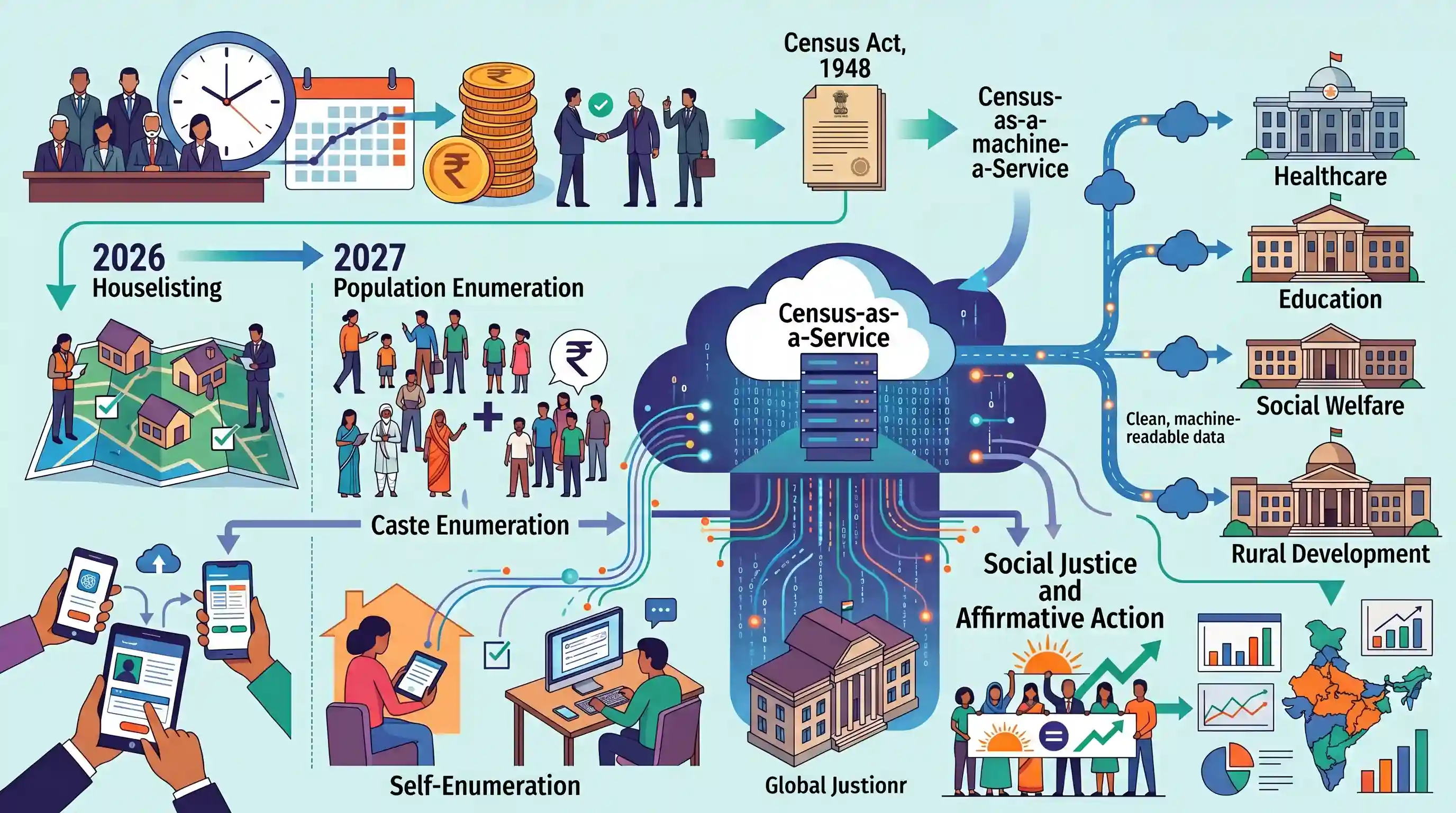
The 2027 Census represents a landmark shift in India's demographic data collection by digitizing the process, introducing a 'Census-as-a-Service' model, and incorporating caste enumeration. For UPSC aspirants, this touches upon governance (e-governance models and digital service delivery), social justice (caste data for affirmative action), and the crucial role of demographic data in evidence-based policy formulation.
Summary
The Union Cabinet has approved a budget of ₹11,718 crore for Census 2027, which will be India's first digital census and the first in independent India to enumerate caste. Conducted under the Census Act, 1948, the exercise will roll out in two phases: houselisting in 2026 and population enumeration in 2027. A key technological innovation is the 'Census-as-a-Service' (CaaS) model, aiming to provide clean, machine-readable demographic data to various government ministries via APIs. Data collection will leverage mobile apps and a self-enumeration option, reflecting a massive shift towards e-governance in population scale data administration.
Key Points
- The Union Cabinet approved ₹11,718 crore for Census 2027, marking the first digital census in independent India.
- The exercise will involve a 'Census-as-a-Service' (CaaS) model, providing machine-readable demographic data to various ministries for better policymaking.
- Data collection will occur via the dedicated Census Management and Monitoring System (CMMS) and mobile applications, with an option for citizen self-enumeration.
- It will be the first Census since independence to include caste enumeration, providing crucial data for affirmative action and social justice policies.
- The Census will be conducted in two phases: Houselisting and Housing Census from April to September 2026, and Population Enumeration in February 2027.
Important Terms
Census Act, 1948

The 1948 legislation providing the legal framework for India's decennial census. It mandates truthful responses, ensures data confidentiality, and empowers the government to appoint census officers.
UPSC context
GS Paper II (Polity & Governance). Tests understanding of the statutory basis for demographic data collection.
Census Rules, 1990
Rules framed under the 1948 Act to manage administrative logistics. Recent amendments allow for digital data collection and self-enumeration, reflecting the shift toward electronic governance.
UPSC context
GS Paper II. Focuses on delegated legislation and procedural updates for modernizing government data exercises.
National Population Register (NPR)
A comprehensive database of "usual residents" in India, including citizens and non-citizens. It is collected under the Citizenship Act, 1955, and conducted alongside census houselisting.
UPSC context
GS Paper II. Relevant for citizenship, internal security, and administrative data integration.
Union Cabinet
The inner core of the Council of Ministers, led by the Prime Minister. It is the highest decision-making authority responsible for approving major policy and financial outlays.
UPSC context
GS Paper II (Executive). Tests knowledge of the Cabinet's role in policy formulation and fiscal approvals.
Ministry of Home Affairs (MHA)
The nodal central ministry responsible for internal security and administration. It oversees the Office of the Registrar General and Census Commissioner for conducting the decennial census.
UPSC context
GS Paper II (Governance). Important for understanding the institutional framework for vital national exercises.
Census-as-a-Service (CaaS)
A cloud-based delivery model for demographic data, providing machine-readable information to ministries via APIs. It enables data-driven governance and inter-departmental interoperability.
UPSC context
GS Paper II & III (E-Governance/Technology). Tests awareness of digital transformation in administrative data management.
Prelims Trap
Census 2027 data can be accessed by courts as evidence or integrated into the NRC.
Section 15 of the Census Act, 1948 guarantees absolute confidentiality. Census records are legally inadmissible as evidence in any civil or criminal court proceeding.
Static Concepts Connected
What is the constitutional and statutory basis of the Census in India?
- Constitutional backing: Covered under Article 246 and listed as Entry 69 in the Union List (Seventh Schedule) of the Constitution.
- Statutory backing: Governed by the Census Act, 1948, which makes citizen participation mandatory while ensuring absolute data confidentiality.
- Nodal Ministry: Conducted by the Office of the Registrar General and Census Commissioner, under the Ministry of Home Affairs.
How does a regular Census differ from the Socio-Economic Caste Census (SECC)?
- Statutory protection: Census is conducted under the Census Act, 1948 (confidentiality guaranteed). SECC was historically conducted by state governments without this specific statutory backing.
- Data utility: Census provides macro-demographic trends and cannot be used to identify individuals. SECC data is actively used to identify specific household beneficiaries for welfare schemes.
Cross-Topic Patterns
Census + Delimitation + Women's Quota
The 106th Constitutional Amendment (Women's Reservation) relies on the next delimitation exercise, which requires the first census figures published after 2026 to be implemented.
Caste Census + Quota Sub-classification
Enumerating caste directly answers the empirical data demands stemming from the Supreme Court's 2024 verdict permitting state-level sub-classification of SCs/STs for equitable reservation.
CaaS + Digital Public Infrastructure (DPI)
‘Census-as-a-Service’ (CaaS) APIs will integrate clean demographic data directly into India's e-governance stack, expanding the Digital Public Infrastructure (DPI) model for welfare delivery.

The linkage between Census 2027, the post-2026 Delimitation freeze, and the Women's Reservation Act will be a prime 2026 Prelims target.
Linked PYQs · 5
Linked PYQs · 5
- 2024MainsGS2
e-governance is not just about the routine application of digital technology in service delivery process. It is as much about multifarious interactions for ensuring transparency and accountability. In this context evaluate the role of the 'Interactive Service Model' of e-governance.
- 2020MainsGS2
The emergence of Fourth Industrial Revolution (Digital Revolution) has initiated e-Governance as an integral part of government". Discuss.
- 2024MainsGS1
Despite comprehensive policies for equity and social justice, underprivileged sections are not yet getting the full benefits of affirmative action envisaged by the Constitution. Comment.
- 2018MainsGS1
Caste system is assuming new identities and associational forms. Hence, caste system cannot be eradicated in India." Comment.
- 2019PrelimsGS1
Which of the following adopted a law on data protection and privacy for its citizens known as 'General Data Protection Regulation' in April 2016 and started implementation of it from 25th May, 2018?
