Employment Linked Incentive Scheme for Manufacturing Sector
Source:The Hindu ↗
Why It Matters
It highlights the government's direct intervention in the labour market through fiscal incentives to address India's unemployment challenge. This is crucial for GS-3 (Employment and Economic Growth) and GS-2 (Welfare Schemes) as it illustrates the ongoing debate over supply-side vs. demand-side solutions for leveraging India's demographic dividend.
Summary
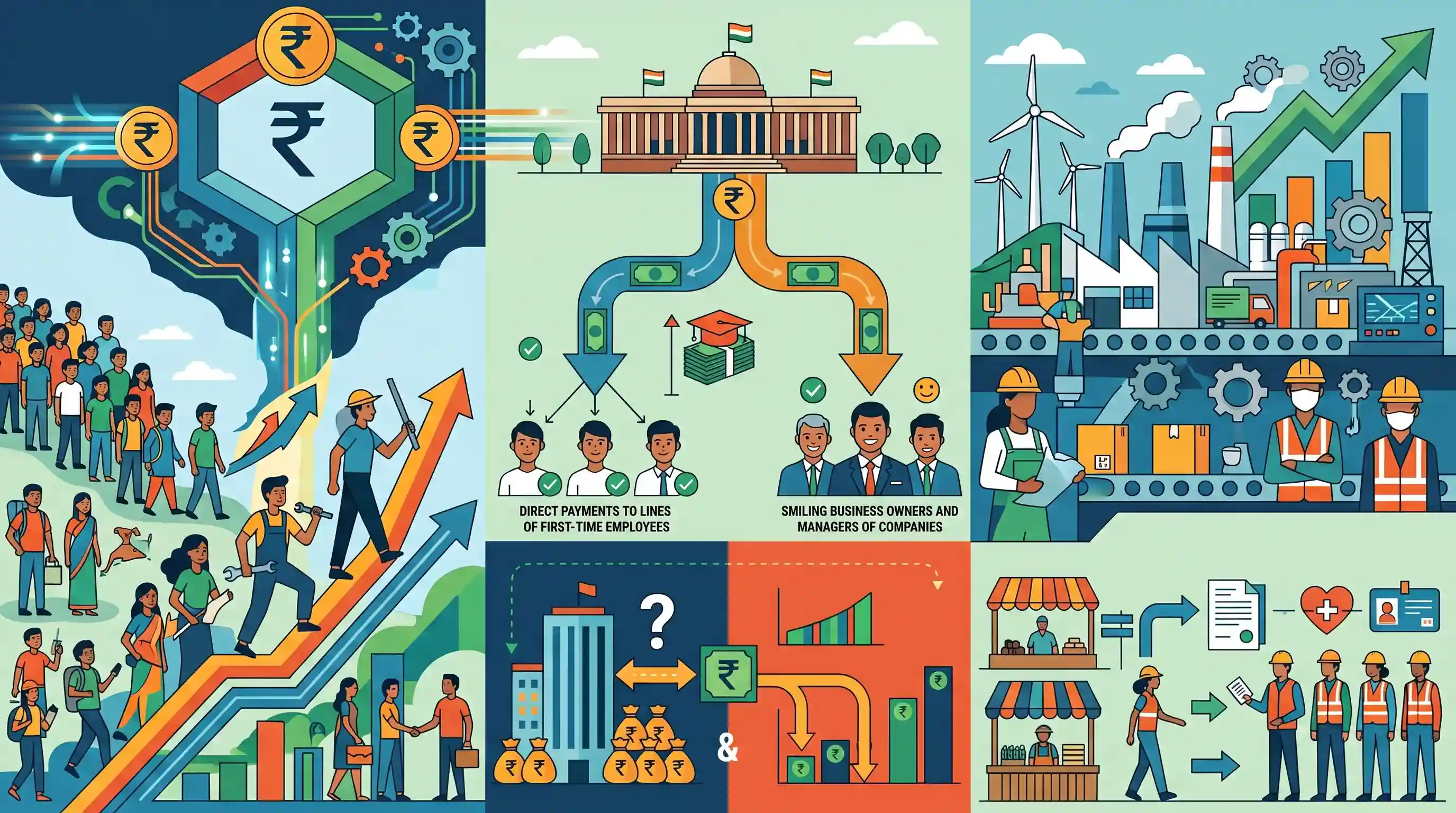
The Union Cabinet has approved the ₹99,446 crore Employment-Linked Incentive (ELI) scheme to generate 3.5 crore jobs over two years, with a major focus on the manufacturing sector. As part of a broader ₹2 lakh crore employment package announced in the Union Budget 2024-25, the ELI scheme provides direct wage incentives to both first-time employees (earning up to ₹1 lakh per month) and their employers. While the government projects it will support 1.92 crore first-time job seekers and formalise the workforce, critics argue it acts as a subsidy for corporations rather than an organic driver of net job creation.
Key Points
- The Union Cabinet approved the Employment-Linked Incentive (ELI) scheme with a ₹99,446 crore budget, aiming to generate 3.5 crore jobs over two years starting August 1, 2025.
- The scheme targets the formalisation of employment, with a specific focus on the manufacturing sector, aiming to benefit 1.92 crore first-time employees.
- First-time employees earning up to ₹1 lakh per month will receive up to ₹15,000 (equivalent to one month's wage) transferred in two instalments to their bank accounts.
- Employers are incentivized with up to ₹3,000 per month for two years for each additional employee retained for at least six months, with manufacturing incentives extending to four years.
- Trade union CITU criticised the scheme, calling it a mechanism to transfer public funds to employers rather than a viable method for creating net new jobs.
Important Terms
Employment-Linked Incentive (ELI) Scheme

A centrally sponsored scheme providing financial incentives to first-time employees and their employers to boost formal job creation, particularly in the manufacturing sector.
UPSC context
GS Paper 3: Indian Economy (Employment, Growth, and Development). Tests knowledge of specific labor market interventions.
Workforce Formalisation
The process of transitioning economic activities and workers from the unregulated informal sector into the formal sector, ensuring legal contracts and social security benefits.
UPSC context
GS Paper 3: Economy and Issues relating to Planning, Mobilization of Resources, and Growth. Key structural reform objective.
Union Budget 2024-25
The constitutional financial statement for FY 2024-25 which introduced a ₹2 lakh crore 'Prime Minister’s Package' for employment, skilling, and youth opportunities.
UPSC context
GS Paper 3: Government Budgeting. Tests awareness of major policy shifts and fiscal allocations.
Manufacturing Sector
A key economic sector focused on goods production; targeted by the ELI scheme for its high employment elasticity and potential for large-scale formal job generation.
UPSC context
GS Paper 3: Industrial Growth and Policy. Tests understanding of sector-specific growth strategies.
Demographic Dividend
The economic advantage resulting from a country's working-age population being larger than the non-working-age population, provided there is productive employment.
UPSC context
GS Paper 1: Population and Associated Issues; GS Paper 3: Economy. Central theme for employment-related policies.
Centre of Indian Trade Unions (CITU)
A major national trade union in India that criticized the ELI scheme as a corporate subsidy lacking accountability for actual net job creation.
UPSC context
GS Paper 2: Governance/Pressure Groups. Tests understanding of stakeholder perspectives and critiques of government policy.
Prelims Trap
"The ELI scheme provides wage incentives exclusively to the manufacturing sector."
While manufacturing gets an extended 4-year employer incentive, other sectors also qualify for a 2-year incentive. Both employees and employers receive benefits.
Static Concepts Connected
What is Employment Elasticity of Growth?
- Definition: The percentage change in employment associated with a 1 percentage point change in economic growth.
- India's Challenge: It has fallen below 0.1, indicating 'jobless growth' where rising GDP does not proportionately create new jobs.
- Causes: Driven by capital-intensive industrialization, increasing automation, and a structural leap directly to the services sector.
How does the government track formal employment?
- EPFO Payroll Data: Net new subscribers to the Employees' Provident Fund Organization (EPFO) act as a proxy for formalization. This is the baseline ELI uses to verify job creation.
- PLFS: The Periodic Labour Force Survey captures broader employment, unemployment, and workforce participation rates across formal and informal sectors.
Cross-Topic Patterns
PLI + ELI: The Dual Strategy
The capital-intensive Production-Linked Incentive (PLI) scheme boosted output but struggled with job creation. ELI complements it by shifting state subsidies directly toward labour-intensive formalization.
Formalisation via Financial Inclusion
Mandating financial literacy programs and fixed savings deposits for the second wage instalment bridges labour welfare with broader financial deepening goals, linking GS3 Economy with GS2 Social Justice.

Expect a GS3 Mains question analyzing if the ELI scheme can offset the capital-bias of PLI to maximize India's demographic dividend.
Linked PYQs · 5
Linked PYQs · 5
- 2023MainsGS3
Faster economic growth requires increased share of the manufacturing sector in GDP, particularly of MSMEs. Comment on the present policies of the Government in this regard.
- 2014MainsGS3
While we flaunt India's demographic dividend, we ignore the dropping rates of employability. What are we missing while doing so? Where will the jobs that India desperately needs come from? Explain.
- 2022MainsGS3
Economic growth in the recent past has been led by increase in labour productivity." Explain this statement. Suggest the growth pattern that will lead to creation of more jobs without compromising labour productivity.
- 2023MainsGS2
Skill development programmes have succeeded in increasing human resources supply to various sectors. In the context of the statement analyse the linkages between education, skill and employment.
- 2022MainsGS2
Besides the welfare schemes, India needs deft management of inflation and unemployment to serve the poor and the underprivileged sections of the society. Discuss.
