Union Cabinet approves terms of reference for 8th Pay Commission
Source:The Hindu ↗
Why It Matters
Central Pay Commissions (CPCs) periodically restructure the salaries and pensions of millions of government employees. Their recommendations lead to a massive surge in the government's revenue expenditure, often straining fiscal deficit targets and reducing fiscal space for capital expenditure. Understanding CPCs is vital for UPSC topics related to public expenditure management, revenue vs. capital budgeting, and broader macroeconomic stability.
Summary
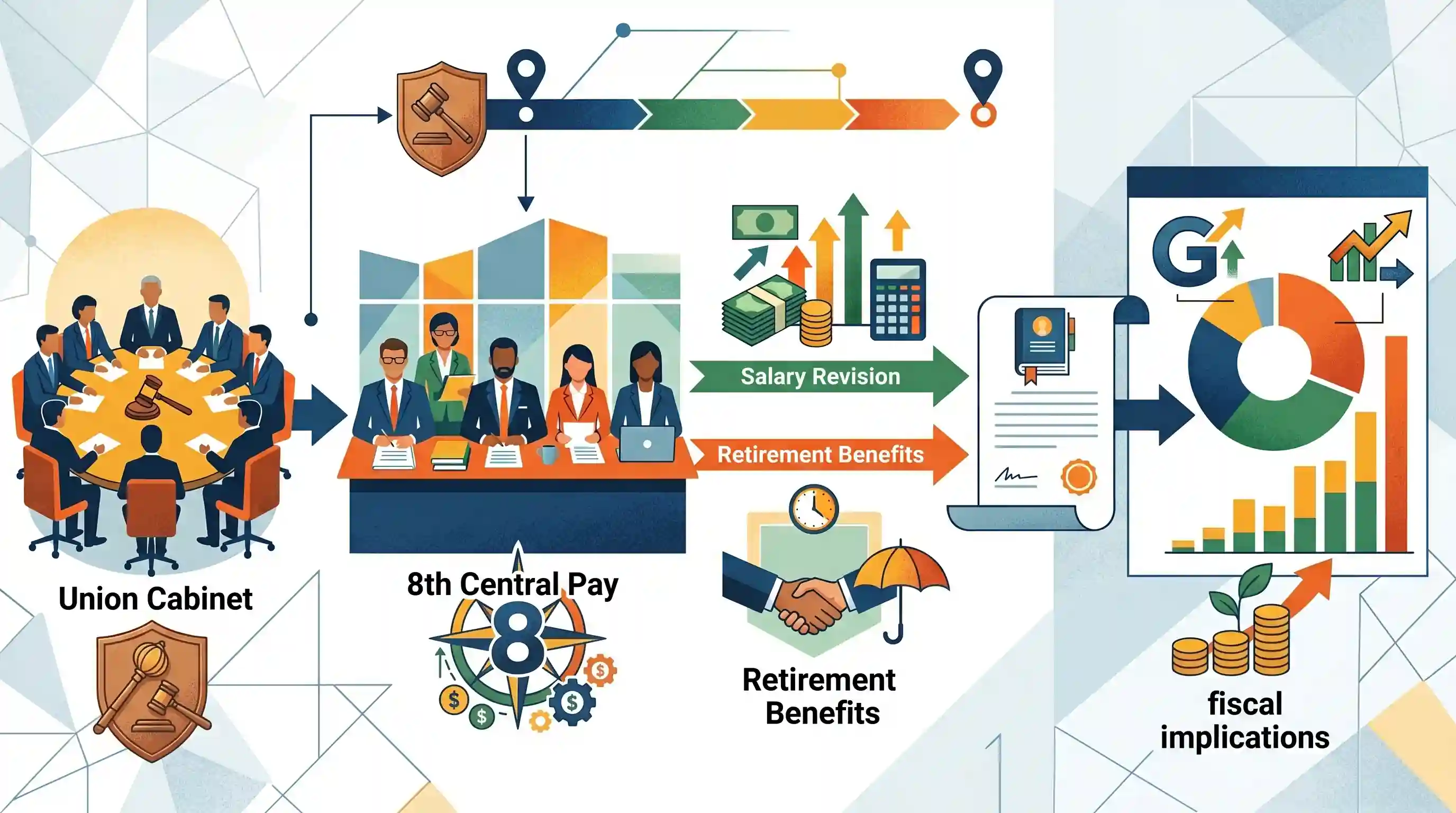
The Union Cabinet has approved the Terms of Reference for the 8th Central Pay Commission, which was constituted in January 2025. Tasked with recommending revisions to the salary structure and retirement benefits of central government employees, the commission is mandated to submit its final report within 18 months. The eventual recommendations will have significant fiscal implications, as they directly impact the government's revenue expenditure.
Key Points
- The Union Cabinet has approved the Terms of Reference (ToR) for the 8th Central Pay Commission (CPC).
- The 8th CPC was formed in January 2025 to review the pay structure, salaries, and retirement benefits of central government employees.
- The Commission has an 18-month deadline from its constitution date to submit its recommendations.
- Pay Commission payouts constitute a major component of the government's revenue budget and have significant implications for fiscal deficit and public expenditure management.
Important Terms
8th Central Pay Commission (CPC)

A periodic body established to review and recommend changes to the salary, allowances, and pension structures for central government employees and retirees, ensuring compensation remains relevant to economic conditions.
UPSC context
GS Paper 3: Indian Economy and Fiscal Policy; tests understanding of public expenditure management and its impact on the fiscal deficit.
Union Cabinet
The highest decision-making executive body in India, consisting of the Prime Minister and senior ministers. It is the core of the Council of Ministers, with constitutional status under Article 352.
UPSC context
GS Paper 2: Polity and Governance; tests knowledge of executive structures, collective responsibility, and constitutional amendments (44th Amendment).
Terms of Reference (ToR)
A formal document defining the scope, mandate, and specific objectives of a commission or committee, outlining the parameters it must consider—such as fiscal prudence and economic conditions.
UPSC context
GS Paper 2: Governance; tests understanding of the administrative process behind government commissions and the boundaries of their advisory roles.
Revenue Expenditure
Government spending on day-to-day operations that does not create assets, including salaries, pensions, and interest payments. Pay commission recommendations significantly increase this component of the budget.
UPSC context
GS Paper 3: Government Budgeting; tests ability to distinguish between revenue and capital expenditure and their respective fiscal implications.
Fiscal Prudence
The policy of managing public finances responsibly by balancing spending with revenue to ensure long-term sustainability, often guided by the Fiscal Responsibility and Budget Management (FRBM) Act.
UPSC context
GS Paper 3: Fiscal Policy; tests understanding of macroeconomic stability and the trade-off between social welfare spending and deficit targets.
Prelims Trap
"The Central Pay Commission is a statutory body constituted under the Constitution of India."
The CPC is an ad-hoc administrative body formed by executive resolution, not a constitutional or statutory body, unlike the Finance Commission (Article 280).
Static Concepts Connected
Why are salaries and pensions classified as Revenue Expenditure?
- Asset Creation: They do not result in the creation of any physical or financial assets for the government.
- Liability Reduction: They do not lead to a reduction in the liabilities of the government.
- Recurring Nature: They are recurring, routine operational costs required to run day-to-day government administration.
How does a Pay Commission differ from the Finance Commission?
- Constitutional Status: The Finance Commission is a constitutional body (Article 280); the CPC is an ad-hoc executive body.
- Mandate: FC recommends tax devolution between Centre and States; CPC revises salaries and pensions of central employees.
Cross-Topic Patterns
CPC hikes and FRBM fiscal targets
Large pay commission payouts spike committed revenue expenditure, often forcing governments to compress capital expenditure to meet Fiscal Responsibility and Budget Management (FRBM) deficit targets.
Domino effect on State exchequers
Central Pay Commission recommendations often trigger similar demands from state government employees, straining state fiscal deficits and impacting their borrowing limits under Article 293.

2026 Prelims may feature a multi-statement question contrasting the CPC's ad-hoc executive nature with constitutional bodies like the FC.
Linked PYQs · 3
Linked PYQs · 3
- 2019MainsGS3
The public expenditure management is a challenge to the Government of India in the context of budget making during the post-liberalization period. Clarify it.
- 2021MainsGS3
Distinguish between Capital Budget and Revenue Budget. Explain the components of both these Budgets.
- 2021MainsGS2
How have the recommendations of the 14th Finance Commission of India enabled the States to improve their fiscal position?
