Constitutional procedure and linguistic reorganization of states
Source:Indian Express ↗
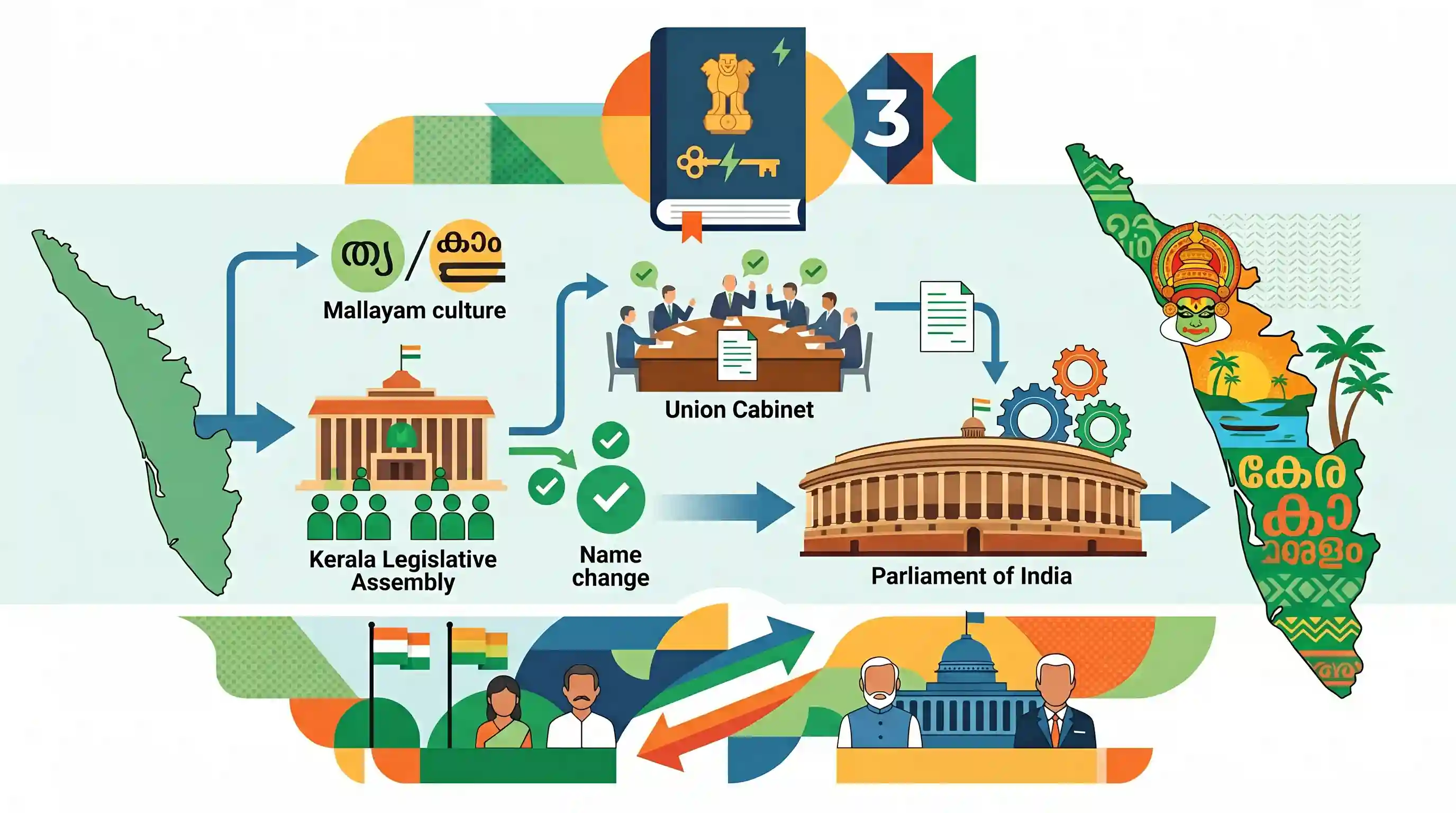
Why It Matters
Understanding the constitutional procedure for renaming a state (Article 3) and the historical context of linguistic state reorganization is highly relevant for UPSC Polity and Post-Independence Consolidation sections.
Summary
The Union Cabinet has given its nod to a 2026 Constitutional Bill that will officially rename Kerala as 'Keralam'. This decision honors the state's linguistic and cultural identity, as 'Keralam' is the traditional name used in the Malayalam language. The move follows unanimous resolutions by the Kerala Legislative Assembly requesting the Centre to change the state's name in the First Schedule of the Constitution. The renaming process highlights the application of Article 3 of the Constitution, which vests the power to alter state names with the Parliament, showcasing the mechanisms of India's federal structure and the ongoing cultural consolidation of states.
Key Points
- The Union Cabinet has approved a Constitutional Bill to officially rename the state of Kerala to 'Keralam'.
- The demand stems from linguistic and historical roots; 'Keralam' is the native Malayalam name for the state, reflecting its cultural and linguistic heritage.
- The Kerala Legislative Assembly had previously passed unanimous resolutions urging the Central Government to amend the First Schedule of the Constitution to effect this change.
- Under Article 3 of the Indian Constitution, the power to alter the name of any state lies with the Parliament, requiring a bill introduced on the recommendation of the President.
Important Terms
Article 3 of the Indian Constitution

Constitutional provision empowering Parliament to form new states, alter areas, boundaries, or names of existing states by law. It reflects India's quasi-federal structure with a unitary tilt.
UPSC context
GS Paper II: Indian Constitution and Federalism. Tests understanding of the Union's power to reorganize states and the procedure involved.
Kerala (Alteration of Name) Bill, 2026
Legislation proposed in 2026 to officially rename Kerala to 'Keralam'. It involves amending the First Schedule of the Constitution to reflect the state's traditional Malayalam identity.
UPSC context
Current Affairs/GS II. Relevant for state reorganization and cultural consolidation within the constitutional framework.
States Reorganisation Act, 1956
A landmark law that reorganized India's state boundaries along linguistic lines. It unified Malayalam-speaking regions to form the state of Kerala on November 1, 1956.
UPSC context
GS I: Post-independence consolidation. Tests knowledge of the evolution of the Indian map and linguistic reorganization.
Union Cabinet
The executive body chaired by the Prime Minister that approves major policy decisions. In this context, it cleared the proposal to rename Kerala before its introduction in Parliament.
UPSC context
GS II: Executive role in legislation. Tests understanding of the initiation of constitutional processes by the central government.
Kerala Legislative Assembly
The unicameral state legislature that unanimously passed resolutions in 2023 and 2024 requesting the name change, representing the linguistic and cultural aspirations of the people of Kerala.
UPSC context
GS II: Federalism and Center-State relations. Highlights the role of state-level initiatives in the federal reorganization process.
Parliament of India
The supreme legislative body of India. Under Article 3, it holds the exclusive power to rename states by passing a bill with a simple majority.
UPSC context
GS II: Parliament and State Legislatures. Tests understanding of legislative procedures and the distribution of power between Union and States.
First Schedule of the Constitution
The part of the Indian Constitution that lists all States and Union Territories. Renaming a state requires an amendment to this Schedule through the Article 3 process.
UPSC context
GS II: Constitution. Tests technical knowledge of where state names are officially recorded and the effect of reorganization laws.
Prelims Trap
"Renaming a state requires a Constitutional Amendment Bill under Article 368 to amend the First Schedule."
Laws under Article 3 altering state names pass by simple majority. Article 4 explicitly exempts them from being considered constitutional amendments under Article 368.
Static Concepts Connected
What is the constitutional procedure under Article 3 to alter a State's name?
- Prior Recommendation: A Bill proposing a name change can only be introduced in Parliament with the prior recommendation of the President.
- State Consultation: The President must refer the Bill to the concerned state legislature for its views within a specified time. These views are non-binding.
- Simple Majority: Parliament passes the Bill by simple majority, altering the First Schedule. Article 4 exempts this from Article 368.
How does internal reorganization differ from ceding territory to a foreign state?
- Internal Reorganization: Internal reorganization (renaming, altering boundaries) falls under Article 3 and requires only a simple majority in Parliament.
- Ceding Territory: As established in the Berubari Union case (1960), ceding Indian territory to a foreign state requires a constitutional amendment under Article 368.
Cross-Topic Patterns
Linguistic identity and the 1956 Reorganization
The shift to Malayalam-based 'Keralam' ties back to the Fazl Ali Commission's linguistic reorganization. UPSC frequently links modern identity demands to post-independence state consolidation.
First Schedule vs Article 368 amendments
Questions on territorial adjustments (like ceding land to Bangladesh via 100th CAA) versus internal reorganization (Article 3) are perennial favorites for tricky Prelims statements.

Expect a tricky Prelims question contrasting the non-binding nature of state resolutions under Article 3 with Article 368 amendments.
Linked PYQs · 3
Linked PYQs · 3
- 2022MainsGS1
The political and administrative reorganization of states and territories has been a continuous ongoing process since the mid-nineteenth century. Discuss with examples.
- 2025MainsGS2
Indian Constitution has conferred the amending power on the ordinary legislative institutions with a few procedural hurdles. In view of this statement, examine the procedural and substantive limitations on the amending power of the Parliament to change the Constitution.
- 2019MainsGS2
“Parliament's power to amend the Constitution is a limited power and it cannot be enlarged into absolute power." In the light of this statement explain whether Parliament under Article 368 of the Constitution can destroy the Basic Structure of the Constitution by expanding its amending power?
