National Sports Policy Framework for Global Sporting Excellence
Source:The Hindu ↗
Why It Matters
UPSC frequently examines the transition of India's demographic dividend into capable human resources. The shift from post-facto rewards for athletes to structural, state-sponsored ecosystem building aligns with historical questions (like the 2014 Mains GS2 question on state talent hunts vs. reward mechanisms) and underscores sports as a tool for national prestige and socio-economic development.
Summary
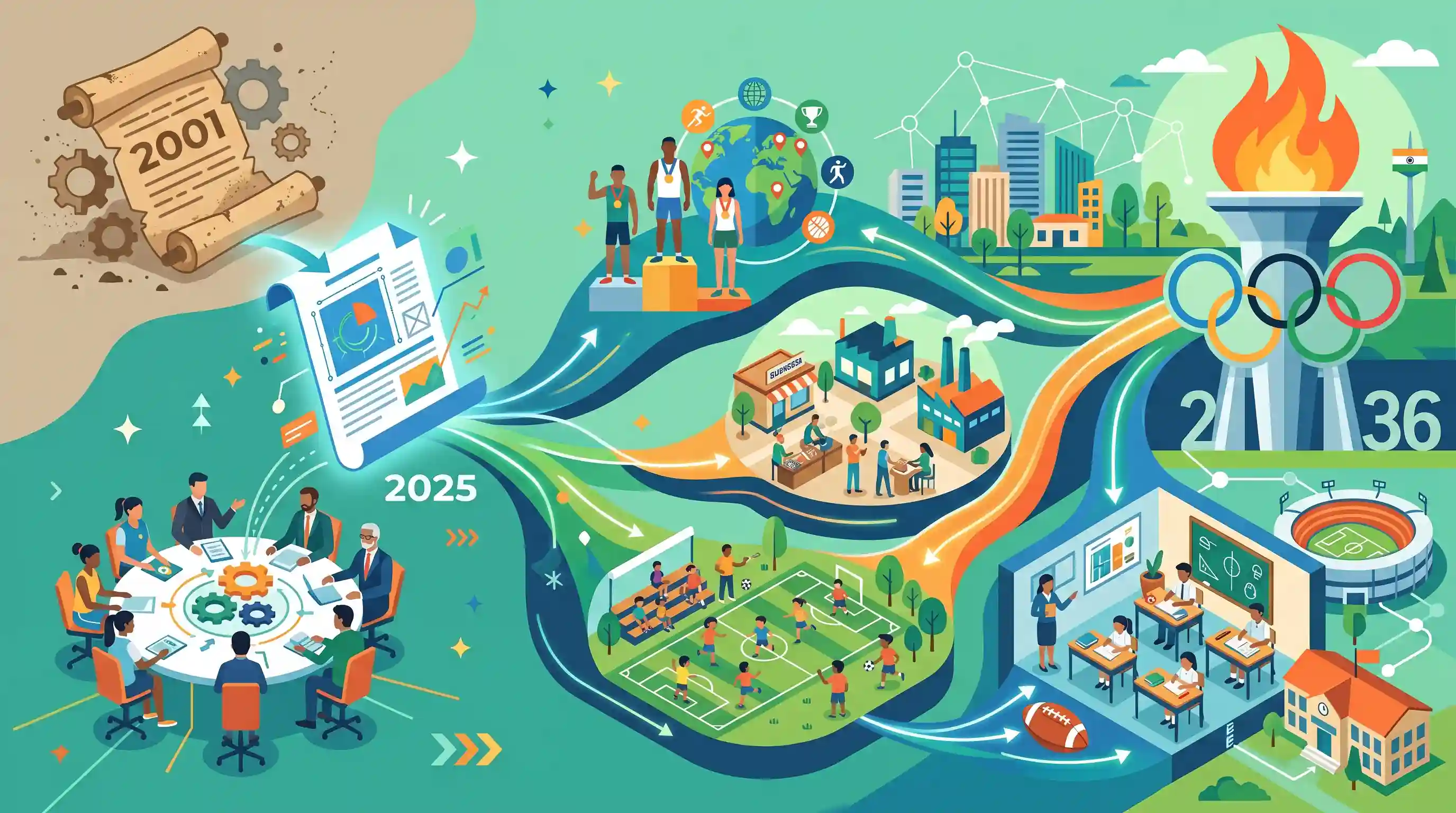
The Union Cabinet has approved the National Sports Policy 2025, replacing the outdated 2001 policy to establish India as a global sporting powerhouse. Spearheaded by extensive multi-stakeholder consultations, the policy rests on five pillars that blend global excellence, socio-economic development, grassroots engagement, and integration with the National Education Policy (NEP) 2020. Crucially, the policy provides a strategic roadmap intended to strengthen India's ambitions to host the 2036 Olympic Games.
Key Points
- The Union Cabinet approved the National Sports Policy 2025 to supersede the 2001 policy, aiming to make India a global sporting powerhouse.
- The policy targets hosting the 2036 Olympic Games by building necessary infrastructure and a strong sporting ecosystem.
- It is built on five pillars: excellence on the global stage, sports for economic development, sports for social development, sports as a people's movement, and integration with education.
- The policy tightly integrates sports with the National Education Policy (NEP) 2020 to ensure sports are a foundational element of human resource development.
Important Terms
National Sports Policy (NSP) 2025

A comprehensive framework replacing the 2001 policy, aiming to make India a global sporting powerhouse by 2047 through grassroots talent, economic growth, and 2036 Olympic hosting ambitions.
UPSC context
GS Paper II (Govt Policies); crucial for questions on sports governance, human resource development, and India's global soft power aspirations.
National Education Policy (NEP) 2020
A transformative policy that integrates sports into school curricula as a core subject rather than an extra-curricular activity, emphasizing physical literacy and holistic development.
UPSC context
GS Paper II (Education/Human Resources); tested under social sector initiatives and holistic student development frameworks.
National Sports Federations (NSFs)
Autonomous voluntary bodies recognized by the Ministry of Youth Affairs and Sports to manage specific sports disciplines, conduct national competitions, and select international teams.
UPSC context
GS Paper II (Governance); relevant for issues regarding transparency, accountability, and professionalization of sports administration in India.
NITI Aayog
The premier policy think tank of the Government of India, which provides strategic and technical advice and played a key role in drafting the NSP 2025.
UPSC context
GS Paper II (Statutory/Regulatory Bodies); central to questions on cooperative federalism and evidence-based policy formulation.
National Sports Development Code of India
A set of guidelines introduced in 2011 to ensure good governance, transparency, and tenure limits within National Sports Federations, recently modernized under NSP 2025.
UPSC context
GS Paper II (Governance); key for topics involving administrative reforms and judicial interventions in Indian sports.
Prelims Trap
Sports is a subject under the Concurrent List of the Seventh Schedule.
Sports actually falls under the State List (Entry 33). The Union drafts national policies and funds elite training, but grassroots implementation relies heavily on State governments.
Static Concepts Connected
What is the Constitutional status of Sports in India?
- State List: Sports, entertainments, and amusements are placed under Entry 33 of the State List (List II) in the Seventh Schedule.
- Concurrent Overlap: Education is a Concurrent subject (Entry 25). Integrating sports with NEP 2020 leverages this overlap to mainstream physical education nationally.
- Union Role: While a State subject, the Union Ministry of Youth Affairs and Sports frames overarching national policies and coordinates international representation (like the Olympics).
How does NEP 2020 integrate sports into mainstream education?
- No Hard Separation: NEP mandates that there will be no hard separations between curricular, extra-curricular, or co-curricular areas in schools.
- Holistic Evaluation: Schools must adopt multidimensional holistic report cards that evaluate physical education and sports on par with traditional academic achievements.
- Pedagogical Approach: Sports-integrated learning is adopted as a cross-curricular pedagogical approach to help students develop collaboration, self-direction, and teamwork.
Cross-Topic Patterns
Sports Diplomacy & Soft Power
Bidding for the 2036 Olympics aligns with India's soft power projection, mirroring how Yoga and cultural diplomacy are used to elevate global diplomatic capital.
Sports Economy & Manufacturing
Treating sports as an economic tool links to GS-3 infrastructure, highlighting sports tourism, startup ecosystems, and traditional manufacturing clusters like Meerut and Jalandhar.

Expect a GS-2 Mains question linking NEP 2020's 'no hard separation' mandate with the NSP 2025's vision for HRD and 2036 Olympic readiness.
Linked PYQs · 4
Linked PYQs · 4
- 2014MainsGS2
An athlete participates in Olympics for personal triumph and nation's glory; victors are showered with cash incentives by various agencies, on their return. Discuss the merit of state sponsored talent hunt and its cultivation as against the rationale of a reward mechanism as encouragement.
- 2021PrelimsGS1
Consider the following statements in respect of the 32nd Summer Olympics : 1. The official motto for this Olympics is 'A New World'. 2. Sport Climbing, Surfing, Skateboarding, Karate and Baseball are included in this Olympics. Which of the above statements is/are correct?
- 2023MainsGS2
The crucial aspect of development process has been the inadequate attention paid to Human Resource Development in India. Suggest measures that can address this inadequacy.
- 2023PrelimsGS1
Consider the following statements in respect of the 44th Chess Olympiad, 2022: 1. It was the first time that Chess Olympiad was held in India. 2. The official mascot was named 'Thambi'. 3. The trophy for the winning team in the open section is the Vera Menchik Cup. 4. The trophy for the winning team in the women's section is the Hamilton-Russell Cup. How many of the above statements are correct?
