Employment Linked Incentive Scheme for Formal Job Creation
Source:The Hindu ↗
Why It Matters
Provides direct examples of government interventions to promote formal employment and boost job creation, relevant for questions addressing unemployment, demographic dividend, and economic formalization.
Summary
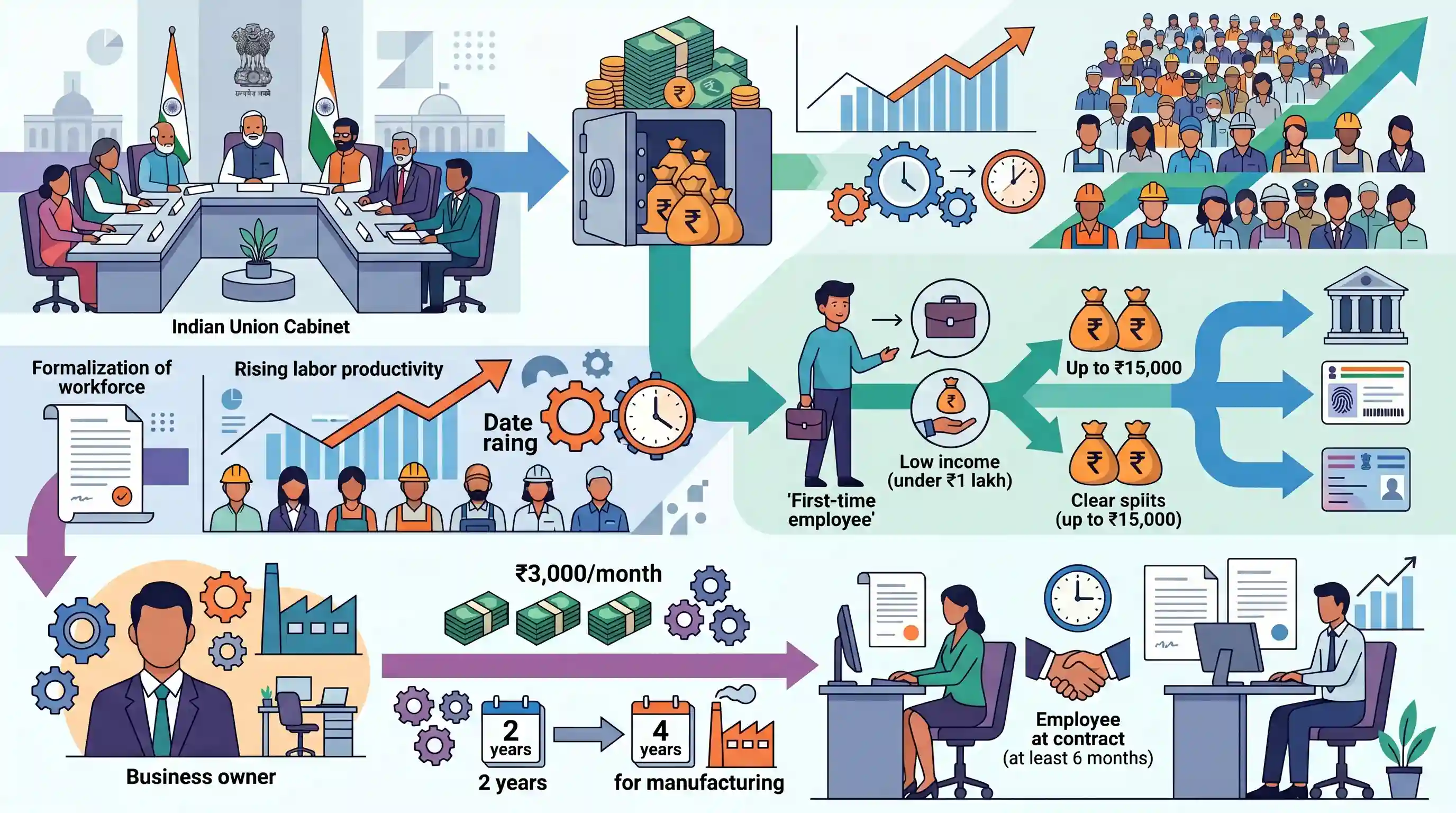
The Union Cabinet has approved the Employment Linked Incentive (ELI) Scheme with a budget of ₹99.45 crore, aimed at creating 3.5 crore jobs between August 2025 and July 2027. The scheme incentivizes formal employment by offering benefits to both first-time employees (earning less than ₹1 lakh) and their employers. Eligible employees will receive up to ₹15,000 in two instalments via Direct Benefit Transfer (DBT) in Aadhaar and PAN linked accounts. Simultaneously, employers will receive ₹3,000 per month per new employee for up to two years (four years in the manufacturing sector), provided they retain the employee for at least six months. The scheme, highlighted by EPFO officials, is designed to enhance workforce formalization and labor productivity.
Key Points
- The Union Cabinet has approved the Employment Linked Incentive (ELI) Scheme with a budget of ₹99.45 crore for August 2025 to July 2027.
- The scheme aims to generate 3.5 crore jobs and promote formal employment across sectors.
- Employees with a wage below ₹1 lakh, who have not been continuously employed with an EPFO-registered establishment in the past three years, are eligible.
- Eligible employees receive up to ₹15,000 in two instalments via Direct Benefit Transfer (DBT) into Aadhaar/PAN-linked bank accounts.
- Employers receive ₹3,000 per month per newly enrolled employee for two years, and for up to four years in the manufacturing sector.
- Employers must retain eligible employees for a minimum of six months to receive the incentive.
Important Terms
Employment Linked Incentive (ELI) Scheme

A Central Sector Scheme providing wage incentives to first-time employees and subsidies to employers to promote workforce formalization, job creation, and manufacturing growth.
UPSC context
GS Paper 3: Employment and Economy. Important for workforce formalization and demographic dividend strategies.
Employees' Provident Fund Organisation (EPFO)
A statutory body under the Ministry of Labour & Employment that manages mandatory retirement savings and social security for India's formal sector employees.
UPSC context
GS Paper 3: Labour Policy. Relevant for social security frameworks and tracking formal employment data.
Direct Benefit Transfer (DBT)
A governance mechanism transferring subsidies and welfare benefits directly into beneficiaries' Aadhaar-linked bank accounts to minimize leakages and eliminate intermediaries.
UPSC context
GS Paper 2: E-governance. A core pillar of public service delivery and financial inclusion.
Union Cabinet
The supreme decision-making body of the executive, comprising senior ministers chaired by the Prime Minister, responsible for formulating national policies and major administrative decisions.
UPSC context
GS Paper 2: Indian Polity. Key to understanding executive functions and the principle of collective responsibility.
Prelims Trap
The ELI scheme provides financial incentives exclusively to employers to subsidise their hiring costs.
The ELI is a dual-benefit scheme. First-time employees directly receive up to ₹15,000 via DBT, alongside the monthly subsidy paid to employers.
Static Concepts Connected
How does PLI differ from ELI in India's economic policy?
- PLI (Production): Incentivizes companies based on incremental sales/production to boost manufacturing scale and substitute imports.
- ELI (Employment): Directly subsidizes wage costs to promote job creation and workforce formalisation, benefiting both the employer and the employee.
How is formal employment defined and tracked in India?
- Social Security: Access to social security benefits (EPFO/ESIC) is the primary definitional marker of a formal worker in India.
- Payroll Tracking: The EPFO net payroll data tracks new subscribers, exits, and re-joiners to estimate formal job creation monthly.
- PLFS Data: The Periodic Labour Force Survey tracks overall employment, differentiating formal/informal status based on enterprise type and contract terms.
Cross-Topic Patterns
ELI complementing PLI in manufacturing
While PLI boosts capital-intensive production, the ELI’s extended 4-year incentive for the manufacturing sector strategically offsets capital bias by directly subsidizing labour costs.
Formalisation via social security nets
Linking employment incentives to EPFO registrations pushes enterprises toward formalization, aligning with the broader agenda of the new Labour Codes to expand the social security net.

UPSC 2026 will likely test the distinction between ELI (labour subsidy) and PLI (production subsidy) in a comparative prelims question.
Linked PYQs · 4
Linked PYQs · 4
- 2014MainsGS3
While we flaunt India's demographic dividend, we ignore the dropping rates of employability. What are we missing while doing so? Where will the jobs that India desperately needs come from? Explain.
- 2022MainsGS3
Economic growth in the recent past has been led by increase in labour productivity." Explain this statement. Suggest the growth pattern that will lead to creation of more jobs without compromising labour productivity.
- 2021PrelimsGS1
With reference to casual workers employed in India, consider the following statements : 1. All casual workers are entitled for Employees Provident Fund coverage. 2. All casual workers are entitled for regular working hours and overtime payment. 3. The government can by a notification specify that an establishment or industry shall pay wages only through its bank account. Which of the above statements are correct?
- 2022MainsGS2
Besides the welfare schemes, India needs deft management of inflation and unemployment to serve the poor and the underprivileged sections of the society. Discuss.
