VGF scheme for large scale energy storage systems in India
Source:The Hindu ↗
Why It Matters
Energy storage is a vital missing link in India's green energy transition. The VGF scheme provides crucial policy and financial insights into how India intends to overcome grid integration challenges for renewables, making it highly relevant for GS3 questions on energy infrastructure and climate targets.
Summary
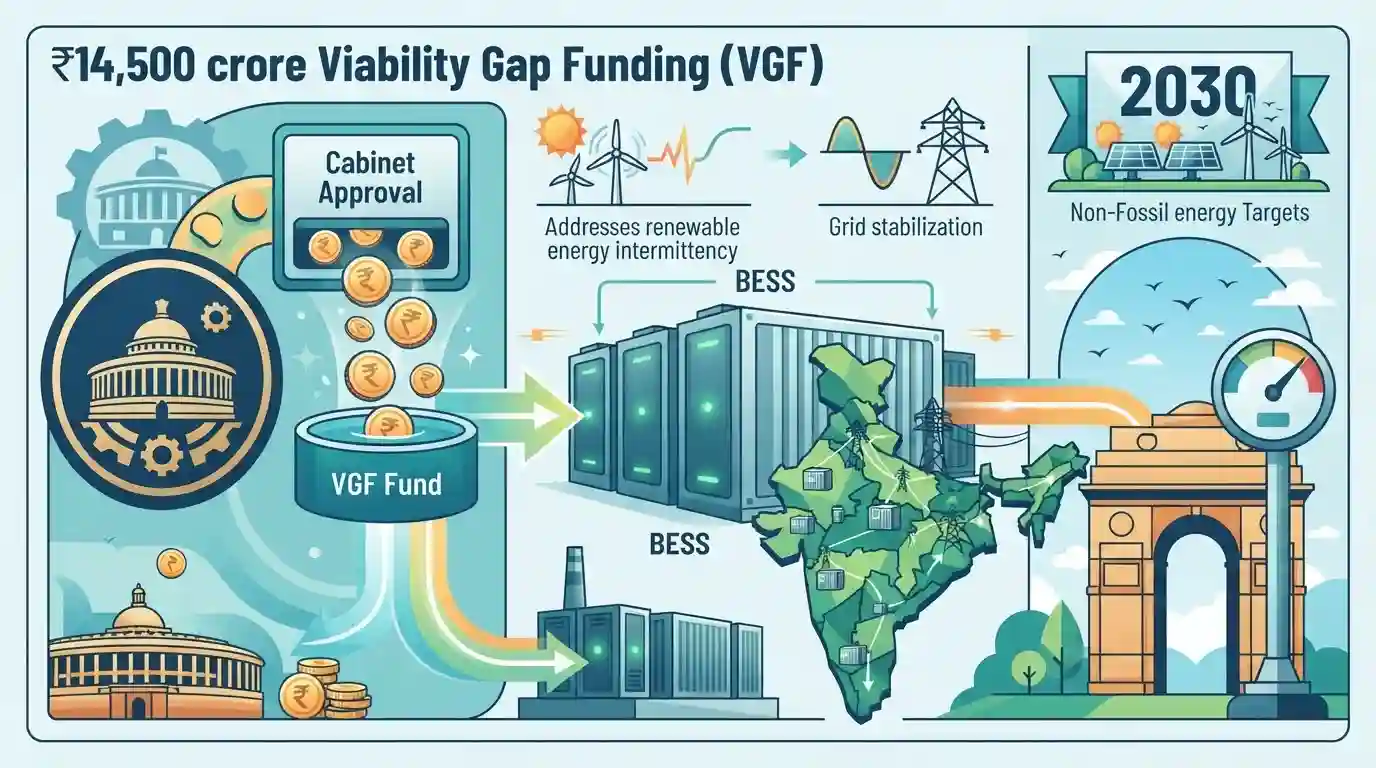
The Union Cabinet approved a ₹14,500 crore Viability Gap Funding (VGF) scheme aimed at establishing large-scale battery energy storage systems across India. This financial mechanism is designed to attract private investment, address renewable energy intermittency, enhance grid stability, and support India's 2030 non-fossil energy targets.
Key Points
- The Union Cabinet approved a ₹14,500-crore Viability Gap Funding (VGF) scheme for developing large-scale battery energy storage systems (BESS) in India.
- The initiative aims to address the intermittent nature of renewable energy sources like solar and wind, ensuring grid stability and reliable power supply.
- VGF support reduces the capital cost barrier for private developers, promoting private sector participation in critical green energy infrastructure.
- Supports India's broader climate commitments and target of achieving 500 GW of non-fossil fuel capacity by 2030.
Important Terms
Viability Gap Funding scheme for energy storage

A financial support mechanism provided by the government to make infrastructure projects commercially viable by bridging the gap between project costs and expected revenue returns.
UPSC context
UPSC GS Paper III (Infrastructure: Energy & Government Policies): Tests understanding of financing models for renewable energy integration and public-private partnerships.
Union Cabinet
The supreme executive body of the Union Government, headed by the Prime Minister, responsible for executive administration and major policy decisions.
UPSC context
UPSC GS Paper II (Polity & Governance): Tests knowledge of executive decision-making, cabinet committees, and constitutional governance in India.
Static Concepts Connected
What is Viability Gap Funding (VGF) and how does it operate in Indian infrastructure development?
- Financial Support: Capital Subsidy: A grant provided upfront or during construction to make economically justified but commercially unviable infrastructure projects financially attractive.
- Project Model: PPP Framework: Typically utilized for Public-Private Partnership (PPP) projects where private developers face high capital costs and uncertain revenue streams.
- Funding Limits: Capping: Generally covers up to 20-40% of the total project cost, disbursed in milestones linked to construction progress.
Cross-Topic Patterns
Energy Storage + Critical Mineral Dependencies
Large-scale integration of intermittent renewables via BESS intersects with national security vulnerabilities around critical battery minerals like lithium, cobalt, and nickel supply chains.
Fiscal VGF Schemes + Green Bond Financing
Capital subsidies like VGF for infrastructure link public fiscal policy with private green bond markets and sovereign climate commitments under NDCS.

VGF funding mechanics + renewable intermittency management is high-yield for both Prelims (statement-based) and Mains (GS-3 Energy).
Linked PYQs · 3
Linked PYQs · 3
- 2025MainsGS3
How can India achieve energy independence through clean technology by 2047? How can biotechnology can play a crucial role in this endeavour?
- 2022MainsGS3
Do you think India will meet 50 percent of its energy needs from renewable energy by 2030 ? Justify your answer. How will the shift of subsidies from fossil fuels to renewables help achieve the above objective ? Explain.
- 2020MainsGS3
Describe the benefits of deriving electric energy from sunlight in contrast to the conventional energy generation. What are the initiatives offered by our Government for this purpose?
