Union Budget 2026-27 focus on infrastructure and employment
Source:The Hindu ↗
Why It Matters
The article provides concrete examples of the Union Budget's policy priorities, such as infrastructure expansion, rural employment schemes (VB-GRAM), and tax reforms. It is highly relevant for GS3 (Government Budgeting, Infrastructure, Economy) and GS2 (Functions and responsibilities of the Union and the States, devolution of powers and finances).
Summary
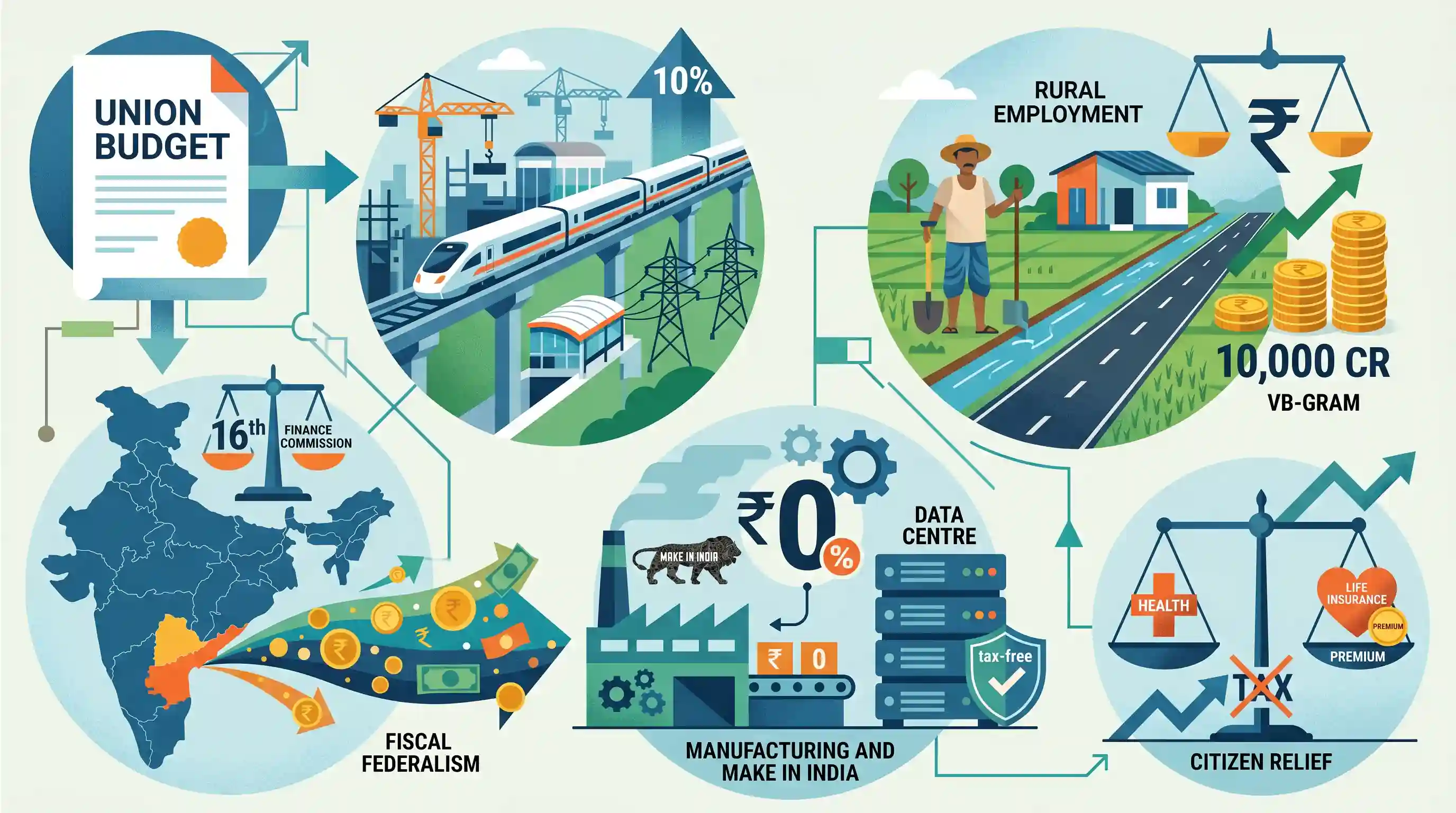
Union Minister of State for Rural Development and Communications Pemmasani Chandrasekhar detailed the growth-oriented measures of the Union Budget 2026-27 during a press conference in Visakhapatnam. He highlighted significant citizen relief, such as the elimination of taxes on health and life insurance premiums. The Budget prioritizes infrastructure and employment, featuring a 10% increase in railway allocations for high-speed corridors and a ₹10,000 crore fund for the VB-GRAM rural employment mission. Additionally, it incentivizes domestic manufacturing and tech sectors, offering tax holidays for data centres. Chandrasekhar also emphasized efforts to secure a greater devolution of central funds for Andhra Pradesh via the 16th Finance Commission.
Key Points
- The Union Budget 2026-27 eliminates tax on health and life insurance premiums and reduces duties on several goods.
- A significant focus is placed on infrastructure, with a 10% hike in the railway budget and the introduction of seven high-speed railway corridors.
- Rural employment is targeted through a ₹10,000 crore allocation to the Viksit Bharat-Guarantee for Rozgar and Ajeevika Mission (Gramin) (VB–GRAM).
- The Budget offers tax holidays for data centres and emphasizes domestic manufacturing, including mobile phone components.
- Efforts are underway to ensure Andhra Pradesh receives a higher share of central funds through the 16th Finance Commission.
Important Terms
Union Budget 2026-27

The annual financial statement of India presented on February 1, 2026, targeting a 4.3% fiscal deficit and prioritizing infrastructure (₹12.2 lakh crore capex) and employment to achieve a 'Viksit Bharat' by 2047.
UPSC context
GS Paper III (Economy/Budgeting); tests understanding of fiscal policy, resource allocation, and national developmental goals.
VB-GRAM (Viksit Bharat-Guarantee for Rozgar and Ajeevika Mission - Gramin)
A flagship rural employment mission enacted in 2025 to succeed MGNREGA. It provides a statutory guarantee of 125 workdays of unskilled manual labor per rural household, aiming for enhanced livelihood security.
UPSC context
GS Paper II (Social Justice) and GS III (Economy); tests knowledge of welfare schemes and rural development legislation.
16th Finance Commission
A constitutional body (Article 280) chaired by Arvind Panagariya. It recommends the formula for tax devolution between the Union and States and among States for the 2026-2031 period.
UPSC context
GS Paper II (Polity/Federalism); tests understanding of fiscal federalism and constitutional mechanisms for revenue sharing.
Vertical Devolution
The percentage-based sharing of the Union's 'divisible pool' of central tax revenue with state governments. The 16th Finance Commission maintained this vertical share at 41% for 2026-31.
UPSC context
GS Paper II (Polity/Governance); tests knowledge of financial relations between the Centre and States.
Tax Holiday
A temporary government incentive that reduces or waives taxes for businesses to encourage investment in specific sectors, such as the holiday for data centers provided in the 2026-27 Budget.
UPSC context
GS Paper III (Economy/Investment); tests understanding of fiscal tools used to promote industrialization and the 'Make in India' initiative.
Prelims Trap
VB-GRAM provides a statutory guarantee for rural employment, akin to MGNREGA.
MGNREGA is backed by a legal right to work (Act of 2005). VB-GRAM is a mission-mode scheme allocation; assuming it provides a statutory right is a common trap.
Static Concepts Connected
What are the constitutional functions of the Finance Commission under Article 280?
- Vertical Devolution: Determines the distribution of net tax proceeds between the Centre and the States.
- Horizontal Devolution: Decides the allocation principles, weights, and formula for distributing funds among the different States.
- Grants-in-Aid: Recommends the principles governing grants-in-aid to States out of the Consolidated Fund of India (Article 275).
How do tax holidays and capital allocations impact economic growth?
- Tax Holidays: Temporary tax exemptions (e.g., for data centres) incentivize private investment in capital-intensive sunrise sectors by lowering initial setup costs.
- Capital Formation: Investments in physical infrastructure (like high-speed railways) create productive assets, reduce long-term logistics costs, and crowd-in private investments.
- Revenue Foregone: While stimulating growth, these tax incentives count as 'revenue foregone' in the Union Budget, temporarily impacting fiscal deficit targets.
Cross-Topic Patterns
Data Sovereignty & Fiscal Incentives
Tax holidays for data centres link fiscal incentives to India's strategic push for data localization under the DPDP Act and the creation of sovereign AI infrastructure.
16th FC & State Fiscal Federalism
States like Andhra Pradesh advocating for higher devolution highlights the ongoing federalism debate over demographic performance penalties and horizontal distribution formulas in the 16th Finance Commission.

Expect a 2026 Prelims question comparing VB-GRAM's livelihood approach with MGNREGA's statutory guarantee, alongside 16th FC criteria.
Linked PYQs · 5
Linked PYQs · 5
- 2021MainsGS3
Distinguish between Capital Budget and Revenue Budget. Explain the components of both these Budgets.
- 2021MainsGS2
How have the recommendations of the 14th Finance Commission of India enabled the States to improve their fiscal position?
- 2025MainsGS2
Examine the evolving pattern of Centre-State financial relations in the context of planned development in India. How far have the recent reforms impacted the fiscal federalism in India?
- 2022MainsGS3
Economic growth in the recent past has been led by increase in labour productivity." Explain this statement. Suggest the growth pattern that will lead to creation of more jobs without compromising labour productivity.
- 2025MainsGS3
India aims to become a semiconductor manufacturing hub. What are the challenges faced by the semiconductor industry in India? Mention the salient features of the India Semiconductor Mission.
