Department of Space Capital Expenditure and Mission Outlays
Source:The Hindu ↗
Why It Matters
Understanding budget allocations for the Department of Space is crucial for tracking India's evolving priorities in space exploration, such as human spaceflight, deep-space missions, astrophysics research, and the push for a self-sustaining commercial space ecosystem.
Summary
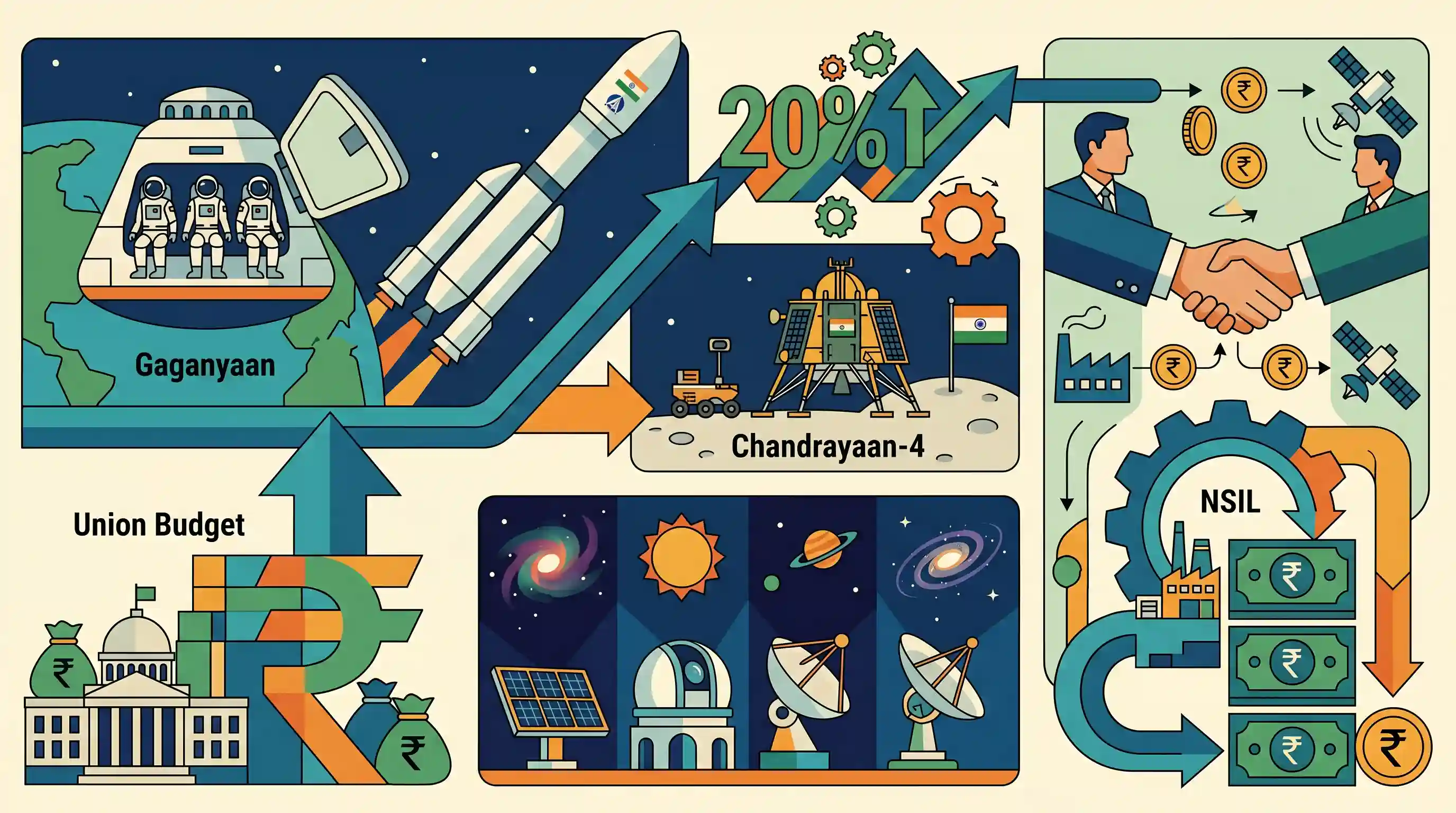
The Union Budget 2026-27 has allocated ₹13,705.63 crore to the Department of Space, highlighting a 20% boost in capital expenditure for major missions like Gaganyaan and Chandrayaan-4. The budget additionally supports space sciences through the development of four new telescope facilities and underscores the commercialization of the space sector, with NSIL expected to generate ₹1,403 crore internally.
Key Points
- The Department of Space was allocated ₹13,705.63 crore for 2026-27, a 10.1% increase over the previous year's revised spending, indicating steady support for space programs.
- Capital expenditure is projected to grow by 20%, focusing on hardware development for upcoming capital-intensive missions like Gaganyaan, Chandrayaan-4, LUPEX, and the Venus orbiter.
- A sum of ₹569.76 crore has been allocated to space sciences, which includes the setup and upgrade of four major telescope facilities: the National Large Solar Telescope, National Large Optical-infrared Telescope, Himalayan Chandra Telescope, and COSMOS-2 Planetarium.
- NSIL's direct budget is a token ₹1 lakh, but its expected internal revenue (IEBR) has grown to ₹1,403 crore, showcasing a push for the commercial arm to become self-sustaining.
- IN-SPACe, the private sector regulator, received a significant allocation of ₹194.57 crore to continue promoting private space ventures.
Important Terms
Gaganyaan

ISRO’s first human spaceflight mission aiming to send a 3-member crew to a 400 km Low Earth Orbit for three days and bring them safely back to Earth.
UPSC context
GS-3: Science and Technology. Tests knowledge of human spaceflight milestones and indigenous technological capabilities for space exploration.
Chandrayaan-4
India’s upcoming lunar mission designed to perform a soft landing and return lunar samples (regolith) from the Moon's southern polar region back to Earth for analysis.
UPSC context
GS-3: Space Exploration. Relevant for India's lunar program progression and sample-return technology critical for future Moon landings.
LUPEX (Lunar Polar Exploration Mission)
A joint mission between ISRO (India) and JAXA (Japan) to explore the Moon’s south pole for water ice, utilizing an Indian lander and a Japanese rover.
UPSC context
GS-3: International Cooperation in Science. Tests understanding of collaborative space exploration and the search for lunar water resources.
Venus Orbiter Mission (VOM)
Also known as Shukrayaan, this planned mission aims to study Venus's atmosphere, surface geology, and its interaction with the Sun to understand planetary evolution.
UPSC context
GS-3: Space Science. Important for planetary science objectives and India’s expanding interplanetary reach beyond Moon and Mars.
IN-SPACe
An autonomous nodal agency that facilitates, promotes, and regulates private sector participation in India’s space activities, acting as an interface between ISRO and non-government entities.
UPSC context
GS-3: Space Reforms. Tests knowledge of institutional changes promoting private sector involvement and the liberalization of the space economy.
NewSpace India Ltd (NSIL)
The commercial arm of ISRO responsible for productionizing launch vehicles, transferring space technologies to industry, and marketing space products on a demand-driven basis.
UPSC context
GS-3: Space Economy. Focuses on commercialization, technology transfer, and the 'demand-driven' shift in India's space strategy.
Department of Space (DoS)
The Indian government department that oversees the country's space program, managing ISRO and governing organizations like IN-SPACe and NSIL through direct reporting to the Prime Minister.
UPSC context
GS-2: Government Policies and GS-3: Budgeting. Relevant for understanding institutional structures and fiscal allocations for strategic sectors.
ISRO (Indian Space Research Organisation)
India’s primary space agency under the Department of Space, dedicated to research, development, and execution of satellite launches and interplanetary scientific exploration missions.
UPSC context
GS-3: Science and Technology. The core agency for India’s technological self-reliance (Atmanirbhar Bharat) in high-technology sectors.
Prelims Trap
NSIL acts as the single-window regulatory agency for non-government private space ventures.
NSIL is the commercial arm of ISRO relying on internal revenue (IEBR). IN-SPACe is the actual regulatory body. Aspirants often swap their mandates or assume they receive massive direct operational subsidies.
Static Concepts Connected
What is the functional difference between NSIL and IN-SPACe?
- NSIL mandate: Acts as the commercial arm of ISRO, focused on tech-transfer, manufacturing launch vehicles through industry, and generating self-sustaining internal revenue (IEBR).
- IN-SPACe mandate: Functions as an independent, single-window nodal agency under the Department of Space to authorize, regulate, and promote non-government private space entities (NGPEs).
Why is Ladakh preferred for major ground-based space observatories?
- Key facilities: Hanle hosts the Himalayan Chandra Telescope, while Merak is planned for the National Large Solar Telescope (NLST).
- Geographic advantage: High altitude, cold desert climate, minimal atmospheric moisture, and virtually zero light pollution provide exceptionally clear and stable skies for astronomical observation.
Cross-Topic Patterns
Space FDI limits + IN-SPACe mandates
IN-SPACe's growing budget allocation strongly complements the recent FEMA amendment allowing up to 100% FDI in the space sector, aiming to build a globally competitive private space ecosystem in India.
Artemis Accords + LUPEX & Chandrayaan-4
Funding for LUPEX (with Japan's JAXA) and Chandrayaan-4 reflects India's strategic positioning within the US-led Artemis Accords framework to counter the China-Russia International Lunar Research Station (ILRS).

A 2026 prelims question contrasting the exact mandates of IN-SPACe and NSIL alongside the recent 100% Space FDI rules is highly likely.
Linked PYQs · 3
Linked PYQs · 3
- 2017MainsGS3
India has achieved remarkable successes in unmanned space missions including the Chandrayaan and Mars Orbitter Mission, but has not ventured into manned space missions. What are the main obstacles to launching a manned space mission, both in terms of technology and logistics? Examine critically.
- 2023MainsGS3
What is the main task of India's third moon mission which could not be achieved in its earlier mission? List the countries that have achieved this task. Introduce the subsystems in the spacecraft launched and explain the role of the Virtual Launch Control Centre' at the Vikram Sarabhai Space Centre which contributed to the successful launch from Sriharikota.
- 2016MainsGS3
Discuss India's achievements in the field of Space Science and Technology. How the application of this technology has helped India in its socio-economic development?
