Space programme capital expenditure hike and planetary missions push
Source:The Hindu ↗
Why It Matters
Space technology is a high-yield theme in UPSC GS3. The transition towards private sector participation (IN-SPACe, NSIL) and the launch of high-value planetary science missions highlights India's evolving space doctrine, aligning with economic growth, self-reliance in launch capability, and deep-tech innovation.
Summary
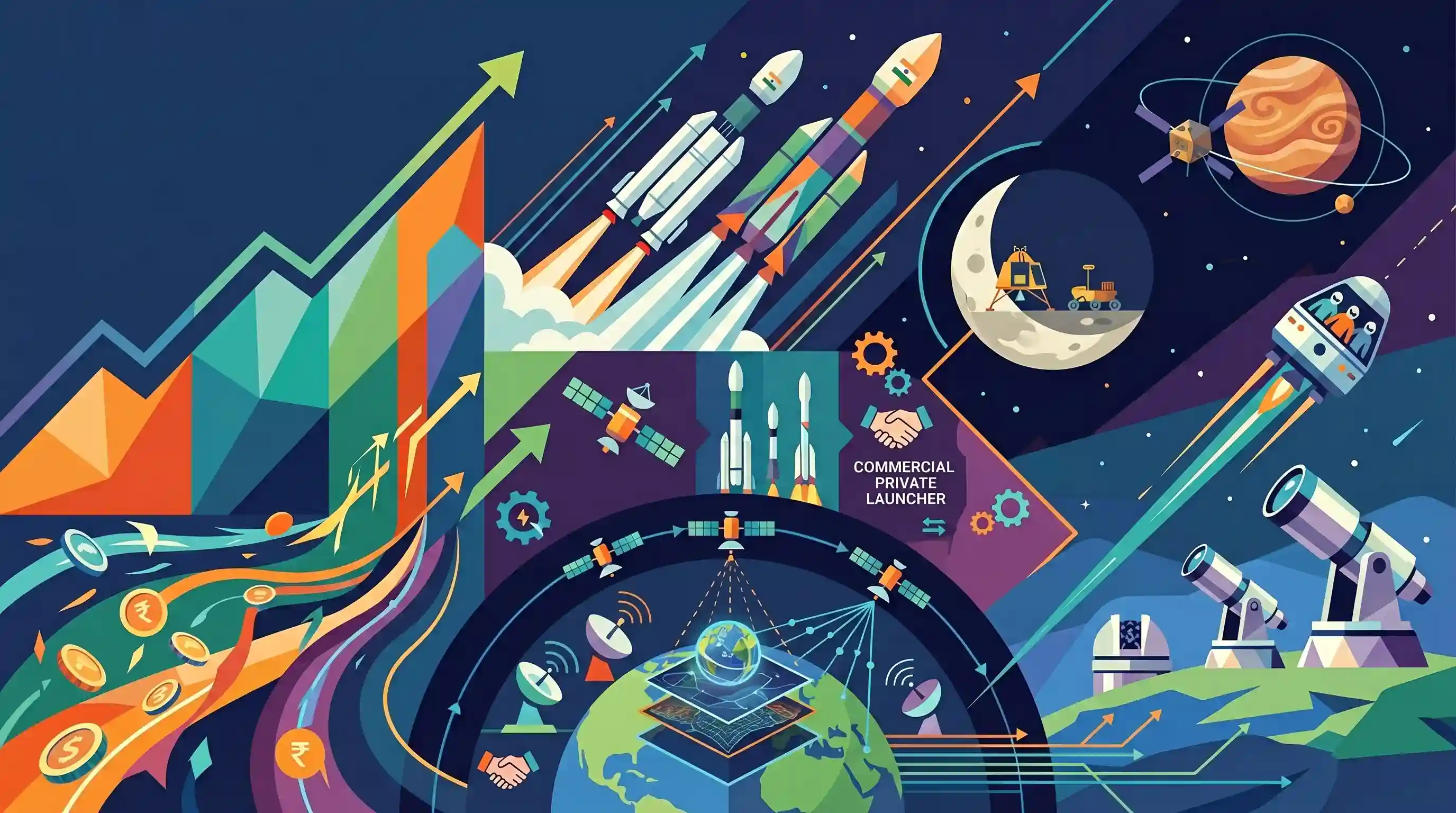
The Union Budget 2026 demonstrates a strong push for India's space program, with the Department of Space's capital expenditure projected to increase by 20% to support hardware manufacturing and complex mission development. Notable allocations include enhanced funding for ISRO's launch vehicles, IN-SPACe to facilitate private sector participation, and the commercialization arm NSIL. The space sciences segment, encompassing planetary exploration and astrophysics, also sees robust funding, with major structural upgrades planned for national observatories. Flagship missions like Gaganyaan, Chandrayaan-4, LUPEX, and the Venus orbiter are set to progress further, cementing India's footprint in both space commerce and deep space exploration.
Key Points
- The Department of Space received a total budget of ₹13,705.63 crore for 2025-26, highlighting an emphasis on capability building through a nearly 20% hike in capital expenditure for hardware and mission development.
- The space science segment was allocated ₹569.76 crore, progressing projects like planetary exploration, climate and atmospheric programmes, and the Venus orbiter mission.
- Capital has been earmarked to upgrade critical astronomical infrastructure, including the National Large Solar Telescope in Merak, the National Large Optical-infrared Telescope in Hanle, and the COSMOS-2 Planetarium in Mysuru.
- The budget balances commercial expansion and private sector integration via IN-SPACe (₹194.57 crore) and NSIL, alongside flagship scientific endeavors like the Gaganyaan and Chandrayaan-4 missions.
- The newly mentioned National Geospatial Mission received an initial ₹100 crore under the Department of Science and Technology, relying heavily on the data generation capabilities of ISRO's space applications.
Important Terms
Gaganyaan

India's flagship human spaceflight mission aiming to send a crew to a 400-km orbit. It represents the foundational step for the Bharatiya Antariksh Station and future manned lunar landings.
UPSC context
GS Paper III: Science and Technology; tests knowledge of indigenous technological capabilities and human spaceflight milestones.
Chandrayaan-4
A lunar sample-return mission designed to land on the Moon, collect rocks and soil, and return them to Earth. It serves as a technological successor to Chandrayaan-3.
UPSC context
GS Paper III: Awareness in the field of Space; tests understanding of deep-space exploration and planetary science.
Venus Orbiter Mission
India's second interplanetary mission (Shukrayaan-1) aimed at studying Venus's atmosphere, surface topography, and volcanic activity. It focuses on understanding planetary evolution and space-weather interactions.
UPSC context
GS Paper III: Space Technology; relevant for questions on interplanetary missions and solar system exploration.
National Large Solar Telescope (NLST)
A 2-metre class solar telescope being established in Merak, Ladakh. It will observe solar magnetic fields and dynamics to better predict space-weather events affecting satellite networks.
UPSC context
GS Paper III: Science and Technology; tests knowledge of domestic scientific infrastructure and heliophysics research.
National Large Optical-infrared Telescope (NLOT)
A proposed 10-12 metre class telescope in Hanle, Ladakh, designed for deep-space observation. It will be one of India's largest optical-infrared facilities for studying exoplanets and distant galaxies.
UPSC context
GS Paper III: Scientific Infrastructure; relates to India's contribution to global observational astronomy and mega-science projects.
National Geospatial Mission
A government initiative to modernize land records and urban planning through satellite-based data. It integrates with the PM Gati Shakti framework to improve infrastructure design and resource management.
UPSC context
GS Paper III: Awareness in the field of IT and Space; relevant for governance and infrastructure development.
Himalayan Chandra Telescope (HCT)
A 2-metre optical-infrared telescope located at Hanle, Ladakh. The Union Budget 2026 approved a major upgrade to its instrumentation to enhance India's ground-based observational capacity.
UPSC context
GS Paper III: Science and Technology; tests awareness of significant domestic astronomical facilities and their development.
COSMOS-2 Planetarium
A new high-tech planetarium and training facility in Amaravati, Andhra Pradesh, designed for public engagement. It aims to popularize space science and astrophysics among students and the public.
UPSC context
GS Paper III: Science and Technology; relates to scientific outreach and building a science-driven society.
Prelims Trap
The newly launched National Geospatial Mission is an initiative administered by the Department of Space.
While it heavily relies on ISRO's satellite data, the nodal implementation agency for the National Geospatial Mission is the Department of Science and Technology (DST), not the Department of Space.
Static Concepts Connected
How do IN-SPACe, NSIL, and Antrix differ in their specific space mandates?
- IN-SPACe (Regulator): Single-window nodal agency to promote, authorize, and supervise private sector participation in Indian space activities.
- NSIL (Commercial Arm): ISRO's commercial arm focusing on industry production of launch vehicles, tech transfer, and commercializing R&D.
- Antrix (Legacy Commercial): The older commercial arm primarily handling legacy contracts and foreign satellite launch service agreements.
Why are major ground-based telescopes like NLOT and NLST located in Ladakh?
- High Altitude: The thin atmosphere at 4,500+ meters reduces atmospheric distortion, which is crucial for clear optical and infrared astronomy.
- Arid Climate: The cold desert environment has extremely low humidity, preventing water vapor from absorbing incoming infrared light signals.
- Dark Skies: Minimal light pollution and low aerosol density in the region offer pristine, unpolluted viewing conditions year-round.
Cross-Topic Patterns
LUPEX & strategic space diplomacy
The ISRO-JAXA joint lunar mission (LUPEX) highlights space cooperation as a soft-power tool, mirroring Quad-level technological alliances in the Indo-Pacific.
S&T infrastructure & map marking
UPSC often tests infrastructure geography. Hanle (NLOT) and Merak (NLST near Pangong Tso) are high-probability candidates for Ladakh-centric Prelims map questions.

Expect a multi-statement question distinguishing IN-SPACe's regulatory role, NSIL's commercial mandate, and DST's geospatial mission.
Linked PYQs · 5
Linked PYQs · 5
- 2016MainsGS3
Discuss India's achievements in the field of Space Science and Technology. How the application of this technology has helped India in its socio-economic development?
- 2017MainsGS3
India has achieved remarkable successes in unmanned space missions including the Chandrayaan and Mars Orbitter Mission, but has not ventured into manned space missions. What are the main obstacles to launching a manned space mission, both in terms of technology and logistics? Examine critically.
- 2019MainsGS3
What is India's plan to have its own space station and how will it benefit our space programme?
- 2023MainsGS3
What is the main task of India's third moon mission which could not be achieved in its earlier mission? List the countries that have achieved this task. Introduce the subsystems in the spacecraft launched and explain the role of the Virtual Launch Control Centre' at the Vikram Sarabhai Space Centre which contributed to the successful launch from Sriharikota.
- 2019PrelimsGS1
For the measurement/estimation of which of the following are satellite images/remote sensing data used? 1. Chlorophyll content in the vegetation of a specific location 2. Greenhouse gas emissions from rice paddies of a specific location 3. Land surface temperatures of a specific location Select the correct answer using the code given below.
