Tax Collected at Source Reduction for Foreign Remittances
Source:The Hindu ↗
Why It Matters
Taxation policies, specifically advance taxes on foreign remittances, impact household financial planning and current account dynamics. Understanding the Liberalised Remittance Scheme (LRS) and the distinction between capital and current account transactions is a core concept in the UPSC economics syllabus.
Summary
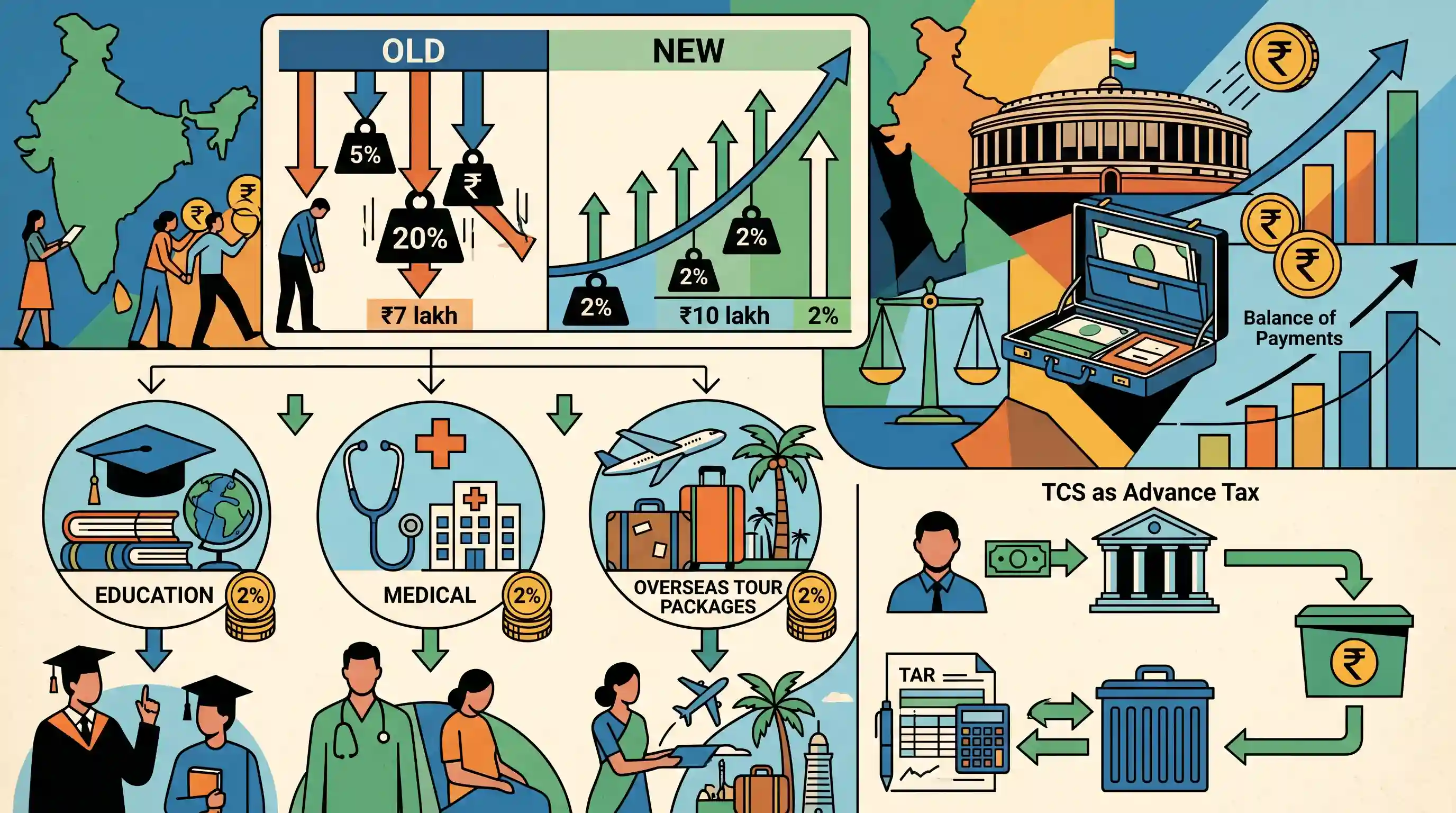
The Union Budget 2026 has provided significant relief to individuals remitting money abroad by reducing the Tax Collected at Source (TCS) on foreign remittances for education, medical purposes, and overseas tour packages to 2%. Effective April 1, 2026, the threshold limit for TCS under the Liberalised Remittance Scheme (LRS) has been increased from ₹7 lakh to ₹10 lakh. This move reduces the upfront financial burden on students studying abroad and patients seeking foreign medical care. It is important to note that TCS acts as an advance tax that can be fully reclaimed during income tax filing.
Key Points
- Union Budget 2026 has reduced the Tax Collected at Source (TCS) for foreign remittances related to education and medical purposes to 2% for amounts exceeding ₹10 lakh.
- The overall threshold for TCS applicability under the Liberalised Remittance Scheme (LRS) has been raised from ₹7 lakh to ₹10 lakh, effective April 1, 2026.
- Overseas tour packages now attract a unified flat 2% TCS, simplifying the earlier tax structure.
- Education remittances funded by approved education loans continue to be exempt from TCS (0%).
- The Liberalised Remittance Scheme (LRS) permits resident individuals to freely remit up to $250,000 per financial year for permissible current or capital account transactions.
- TCS acts as an advance tax collection that can be fully reclaimed or adjusted against an individual's total income tax liability when filing their income tax return (ITR).
Important Terms
Liberalised Remittance Scheme (LRS)

An RBI framework allowing resident individuals to freely remit up to USD 250,000 annually for permitted current and capital account transactions, including education and medical expenses.
UPSC context
GS Paper III: Indian Economy; tests knowledge of foreign exchange management, capital account convertibility, and balance of payments.
Tax Collected at Source (TCS)
An advance tax collected by authorized dealers (banks) during specific transactions, such as foreign remittances, which can be claimed as a refund or tax credit.
UPSC context
GS Paper III: Mobilization of Resources; tests understanding of direct tax mechanisms and impact on consumer liquidity.
Reserve Bank of India (RBI)
India's central bank and regulatory body responsible for managing foreign exchange reserves and overseeing the Liberalised Remittance Scheme (LRS) guidelines.
UPSC context
GS Paper III: Indian Economy; tests knowledge of regulatory institutions and their role in stabilizing the external sector.
Foreign Exchange Management Act (FEMA)
The primary legislation in India that regulates foreign exchange transactions, aiming to facilitate external trade and maintain the domestic foreign exchange market.
UPSC context
GS Paper III: Indian Economy; vital for understanding the legal framework governing international capital flows and trade.
Union Budget
The annual financial statement presented under Article 112, detailing the government's proposed expenditures and expected receipts for the upcoming fiscal year.
UPSC context
GS Paper III: Government Budgeting; a core topic covering fiscal policy, taxation changes, and developmental resource allocation.
Prelims Trap
"The Liberalised Remittance Scheme (LRS) is available to all resident entities including corporates and HUFs."
LRS is strictly restricted to resident individuals, including minors. Entities such as corporates, partnership firms, Hindu Undivided Families (HUFs), and trusts are explicitly barred from utilizing it.
Static Concepts Connected
How are LRS transactions classified in the Balance of Payments (BoP)?
- Current Account: Outward remittances for education, medical care, tours, or gifts are recorded as unilateral transfers under the Current Account.
- Capital Account: LRS funds used to purchase overseas property, foreign equity shares, or open foreign bank accounts are recorded under the Capital Account.
What is the core mechanism of Tax Collected at Source (TCS)?
- Point of Collection: It is collected by the seller or facilitator (like authorized dealer banks for LRS) from the buyer/remitter at the point of transaction.
- Not a Final Tax: TCS is an advance tax. It is not an additional fee; it can be fully adjusted against an individual's final income tax liability or claimed as a refund.
Cross-Topic Patterns
LRS and Capital Account Convertibility
The $250,000 LRS limit reflects India's approach to partial Capital Account Convertibility (Tarapore Committee), allowing residents overseas asset creation while safeguarding macroeconomic stability and forex reserves.
Forex Outflows vs Diaspora Soft Power
Easing outward education remittances causes immediate current account outflows but strategically invests in human capital, directly linking to long-term inward remittances and the strengthening of Indian diaspora soft power.

Expect a 2026 Prelims question mixing LRS eligibility (individuals only) with BoP classification of education vs. asset-purchase remittances.
Linked PYQs · 1
Linked PYQs · 1
- 2013PrelimsGS1
Which of the following constitute Capital Account? 1. Foreign Loans 2. Foreign Direct Investment 3. Private Remittances 4. Portfolio Investment Select the correct answer using the codes given below.
