Union Budget defense reforms and indigenisation push for security
Source:The Hindu ↗
Why It Matters
The defense budget is a direct reflection of India's strategic priorities. For UPSC aspirants, understanding the shift towards capital expenditure, indigenization, and military structural reforms is essential for addressing GS3 questions on internal security, budgeting, and technological self-reliance.
Summary
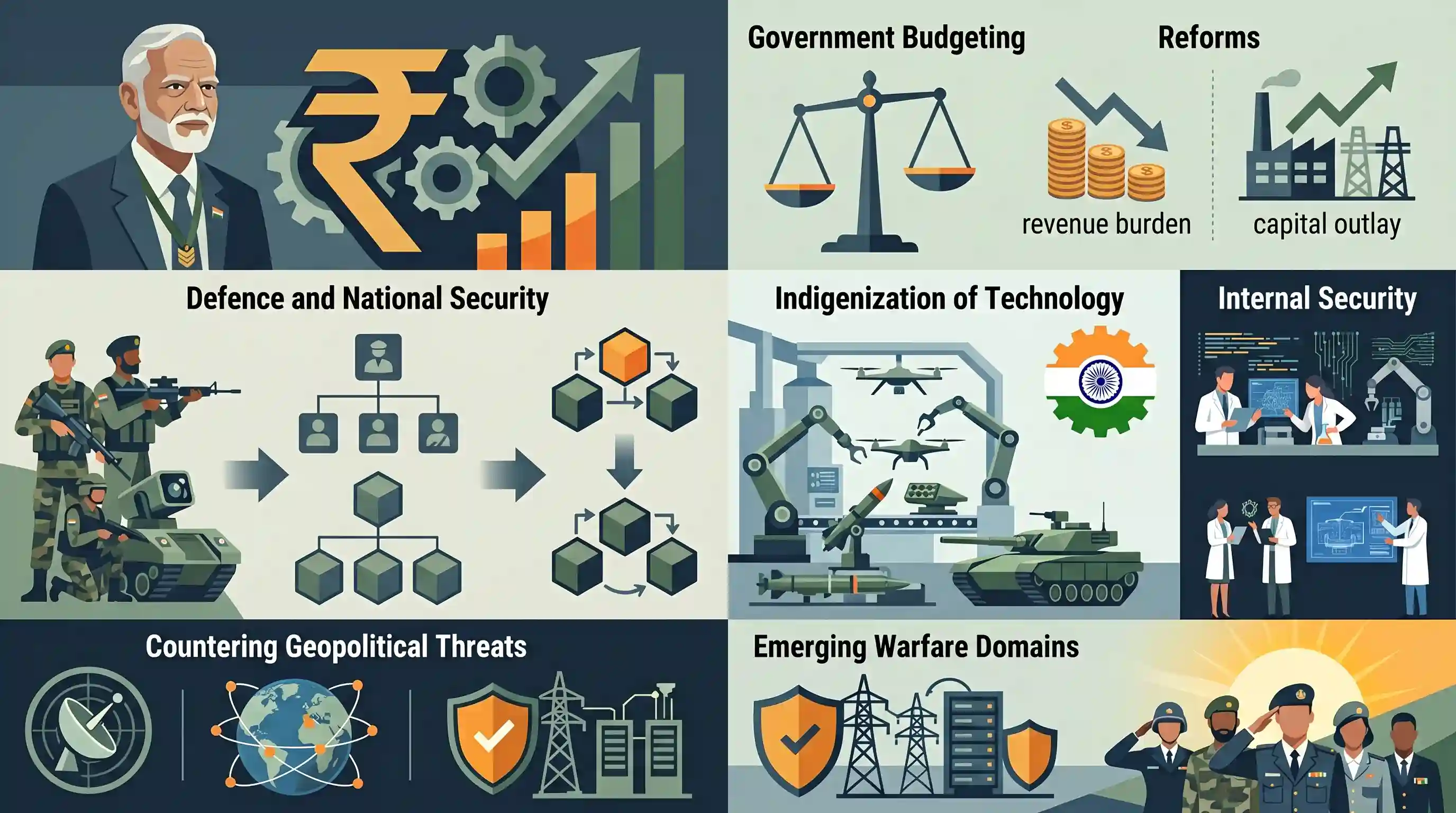
In this article, former Army Commander Raj Shukla analyzes the Union Budget 2026, noting its critical role in accelerating reforms within India's defence and national security architecture. The budget places a strong emphasis on capability building through higher capital outlays, structural optimization, and reducing the military's revenue burden. A key focus remains on self-reliance (Atmanirbhar Bharat) via indigenous defence manufacturing and deeper investments in military R&D, positioning the armed forces to effectively counter contemporary geopolitical threats and emerging warfare domains.
Key Points
- The Union Budget 2026 focuses on modernizing the Indian armed forces by shifting budgetary allocations towards capital expenditure for capability development.
- Emphasis is placed on 'Atmanirbhar Bharat' in defense, minimizing import dependency and encouraging domestic manufacturing of military hardware.
- There is a dedicated push for indigenous research and development (R&D) through initiatives like iDEX and greater private sector participation in deep-tech defense solutions.
- The article highlights the 'Reform Express', indicating institutional structural reforms aimed at achieving jointness, technological superiority, and a leaner, more agile military structure.
Important Terms
Union Budget 2026-27

The 2026-27 fiscal plan which allocated a record ₹7.85 lakh crore to the Ministry of Defence, prioritizing modernization and domestic procurement after major strategic shifts.
UPSC context
GS III (Economy/Budgeting); tests knowledge of fiscal priorities, sectoral allocations, and the shift towards capital-intensive modernization.
Atmanirbhar Bharat (Defence)
A policy initiative aiming for self-reliance in defense by reducing import dependency and fostering an ecosystem of indigenous design, development, and manufacturing.
UPSC context
GS III (Security/Economy); central to discussions on strategic autonomy and the development of a domestic defense industrial base.
iDEX (Innovations for Defence Excellence)
A flagship scheme launched in 2018 to foster innovation in defense and aerospace by providing grants and funding to startups, MSMEs, and individual innovators.
UPSC context
GS III (Security/S&T); relevant for evaluating the role of the private sector and startups in military modernization.
DRDO (Defence Research and Development Organisation)
India's premier military R&D agency under the Ministry of Defence, responsible for developing indigenous technologies like the Tejas aircraft and Akash missile systems.
UPSC context
GS III (S&T/Security); tests understanding of indigenous technology development and the challenges of institutional R&D.
Capital Outlay (Defence)
The portion of the budget dedicated to the acquisition of new platforms, weaponry, and infrastructure, crucial for long-term military modernization and capability building.
UPSC context
GS III (Economy/Budgeting); vital for analyzing the revenue-capital ratio and the military's modernization trajectory.
Indigenization of Technology
The capability of developing and producing defense equipment within the country to achieve self-reliance and reduce the fiscal and strategic burden of imports.
UPSC context
GS III (Internal Security/S&T); a key strategy for ensuring "technological sovereignty" and reducing strategic vulnerabilities.
Prelims Trap
"Capital procurement forms the largest share of India's annual defence budget."
Aspirants often assume modernization drives make capital outlay the largest component. In reality, revenue expenditure (salaries, pensions) still consumes the vast majority of the budget.
Static Concepts Connected
How is the Defence Budget structurally divided between Revenue and Capital expenditure?
- Revenue Expenditure: Covers day-to-day running costs, including salaries, pensions (the largest single chunk), fuel, maintenance, and routine ammunition.
- Capital Expenditure: Funds the acquisition of new weapons, platforms (ships, aircraft, tanks), land, and the long-term modernization of existing military equipment.
What is the core mandate of the iDEX (Innovations for Defence Excellence) initiative?
- Objective: To foster innovation and technology development in defence and aerospace by engaging private ecosystem players.
- Target Group: Specifically targets and funds MSMEs, start-ups, individual innovators, R&D institutes, and academia, shifting reliance away from traditional DPSUs/DRDO.
- Funding Mechanism: Provides grants and support to carry out R&D that has high potential for future adoption by the Indian armed forces.
Cross-Topic Patterns
Defence indigenization boosting MSMEs
The push for domestic defence manufacturing via iDEX directly overlaps with MSME promotion policies, linking national security imperatives to industrial employment and domestic economic self-reliance.
Jointness and Integrated Theatre Commands
Financial optimization in the budget supports the structural shift towards Integrated Theatre Commands, a crucial administrative reform spearheaded by the CDS to ensure tri-service synergy.

Expect a 2026 multi-statement Prelims question comparing defence capital vs. revenue expenditure trends alongside the mandate of iDEX.
Linked PYQs · 3
Linked PYQs · 3
- 2021MainsGS3
Distinguish between Capital Budget and Revenue Budget. Explain the components of both these Budgets.
- 2019MainsGS3
The public expenditure management is a challenge to the Government of India in the context of budget making during the post-liberalization period. Clarify it.
- 2014MainsGS3
Foreign Direct Investment (FDI) in the defence sector is now set to be liberalized. What influence this is expected to have on Indian defence and economy in the short and long run?
