National Destination Digital Knowledge Grid for heritage digitisation
Source:The Hindu ↗
Why It Matters
The preservation of India's vast cultural heritage is a recurring theme in UPSC examinations. This development integrates heritage conservation with modern digital technologies and links it to tourism-driven employment, making it highly relevant for questions on safeguarding Indian art heritage and the socio-economic impacts of tourism.
Summary
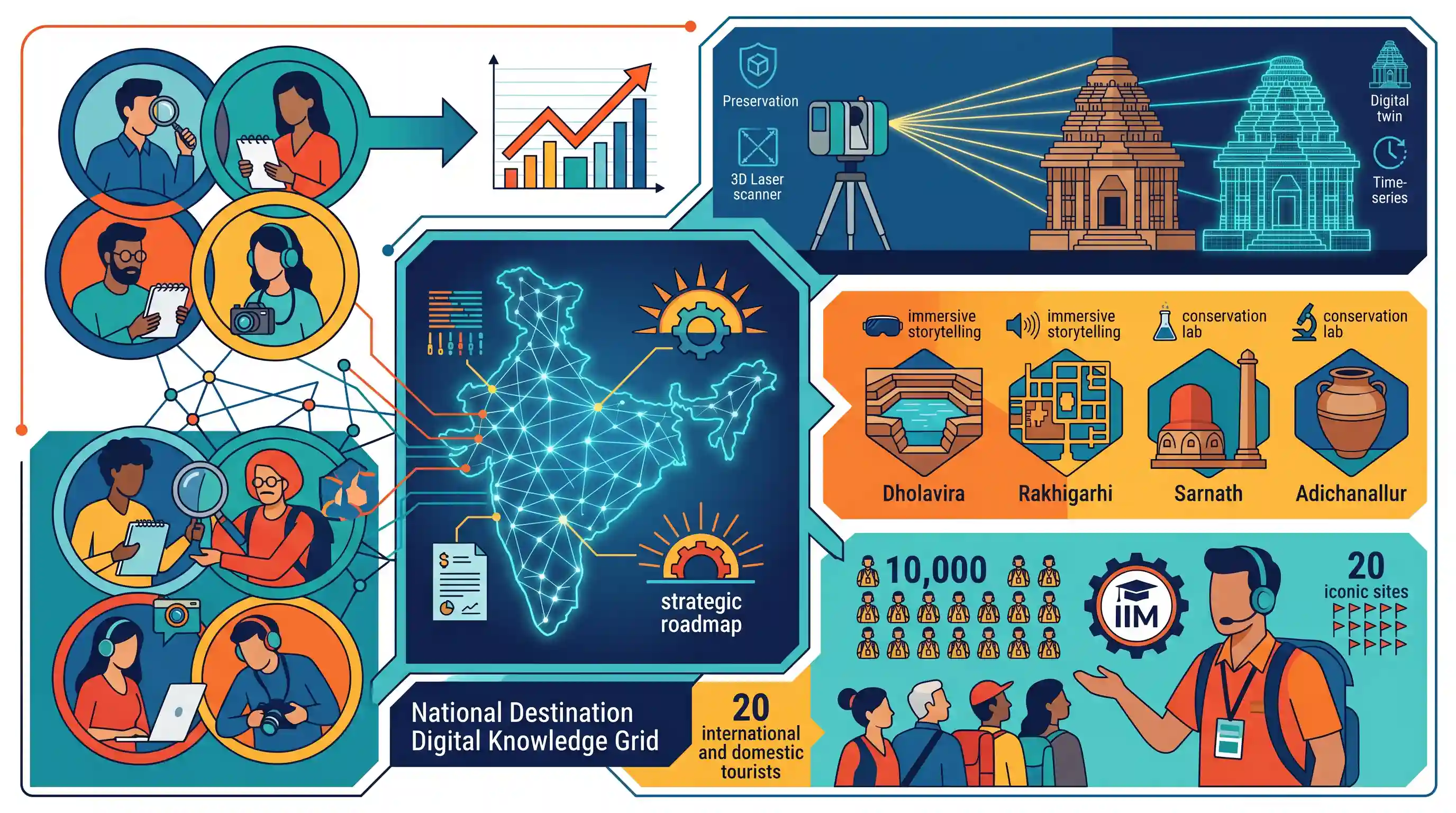
The Union Budget 2026-27 unveiled a strategic roadmap to digitise and open up India's archaeological sites to boost tourism and heritage conservation. A key initiative is the 'National Destination Digital Knowledge Grid', which aims to document places of cultural and historical significance, simultaneously generating employment for researchers, historians, and content creators. The budget plans to leverage technologies like 3D laser scanning to create digital twins of monuments for preservation. Furthermore, 15 prominent archaeological sites, including Dholavira, Rakhigarhi, Sarnath, and Adichanallur, are slated for comprehensive development featuring immersive storytelling and conservation labs. Additionally, an upskilling program for 10,000 tourist guides at 20 iconic sites will be designed by an IIM.
Key Points
- The Union Budget 2026-27 has announced the establishment of the 'National Destination Digital Knowledge Grid' to comprehensively document India's cultural, spiritual, and heritage sites.
- Advanced technologies, including 3D laser scanning, will be utilized to create digital twins of monuments (e.g., Osmania General Hospital in Hyderabad) for better conservation and restoration.
- Fifteen significant archaeological sites, such as Dholavira, Rakhigarhi, Sarnath, and Adichanallur, will be developed with tourist amenities like curated walkways, immersive storytelling, and conservation labs.
- To boost employment and enhance the visitor experience, a 12-week course designed by an IIM will upskill 10,000 tourist guides at 20 iconic sites.
Important Terms
National Destination Digital Knowledge Grid

A technology-driven national repository introduced in Budget 2026-27 to digitally document India’s cultural, spiritual, and historical heritage sites, improving their discoverability, interpretation, and destination management.
UPSC context
GS Paper III (Infrastructure) and GS Paper I (Art & Culture); tests technology-led heritage conservation and tourism.
Digital Twin (Heritage)
Precise digital replicas of physical monuments created using 3D laser scanning. They enable high-fidelity conservation, structural health monitoring, and immersive virtual tourism without risking damage to the original site.
UPSC context
GS Paper III (S&T) and GS Paper I (Conservation); tests knowledge of emerging technologies in cultural preservation.
Iconic Archaeological Sites
Prominent historical locations (e.g., Dholavira, Rakhigarhi, Sarnath) slated for comprehensive development into experiential destinations featuring immersive storytelling, conservation labs, and public walkways.
UPSC context
GS Paper I (Ancient History/Archaeology); focuses on Indus Valley Civilization, Buddhism, and heritage-based economic growth.
Orange Economy
Also known as the Creative Economy, it involves sectors like heritage, arts, and digital content. Budget 2026-27 promotes this by employing researchers, historians, and digital storytellers.
UPSC context
GS Paper III (Employment/Economy); relevant for diversifying the job market through creative and cultural sectors.
Adichanallur
An iron-age urn-burial site in Tamil Nadu significant for its megalithic culture and early Tamil-Brahmi scripts. It is one of the five original 'iconic sites' identified for development.
UPSC context
GS Paper I (Ancient History); tests knowledge of pre-historic and early-historic South India.
IIM-led Guide Upskilling
A pilot scheme to train 10,000 tourist guides at 20 iconic sites via a 12-week hybrid course designed by IIMs to standardize service quality and historical accuracy.
UPSC context
GS Paper III (Skill Development); examines strategies for professionalizing tourism and enhancing global competitiveness.
Prelims Trap
Dholavira, Rakhigarhi, and Adichanallur are all prominent Harappan sites slated for digital conservation.
Adichanallur is an Iron Age/Megalithic urn-burial site in Tamil Nadu, not a Harappan site, despite being grouped with Harappan sites in recent heritage schemes.
Static Concepts Connected
What are the unique archaeological signatures of Dholavira and Adichanallur?
- Dholavira (Gujarat): Renowned for sophisticated water harvesting systems, cascading reservoirs, rock-cut architecture, and the unique 10-letter Harappan signboard.
- Adichanallur (Tamil Nadu): A major Iron Age/Megalithic site on the Thamirabarani river, celebrated for extensive urn burials yielding iron implements and bronze artifacts.
What is "Digital Twin" technology in governance and conservation?
- Core Concept: A highly precise, dynamic virtual replica of a physical asset, created using 3D laser scanning, photogrammetry, and real-time data integration.
- Conservation Application: Allows researchers to run structural simulations, conduct predictive maintenance, and plan non-invasive restorations without damaging the original ancient monument.
Cross-Topic Patterns
DPI expanding to Cultural Tourism
The National Destination Digital Knowledge Grid extends India's Digital Public Infrastructure (DPI) framework beyond finance and health into heritage management and the tourism economy.
Formalizing the tourism workforce
Upskilling 10,000 guides via IIMs connects heritage conservation with economic formalization, turning informal tourism workers into certified, high-productivity contributors to the service sector.

Expect a blended 2026 Prelims question mixing historical features of Adichanallur and Dholavira with 'Digital Twin' tech applications.
Linked PYQs · 3
Linked PYQs · 3
- 2018MainsGS1
Safeguarding the Indian art heritage is the need of the moment. Discuss.
- 2021PrelimsGS1
Which one of the following ancient towns is well-known for its elaborate system of water harvesting and management by building a series of dams and channelizing water into connected reservoirs?
- 2025MainsGS1
How can Artificial Intelligence (AI) and drones be effectively used along with GIS and RS techniques in locational and areal planning?
