Capital Gains Tax and Foreign Investment Trends in India
Source:Indian Express ↗
Why It Matters
Understanding the impact of taxation changes like Long Term Capital Gains (LTCG) and foreign investment trends is vital for aspirants studying fiscal policy, resource mobilization, and economic growth under GS Paper III.
Summary
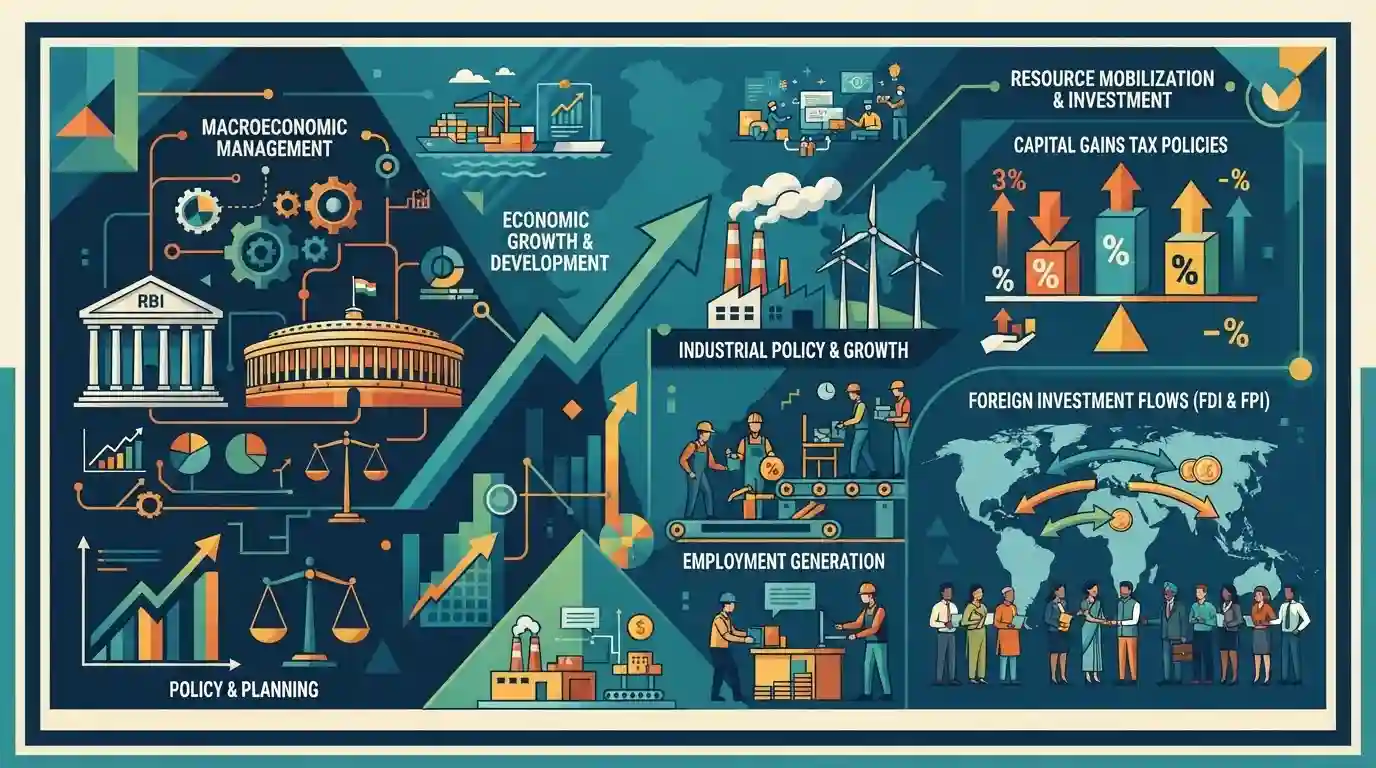
This article examines the implications of capital gains tax policies, foreign investment flows, and macroeconomic management by the Reserve Bank and the Union Budget on India's economic landscape.
Key Points
- Analysis of taxation policies affecting capital gains and foreign investment trends in India.
- Evaluation of fiscal measures in the Union Budget and their implications on economic growth and investment inflows.
- The intersection of monetary policy stance by the RBI and fiscal measures in shaping the broader financial market environment.
Important Terms
Reserve Bank of India

The apex central banking institution of India responsible for regulating the monetary system, issuing currency, managing foreign exchange reserves, and maintaining macroeconomic and financial stability.
UPSC context
GS Paper III (Indian Economy): Essential for questions on monetary policy, inflation targeting, central banking, and macroeconomic management.
Union Budget
The annual financial statement presented by the government under Article 112 detailing estimated receipts and expenditures, fiscal policy, tax proposals, and resource allocation strategies.
UPSC context
GS Paper III (Indian Economy): Tests knowledge of fiscal policy, resource mobilization, taxation, capital expenditure, and budgetary trends.
Static Concepts Connected
What is the difference between Long-Term Capital Gains (LTCG) and Short-Term Capital Gains (STTCG) tax in India?
- Holding Period: Holding period for equity shares and equity-oriented mutual funds to qualify as long-term is more than 12 months, whereas for most other assets it is 24 or 36 months.
- Tax Rates: LTCG on listed equities is taxed at concessional rates (with exemptions up to specified thresholds per financial year), whereas STCG is taxed at higher short-term rates.
Cross-Topic Patterns
LTCG Tax & Capital Account Convertibility
Tax concessions on capital gains and FII debt inflows connect directly to capital account convertibility debates and RBI's foreign exchange reserve management under the FEMA framework.

Union Budget tax rationalisation combined with RBI monetary stance will likely be tested via a statement-based fiscal federalism/policy coordination Q.
Linked PYQs · 2
Linked PYQs · 2
- 2018MainsGS3
Comment on the important changes introduced in respect of the Long-term Capital Gains Tax (LCGT) and Dividend Distribution Tax (DDT) in the Union Budget for 2018-2019.
- 2016MainsGS3
Justify the need for FDI for the development of the Indian economy. Why there is gap between MOUs signed and actual FDIs? Suggest remedial steps to be taken for increasing actual FDIs in India.
