Union Budget 2026-27 Outlines 25 Year Roadmap for Viksit Bharat
Source:The Hindu ↗
Why It Matters
The article provides a holistic overview of the Union Budget's long-term objectives across key UPSC themes: public health, climate action (carbon capture), digital governance (drone mapping), and strategic resource management (rare minerals and blue economy). These multi-sectoral allocations reflect current government priorities, essential for answering questions on GS3 economy, environment, and technology, as well as GS1 resource geography.
Summary
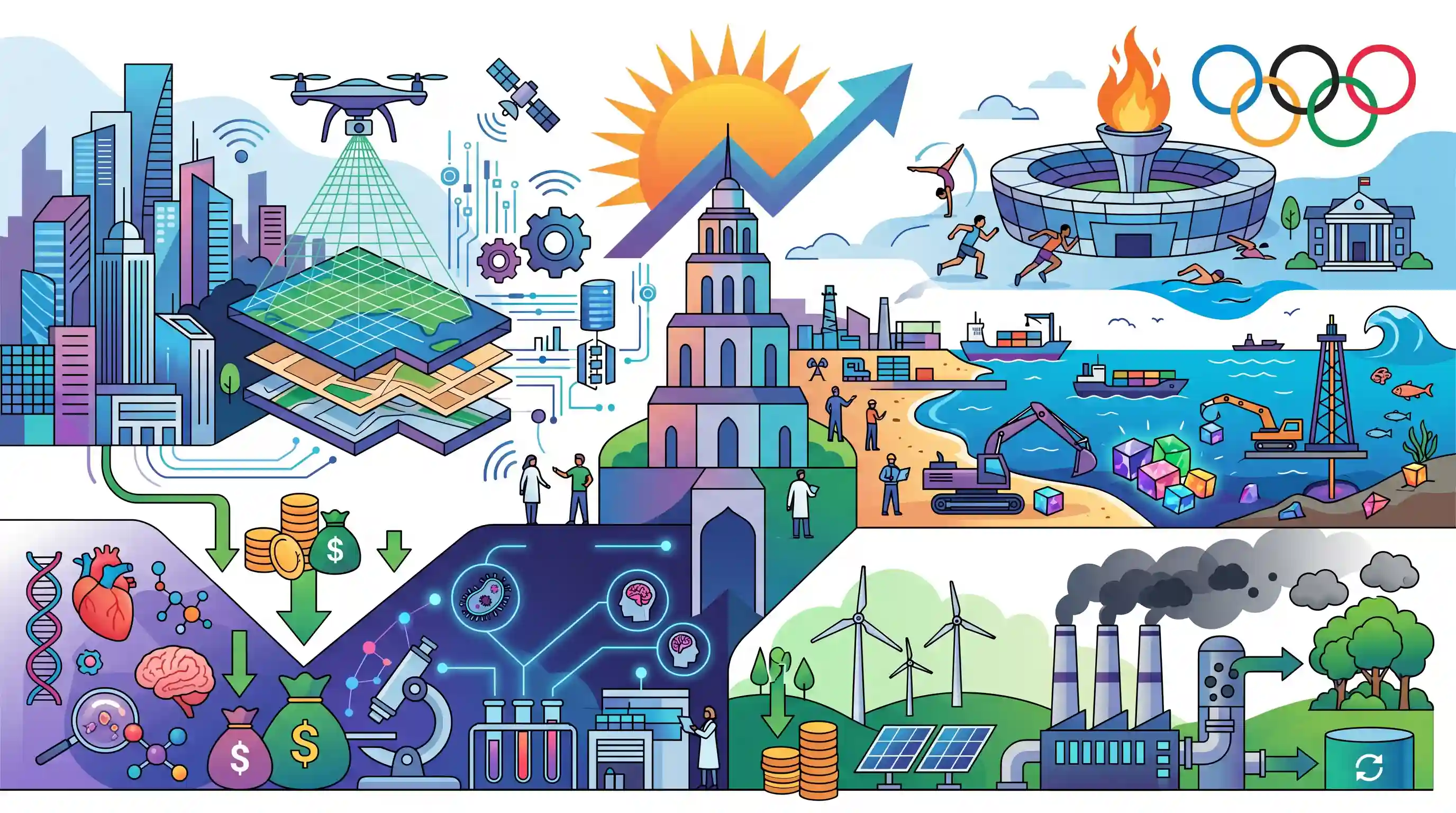
Union Minister Jitendra Singh characterized the Union Budget 2026-27 as a comprehensive development roadmap aimed at realizing 'Viksit Bharat' over the next 25 years. The budget outlines critical interventions across multiple sectors. In healthcare, it introduces tax exemptions for cancer and rare disease medicines and allocates ₹10,000 crore for biotechnology, with an added emphasis on mental health. For environmental sustainability, ₹20,000 crore is earmarked for carbon capture projects to foster green industries. The budget also integrates technology into governance through drone-based land mapping and urban development missions. Furthermore, it focuses on the blue economy by promoting the extraction of rare earth minerals in coastal states like Andhra Pradesh, and sets the stage for hosting the 2036 Olympics by proposing a dedicated governing body.
Key Points
- The Union Budget 2026-27 is positioned as a 25-year roadmap for achieving 'Viksit Bharat' by 2047.
- Health sector priorities include tax exemptions for 17 cancer drugs and 7 rare disease medicines, alongside a ₹10,000 crore allocation for biotechnology and a special focus on mental health.
- Environmental sustainability and green industry are promoted through a ₹20,000 crore allocation for carbon capture projects.
- Technology-driven governance is highlighted by a mission using drones for the scientific mapping of land records and city development.
- Strategic regional focus on coastal areas like Andhra Pradesh to strengthen the blue economy, emphasizing the extraction and processing of rare minerals.
- The budget proposes establishing a special governing body to facilitate India's bid to host the 2036 Olympics.
Important Terms
Viksit Bharat 2047

A long-term vision to transform India into a developed nation by 2047, the centenary of independence. It focuses on inclusive growth, economic expansion, and sustainability.
UPSC context
GS-3 (Economy/Growth); tests knowledge of long-term national development goals and pillars of growth.
Union Budget
Constitutionally known as the Annual Financial Statement (Article 112), it details the government's estimated receipts and expenditures for a financial year.
UPSC context
GS-2 (Polity) and GS-3 (Economy); crucial for understanding constitutional procedures and resource mobilization.
Blue Economy
The sustainable use of ocean resources for economic growth, improved livelihoods, and jobs while preserving the health of the marine ecosystem.
UPSC context
GS-3 (Environment/Economy) and GS-1 (Geography); relates to maritime resources and sustainable development.
Rare Earth Elements (REEs)
A set of 17 chemical elements (15 lanthanides, scandium, and yttrium) essential for high-tech applications like electric vehicles, wind turbines, and defense equipment.
UPSC context
GS-1 (Natural Resources) and GS-3 (S&T); tests strategic resource geography and technological self-reliance.
Carbon Capture and Storage (CCS)
A suite of technologies that capture CO2 emissions from industrial sources or the atmosphere, preventing their release to mitigate climate change.
UPSC context
GS-3 (Environment); focuses on climate change mitigation strategies and net-zero emission targets.
Biotechnology
The use of biological systems and organisms to develop products in sectors like healthcare (rare disease medicines), agriculture, and environment.
UPSC context
GS-3 (Science & Technology); focuses on indigenization of technology and applications in healthcare.
Prelims Trap
Private sector entities are encouraged to extract monazite and rare earth minerals from beach sand deposits to boost the Blue Economy.
Monazite contains thorium and is a prescribed substance under the Atomic Energy Act. Its mining is strictly reserved for government entities (like IREL), barring private sector extraction.
Static Concepts Connected
What are the characteristics and regulatory status of Monazite deposits in India?
- Mineral Composition: It is an orthophosphate mineral primarily containing rare earth elements (REEs) and radioactive thorium.
- Geographic Distribution: Found abundantly as placer deposits along the eastern and southern coasts, particularly in Andhra Pradesh, Odisha, Kerala, and Tamil Nadu.
- Legal Restriction: Classified as a prescribed substance; its commercial mining and processing are restricted exclusively to government-owned enterprises.
How does Carbon Capture, Utilization, and Storage (CCUS) function in hard-to-abate sectors?
- Point-Source Capture: Extracts CO2 directly from high-emission industrial exhausts (like steel or cement plants) before it reaches the atmosphere.
- Industrial Utilization: Converts the captured carbon into commercially useful products such as synthetic fuels, green urea, or construction materials.
Cross-Topic Patterns
Blue Economy + Atomic Energy
Extracting coastal rare earths (monazite) bridges the Blue Economy with India's 3-stage nuclear program, linking maritime resources directly to strategic energy security and atomic regulations.
Drones + Rural Financial Inclusion
Drone mapping under schemes like SVAMITVA merges geospatial tech with governance, turning unmapped rural land into formalized assets that can be used as collateral for formal credit.

Expect a multi-statement Prelims question merging coastal Placer deposits, REE extraction rules, and Blue Economy initiatives in 2026.
Linked PYQs · 4
Linked PYQs · 4
- 2017MainsGS3
One of the intended objectives of the Union Budget 2017-18 is to 'transform, energise and clean India'. Analyse the measures proposed in the Budget 2017-18 to achieve the objective.
- 2025MainsGS3
What is Carbon Capture, Utilization and Storage (CCUS)? What is the potential role of CCUS in tackling climate change?
- 2023PrelimsGS1
Consider the following activities: 1. Spreading finely ground basalt rock on farmlands extensively 2. Increasing the alkalinity of oceans by adding lime 3. Capturing carbon dioxide released by various industries and pumping it into abandoned subterranean mines in the form of carbonated waters How many of the above activities are often considered and discussed for carbon capture and sequestration?
- 2021PrelimsGS1
Consider the following statements : 1. The Global Ocean Commission grants licences for seabed exploration and mining in international waters. 2. India has received licences for seabed mineral exploration in international waters. 3. 'Rare earth minerals' are present on seafloor in international waters. Which of the statements given above are correct?
