Human Wildlife Conflict and Ex Situ Conservation Strategy
Source:The Hindu ↗
Why It Matters
The article highlights a critical policy shift in wildlife management—moving from the relocation of problem-animals within natural habitats to placing them in ex-situ facilities (zoos/rehab centers) due to the inefficacy of deep-forest release. It also touches upon the friction in fiscal federalism, illustrating the financial burden states bear when central budget allocations for environmental mitigation fall short.
Summary
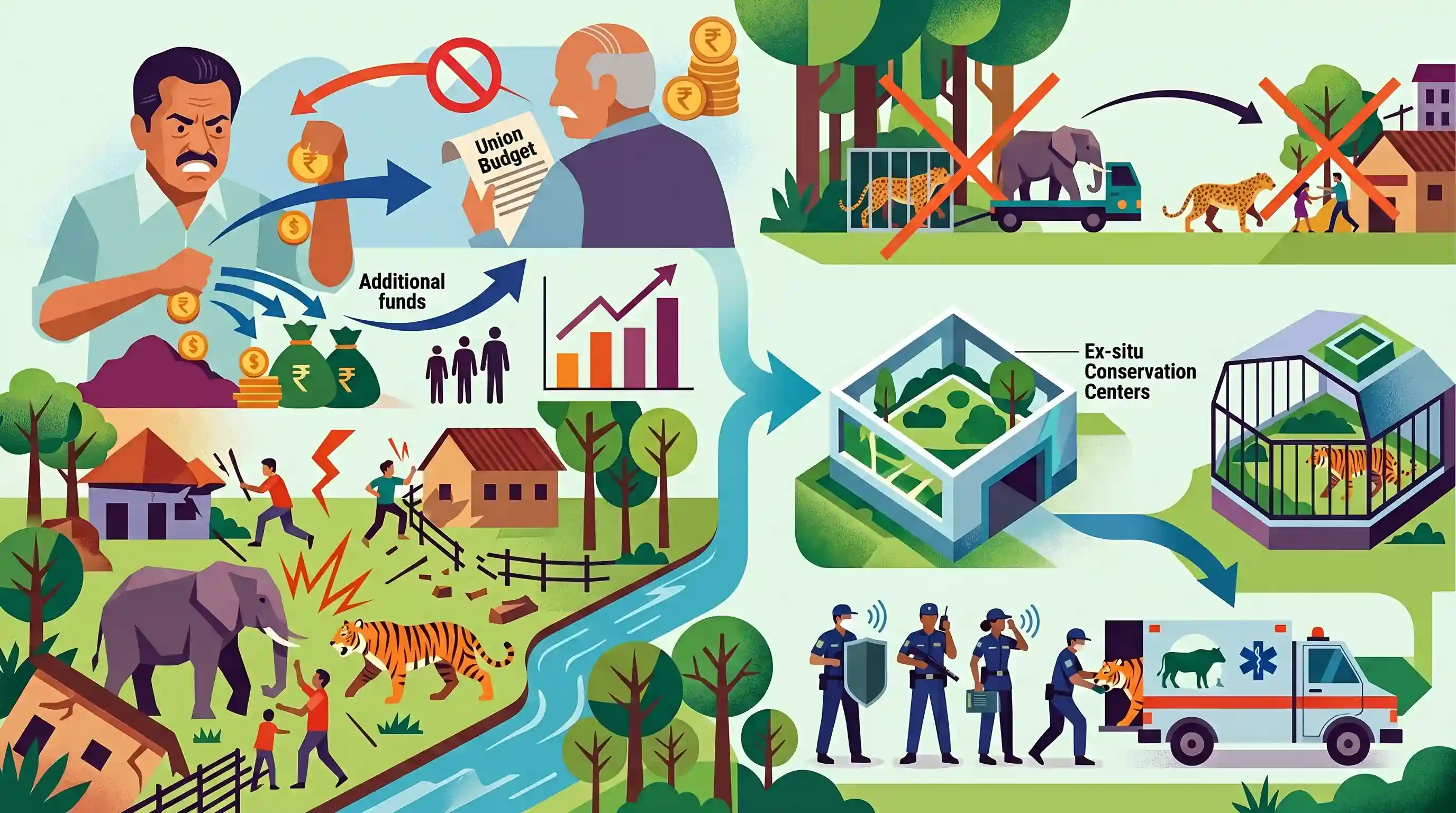
Kerala Forest Minister A.K. Saseendran has criticized the Union Budget for ignoring the state's severe human-wildlife conflict crisis, prompting the state to allocate an additional ₹29 crore from its own funds. Addressing the failure of previous methods, the state has adopted a new strategy to stop releasing captured 'problem' animals into deep forests, as they tend to return to human habitations. Instead, these animals will be housed in ex-situ conservation centers, such as the new Zoological Park in Puthur, Thrissur, and a planned specialized facility in Perambra, Kozhikode. The state is also enhancing its Rapid Response Teams (RRTs) and deploying animal ambulances to better manage conflict incidents.
Key Points
- Kerala's Forest Minister criticized the Union Budget for neglecting to allocate funds for managing the state's escalating human-wildlife conflict crisis.
- The Kerala state government has independently allocated an additional ₹29 crore to mitigate human-animal encounters.
- The state is shifting its wildlife management strategy: captured problem-animals will no longer be released into deep forests, as they frequently return to human settlements.
- Instead, captured animals will be relocated to ex-situ conservation facilities, including the newly established Zoological Park in Puthur (Thrissur) and a proposed specialized facility in Perambra (Kozhikode).
- Efforts are also underway to bolster infrastructure by deploying animal ambulances and forming Rapid Response Teams (RRTs) in conflict-prone areas.
Important Terms
Human-Wildlife Conflict (HWC)

Negative interactions between humans and wildlife resulting in loss of life, crops, or property. Driven by habitat fragmentation and climate-induced changes.
UPSC context
GS Paper 3 (Environment); focus on mitigation strategies, legal frameworks, and Kerala's declaration of HWC as a state-specific disaster.
Fiscal Federalism
The financial relationship and division of resources between the Union and States. Governed by Articles 268-293 and Finance Commission recommendations.
UPSC context
GS Paper 2 (Federalism) and GS Paper 3 (Economy); addresses vertical imbalances and state autonomy in funding regional crises.
Ex-situ Conservation
Conservation of species outside their natural habitats in controlled environments like zoological parks, gene banks, or botanical gardens.
UPSC context
GS Paper 3 (Biodiversity); tests understanding of off-site conservation as a complement to in-situ (habitat-based) protection.
Rapid Response Teams (RRTs)
Specialized, 24/7 units within the Forest Department equipped to intervene in stray animal incidents to ensure human safety and wildlife rescue.
UPSC context
GS Paper 3 (Disaster Management); tests administrative response mechanisms and field-level implementation of wildlife policies.
Thrissur Zoological Park (Puthur Zoo)
Located in Puthur, it is India’s first 'designer zoo' designed to replicate natural habitats without traditional cages.
UPSC context
GS Paper 3 (Environment); a case study in modern wildlife welfare, research, and ex-situ conservation infrastructure.
State-specific Disaster
A classification used by states to manage localized calamities not listed in the national list of disasters, allowing use of state-specific funds.
UPSC context
GS Paper 3 (Disaster Management); specific to Kerala's 2024 decision to treat HWC under the Disaster Management Act.
Prelims Trap
"All wild animals found in India are legally the exclusive property of the Central Government."
Under Section 39 of the WPA 1972, wild animals are property of the State Government, except when hunted/found in a Centrally-declared National Park or Sanctuary.
Static Concepts Connected
How is wildlife management jurisdiction divided between the Centre and States?
- Concurrent List: The 42nd Constitutional Amendment (1976) shifted 'Protection of wild animals and birds' from the State List to the Concurrent List (Entry 17B).
- Disaster Management: States can declare human-wildlife conflict a 'State-Specific Disaster' under the DM Act, 2005, unlocking up to 10% of the State Disaster Response Fund (SDRF) for immediate relief.
- Property Rights: Under the Wildlife (Protection) Act, 1972, captured or dead wild animals are generally State Government property, making states the primary custodians of wildlife.
What is the legal protocol for managing 'problem' wild animals?
- Chief Wildlife Warden: Under the WPA 1972, the Chief Wildlife Warden can authorize the capturing or killing of a Schedule I animal if it becomes a clear threat to human life.
- NTCA Guidelines: Standard Operating Procedures mandate that if translocated 'problem' tigers repeatedly enter human habitations, they must be moved to permanent captivity (ex-situ) or euthanized.
- Ex-situ Shift: Kerala’s shift to housing captured problem animals in facilities like the Puthur Zoological Park is an application of ex-situ conservation to prevent repeat conflicts.
Cross-Topic Patterns
Wildlife Conflict + Disaster Management Act
Kerala treating human-wildlife conflict as a state-specific disaster allows the use of SDRF funds, directly linking biodiversity conservation (GS3) with disaster management and relief frameworks (GS3).
Fiscal Federalism + Conservation Mandates
The placement of wildlife in the Concurrent List means states bear heavy on-ground implementation costs for central acts (like WPA) without guaranteed Union budget devolution, creating fiscal friction.

A 2026 prelims question will likely blend WPA 1972 Section 39 (animal ownership) with the use of SDRF for wildlife conflict mitigation.
Linked PYQs · 4
Linked PYQs · 4
- 2022PrelimsGS1
With reference to Indian laws about wildlife protection, consider the following statements : 1. Wild animals are the sole property of the government. 2. When a wild animal is declared protected, such animal is entitled for equal protection whether it is found in protected areas or outside. 3. Apprehension of a protected wild animal becoming a danger to human life is sufficient ground for its capture or killing. Which of the statements given above is/are correct?
- 2011PrelimsGS1
Which one of the following is not a site for in-situ method of conservation of flora?
- 2025MainsGS2
Examine the evolving pattern of Centre-State financial relations in the context of planned development in India. How far have the recent reforms impacted the fiscal federalism in India?
- 2024MainsGS2
What changes has the Union Government recently introduced in the domain of Centre-State relations ? Suggest measures to be adopted to build the trust between the Centre and the States and for strengthening federalism.
