Union Budget green capacity targets for sustainable industrial growth
Source:The Hindu ↗
Why It Matters
Understanding how the Union Budget allocates resources for the green transition is crucial for UPSC aspirants, especially for GS Paper 3 (Economy and Environment). It highlights the intersection of industrial growth, renewable energy targets, and climate resilience, which are recurring themes in both Prelims and Mains examinations.
Summary
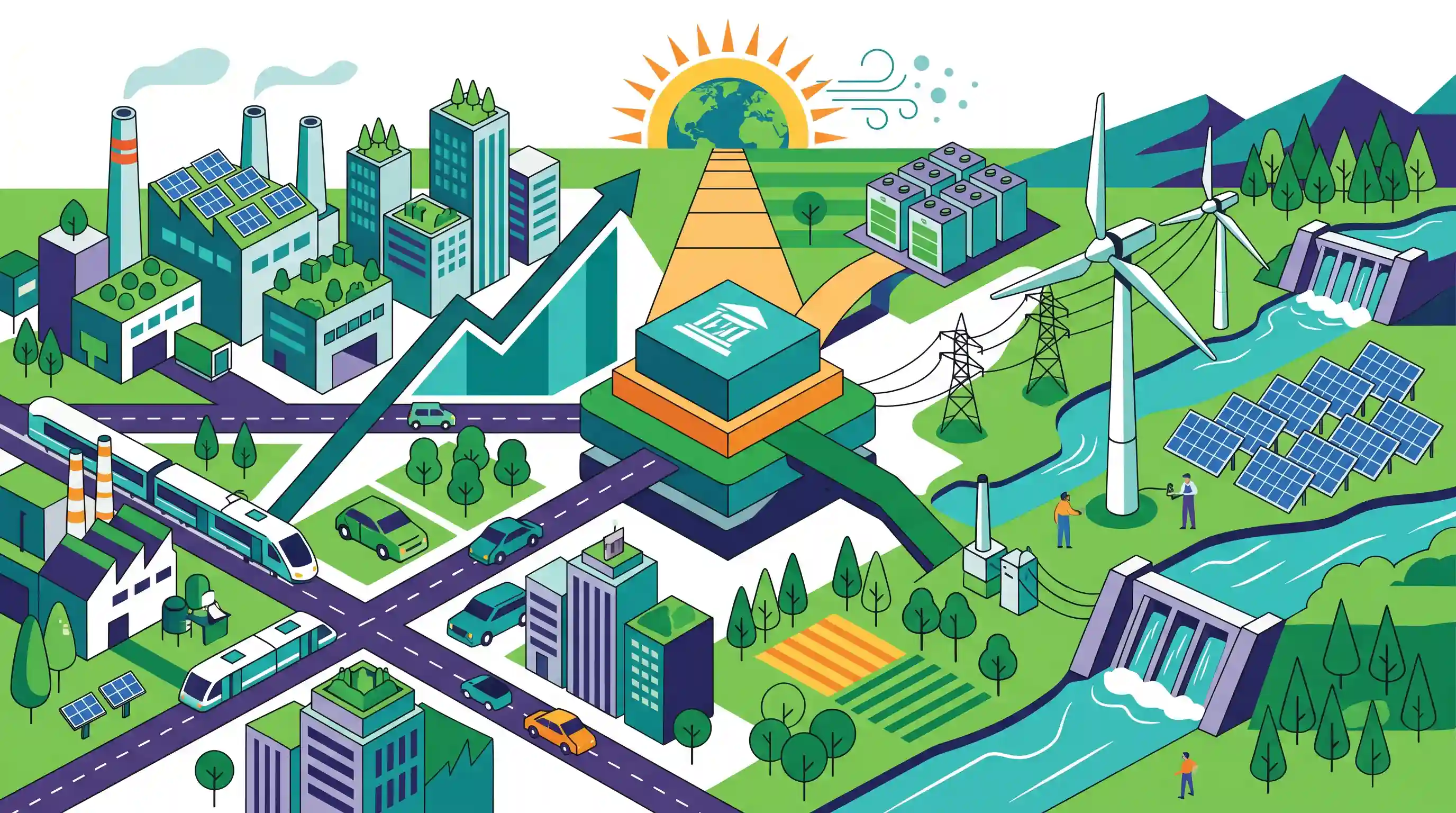
In an opinion piece on the Union Budget 2026, Sumant Sinha highlights the government's strategic focus on building India’s green capacity over the next decade. The budget is seen as a blueprint for marrying industrial growth with the green transition, ensuring that economic expansion does not come at the cost of sustainability. By prioritizing renewable energy investments and green infrastructure, the budget aims to build a resilient economy capable of achieving long-term decarbonization targets while mitigating global energy supply vulnerabilities.
Key Points
- The Union Budget 2026 emphasizes building India's green capacity to drive sustainable industrial growth over the coming decade.
- Investments in green energy infrastructure and capacity building are positioned as central to making the Indian economy resilient against global energy shocks and climate challenges.
- The budget initiatives align with India's long-term climate commitments, focusing on decarbonization and accelerating the renewable energy transition.
- Strategic shifts in budgetary support aim to balance rapid industrial expansion with the overarching goal of sustainability and green transition.
Important Terms
Net Zero 2070

India's pledge at COP26 to achieve a balance between greenhouse gas emissions produced and removed from the atmosphere by the year 2070.
UPSC context
GS Paper III (Environment/Climate Change); essential for understanding India's long-term climate commitments and international negotiations.
Panchamrita
The five-fold climate action plan announced by India at COP26, including targets for non-fossil capacity, renewable energy share, carbon emission reduction, and carbon intensity.
UPSC context
GS Paper III (Environment); frequently tested in Prelims and Mains regarding India's Nationally Determined Contributions (NDCs).
Union Budget 2026
A strategic financial blueprint for FY 2026-27 that prioritized infrastructure, green growth, and fiscal consolidation with a deficit target of approximately 4.3-4.4% of GDP.
UPSC context
GS Paper III (Economy/Budgeting); tests knowledge of current fiscal priorities and green investment allocations.
PM Surya Ghar Muft Bijli Yojana
A flagship government scheme providing subsidies and free electricity up to 300 units per month to 1 crore households through rooftop solar installations.
UPSC context
GS Paper III (Energy/Social Justice); relevant for government schemes and decentralized renewable energy adoption.
Carbon Capture, Utilisation, and Storage (CCUS)
Technology that captures CO2 emissions at source to prevent atmospheric release, identified as a priority in Budget 2026 with a ₹20,000 crore allocation.
UPSC context
GS Paper III (Science & Tech/Environment); critical for the 'hard-to-abate' industrial decarbonization strategy.
National Green Hydrogen Mission
A strategic initiative to make India a global hub for the production and export of hydrogen generated through renewable energy sources.
UPSC context
GS Paper III (Infrastructure/Energy); key for discussions on energy security and the 2030 transition targets.
Hard-to-abate sectors
Industrial segments like steel, cement, and chemicals where emissions are technically difficult or expensive to reduce without specialized technology like green hydrogen or CCUS.
UPSC context
GS Paper III (Industrial Growth/Environment); identifies specific challenges in achieving comprehensive national decarbonization.
Prelims Trap
India's updated NDC commits to meeting 50% of its total energy requirements from renewable sources by 2030.
The formal NDC targets 50% of cumulative electric power *installed capacity* from non-fossil sources, not total energy consumption. Aspirants frequently conflate installed capacity with actual energy generation/needs.
Static Concepts Connected
What are the updated targets under India's Nationally Determined Contributions (NDCs)?
- Emission Intensity: Reduce emission intensity of its GDP by 45% by 2030, compared to 2005 levels.
- Installed Capacity: Achieve 50% cumulative electric power installed capacity from non-fossil fuel-based energy resources by 2030.
- Carbon Sink: Create an additional carbon sink of 2.5 to 3 billion tonnes of CO2 equivalent by 2030 through additional forest and tree cover.
What makes certain industries 'hard-to-abate' in the green transition?
- Definition: Sectors like steel, cement, and fertilizers where cutting carbon emissions is technologically challenging or prohibitively expensive.
- Core Challenge: They require extremely high-temperature heat or rely on chemical processes (like calcination in cement) that inherently release carbon dioxide.
- Mitigation Tools: Decarbonization relies heavily on unscaled technologies like Green Hydrogen and Carbon Capture, Utilisation, and Storage (CCUS).
Cross-Topic Patterns
Green transition vs. critical mineral dependency
Expanding RE capacity shifts India's strategic vulnerability from Middle Eastern oil to Chinese-dominated supply chains for lithium and rare earths, elevating the importance of the Mineral Security Partnership.
Climate finance & Sovereign Green Bonds
Meeting the estimated $10 trillion requirement for Net-Zero by 2070 necessitates massive domestic and global climate finance, making RBI's Sovereign Green Bonds a recurring macroeconomic theme.

Expect a 2026 Prelims question mapping 'hard-to-abate' sectors to specific mitigation technologies like CCUS and Green Hydrogen.
Linked PYQs · 4
Linked PYQs · 4
- 2022MainsGS3
Do you think India will meet 50 percent of its energy needs from renewable energy by 2030 ? Justify your answer. How will the shift of subsidies from fossil fuels to renewables help achieve the above objective ? Explain.
- 2021MainsGS3
“Investment in infrastructure is essential for more rapid and inclusive economic growth.” Discuss in the light of India's experience.
- 2017MainsGS3
One of the intended objectives of the Union Budget 2017-18 is to 'transform, energise and clean India'. Analyse the measures proposed in the Budget 2017-18 to achieve the objective.
- 2019MainsGS3
It is argued that the strategy of inclusive growth is intended to meet the objectives of inclusiveness and sustainability together. Comment on this statement.
