Union Budget announces regional medical hubs to boost medical tourism
Source:The Hindu ↗
Why It Matters
The development of medical hubs and the focus on traditional medicine are significant for India's economic growth and soft power. Medical tourism attracts foreign exchange, while the integration of AYUSH into mainstream healthcare and global health networks (like WHO) elevates India's status as a global wellness destination. This relates directly to the GS2 syllabus regarding the development and management of social sectors relating to health.
Summary
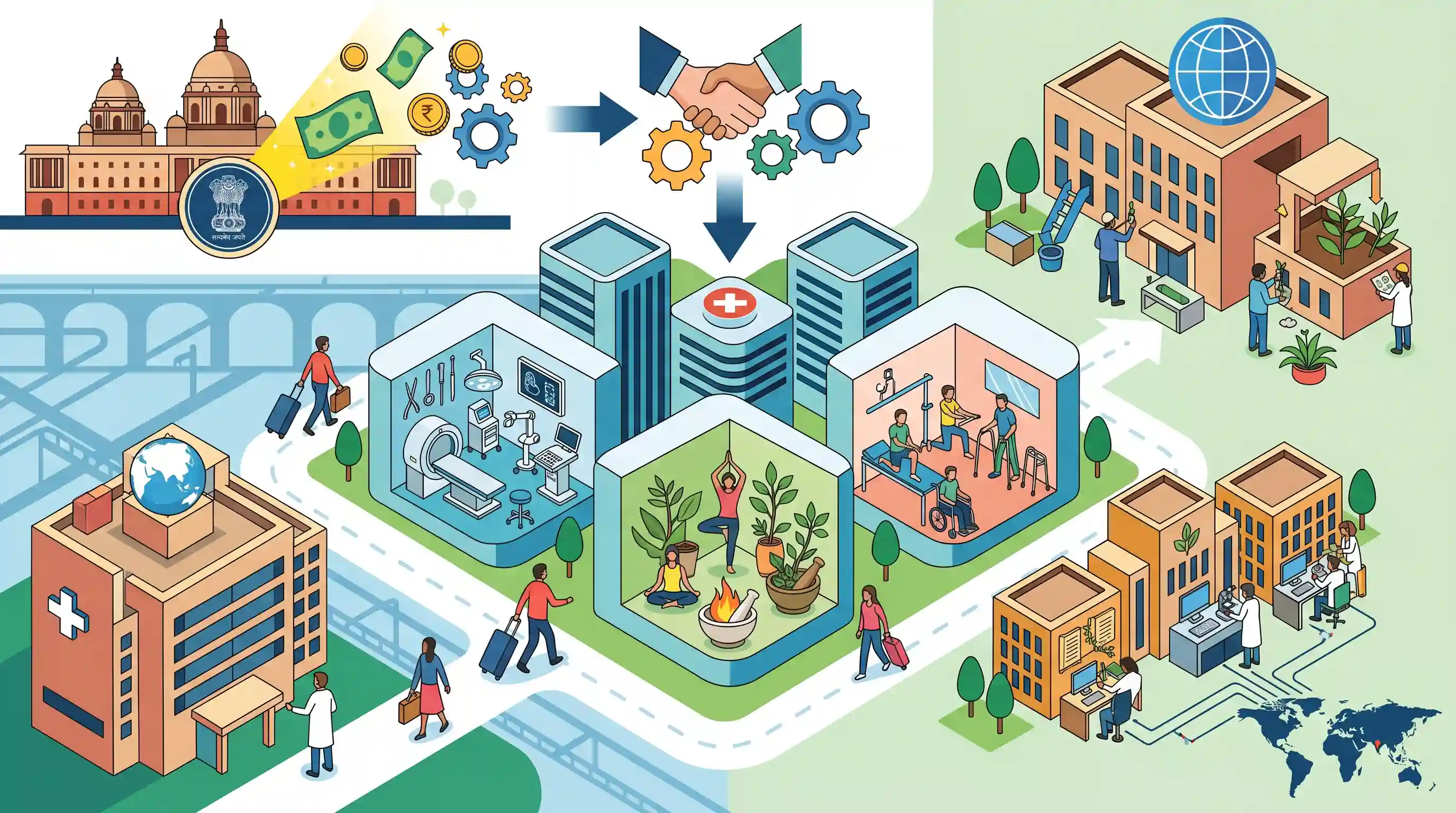
The Union Budget 2026-27 has announced the establishment of five regional medical hubs in partnership with the private sector to promote 'medical value tourism' (MVT) in India. These hubs will function as integrated healthcare complexes offering a blend of modern medical treatments, AYUSH facilities, and post-care rehabilitation. To further solidify India's position in global health and wellness, the budget also allocates funds to upgrade the WHO Global Traditional Medicine Centre in Jamnagar and establish three new All India Institutes of Ayurveda, emphasizing evidence-based research and the global integration of traditional Indian medicine.
Key Points
- The Union Budget proposes five regional medical hubs developed with the private sector to boost medical value tourism (MVT) in India.
- These integrated complexes will offer comprehensive services including modern medicine, AYUSH centres, diagnostics, and post-care rehabilitation.
- The WHO Global Traditional Medicine Centre in Jamnagar will be upgraded to bolster evidence-based research, training, and awareness for traditional medicine.
- Three new All India Institutes of Ayurveda will be established to strengthen research in traditional Indian medicine.
- The government will also upgrade Ayush pharmacies and drug testing laboratories to improve the quality of traditional medicines.
Important Terms
Medical Value Tourism (MVT)

The practice of traveling across international borders to seek medical services, ranging from complex surgeries to holistic wellness treatments. India aims to position itself as a global leader via the 'Heal in India' campaign.
UPSC context
GS Paper 2 (Health) and GS Paper 3 (Economy); tested for potential in foreign exchange earnings and global healthcare integration.
AYUSH
An acronym for Ayurveda, Yoga & Naturopathy, Unani, Siddha, Sowa-Rigpa, and Homoeopathy. This Ministry oversees the development and scientific validation of India's traditional and alternative medicine systems.
UPSC context
GS Paper 2 (Social Sector - Health); critical for understanding pluralistic healthcare and India’s soft power in global wellness.
WHO Global Centre for Traditional Medicine (GCTM)
The first global outposted knowledge centre for traditional medicine, established in Jamnagar, Gujarat, to develop standards, evidence-based research, and data for traditional medicine systems worldwide.
UPSC context
GS Paper 2 (International Relations & Health); signifies India’s leadership in institutionalizing traditional medicine at a global level.
All India Institute of Ayurveda (AIIA)
The apex autonomous institution under the Ministry of AYUSH, modeled after AIIMS, designed to bring synergy between traditional Ayurveda and modern diagnostic tools through research and tertiary care.
UPSC context
GS Paper 2 (Health Infrastructure); important for questions on standardizing traditional medical education and evidence-based clinical practices.
Public-Private Partnership (PPP)
A cooperative arrangement between government and private entities to provide public services. In healthcare, the public sector ensures equity while the private sector contributes capital and operational efficiency.
UPSC context
GS Paper 3 (Infrastructure and Investment Models); relevant for health infrastructure development and sustainable financing strategies in the Union Budget.
Prelims Trap
The five regional medical hubs will be exclusively owned and operated by the Union Ministry of Health.
These hubs are explicitly proposed to be developed under a Public-Private Partnership (PPP) model to boost Medical Value Tourism, not as solely government-run hospitals.
Static Concepts Connected
How does Medical Tourism fit into the WTO GATS framework?
- Mode 2: Medical tourism is classified as 'Consumption Abroad', where foreign patients travel to India to avail healthcare services.
- Mode 4: Contrasts with Mode 4 (Movement of Natural Persons), which covers Indian doctors travelling abroad to treat patients.
What is the WHO Global Centre for Traditional Medicine (GCTM)?
- Global Outpost: Established in Jamnagar, Gujarat, it is the first and only global outpost centre for traditional medicine worldwide, heavily supported by the Government of India.
- Core Mandate: Focuses on evidence-based research, data analytics, sustainability, and standardising global norms for traditional medical practices.
Cross-Topic Patterns
Medical Pluralism & Services Export
Merging modern medicine with AYUSH aligns GS2 health policy with GS3 services export, driving the 'Heal in India' initiative to boost foreign exchange earnings.
Traditional Knowledge & Biopiracy
Upgrading AYUSH labs and standardising traditional medicine directly strengthens India's Traditional Knowledge Digital Library (TKDL) framework against international patent biopiracy.

Expect a multi-statement Prelims question on WHO GCTM's location and mandate, or a GS2 Mains question on India's MVT potential.
Linked PYQs · 2
Linked PYQs · 2
- 2024MainsGS2
In a crucial domain like the public healthcare system the Indian State should play a vital role to contain the adverse impact of marketisation of the system. Suggest some measures through which the State can enhance the reach of public healthcare at the grassroots level.
- 2020MainsGS2
Critically examine the role of WHO in providing global health security during the Covid-19 pandemic.
