Opposition criticises Union Budget for failing to address unemployment
Source:The Hindu ↗
Why It Matters
The debate over the Union Budget underscores central macroeconomic themes for UPSC aspirants: the tension between corporate-led growth and broad-based inclusive development, the critical role of MSMEs in employment generation, and the challenge of jobless growth in the Indian economy.
Summary
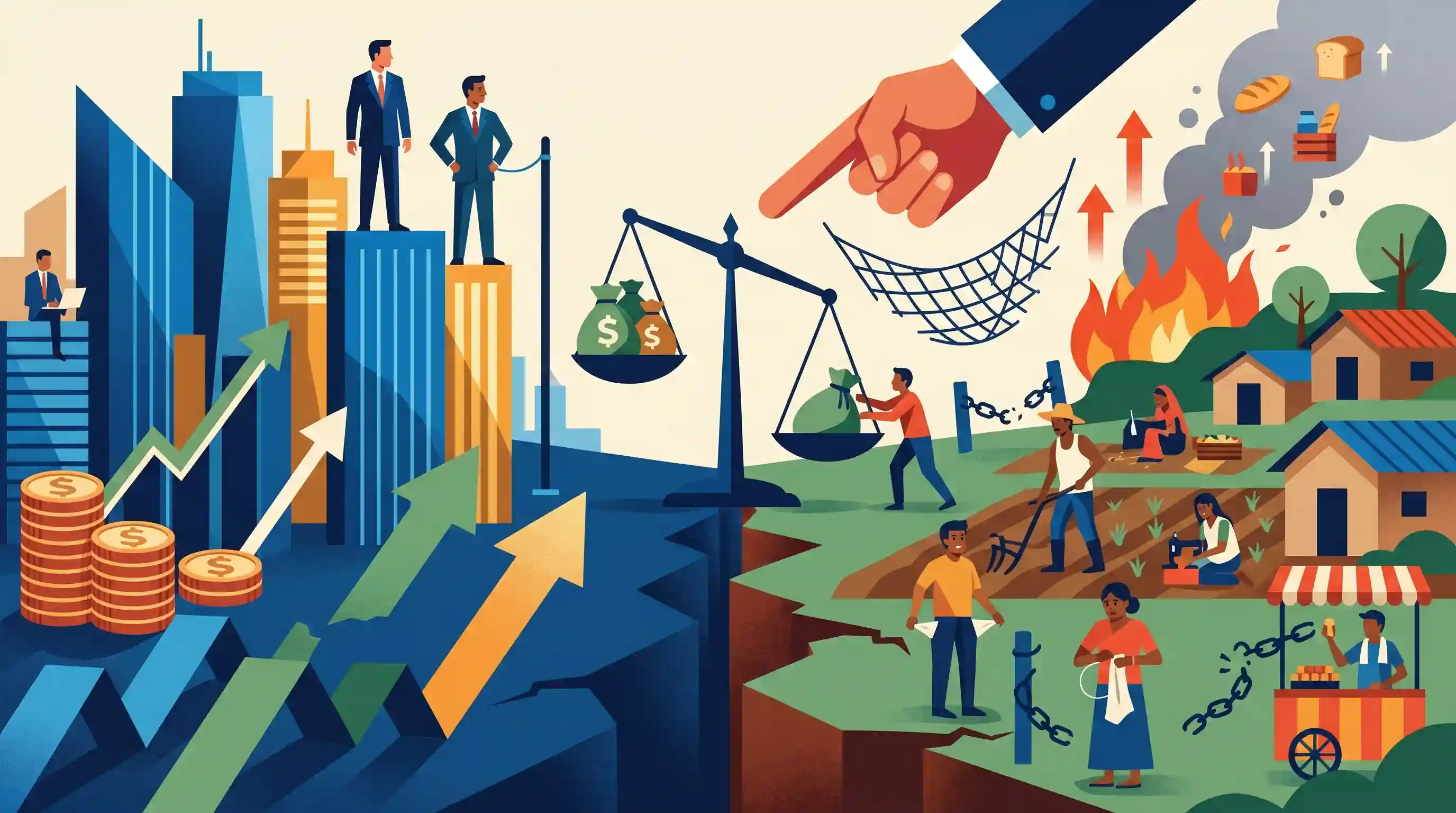
The Congress party strongly criticized the Union Budget 2026-27, alleging that it fails to tackle the critical issue of unemployment. Political leaders argued that the budget's economic policies disproportionately favor large corporates while ignoring the informal sector, farmers, and MSMEs—sectors that form the backbone of employment generation in India. Critics emphasized the need for policies focused on broad-based inclusive growth rather than rhetoric, warning that jobless growth exacerbates inflation and weakens public welfare.
Key Points
- Congress leader Valluru Bhargav criticized the Union Budget 2026-27 for failing to address India's high unemployment rate and stagnant real wages.
- He highlighted that the budget neglected MSMEs, farmers, and the informal sector, which are the primary engines of job creation.
- The government was accused of prioritizing a small group of large corporates over policies promoting broad-based inclusive growth.
- Tamil Nadu Chief Minister M.K. Stalin also criticized the Budget for ignoring the state's demands.
Important Terms
Union Budget

Known as the 'Annual Financial Statement' under Article 112, it estimates the government's receipts and expenditures for a financial year (April 1 to March 31).
UPSC context
GS Paper II & III (Budgeting); tests constitutional mandates, fiscal policy, and resource mobilization.
MSME Sector
Enterprises classified by investment and turnover thresholds; they are the "backbone" of India's economy, contributing significantly to GDP, manufacturing, and exports.
UPSC context
GS Paper III (Industrial Policy/Inclusive Growth); tests employment generation and grassroots economic activity.
Inclusive Growth
Economic growth that benefits all sections of society, ensuring equitable distribution of wealth and opportunities, particularly for the poor and marginalized.
UPSC context
GS Paper III (Issues relating to planning/growth); central to developmental justice and poverty reduction strategies.
Jobless Growth
An economic condition where the GDP increases without a corresponding or proportional increase in the creation of employment opportunities.
UPSC context
GS Paper III (Employment); tests the demographic dividend and structural shifts toward capital-intensive sectors.
Informal Economy
The part of the economy consisting of jobs and businesses without formal registration, legal protections, or social security benefits for workers.
UPSC context
GS Paper III (Indian Economy/Labor); tests formalization challenges and social security for vulnerable workers.
Prelims Trap
"High GDP growth inherently eliminates jobless growth and increases real wages for the informal sector."
Jobless growth means GDP expands without proportional job creation (low employment elasticity). Real wages can also stagnate or fall if inflation outpaces nominal wage growth.
Static Concepts Connected
How is 'Jobless Growth' economically defined and measured?
- Employment Elasticity: Measures how employment responds to GDP growth. Jobless growth implies an employment elasticity close to zero.
- Capital Intensity: Growth driven by capital-intensive sectors (tech, heavy industry) rather than labor-intensive ones (textiles, agriculture) often causes jobless growth.
What is the official classification criteria for MSMEs in India?
- Micro Enterprise: Investment in Plant & Machinery/Equipment ≤ ₹1 crore and Annual Turnover ≤ ₹5 crore.
- Small Enterprise: Investment in Plant & Machinery/Equipment ≤ ₹10 crore and Annual Turnover ≤ ₹50 crore.
- Medium Enterprise: Investment in Plant & Machinery/Equipment ≤ ₹50 crore and Annual Turnover ≤ ₹250 crore.
Cross-Topic Patterns
Jobless Growth & Demographic Dividend
India's demographic window closes around 2055. Jobless growth turns this potential dividend into a demographic liability, leading to underutilized human capital and potential social unrest.
MSME Formalization & Credit Gap
Despite the Udyam registration portal, the vast majority of micro-enterprises remain informal. This limits their access to Priority Sector Lending and exacerbates the structural credit gap.

Expect a 2026 prelims question linking PLFS trends (stagnant real wages, informalization) directly with 'employment elasticity of growth'.
Linked PYQs · 5
Linked PYQs · 5
- 2022MainsGS3
Economic growth in the recent past has been led by increase in labour productivity." Explain this statement. Suggest the growth pattern that will lead to creation of more jobs without compromising labour productivity.
- 2023MainsGS3
Faster economic growth requires increased share of the manufacturing sector in GDP, particularly of MSMEs. Comment on the present policies of the Government in this regard.
- 2016MainsGS3
How globalization has led to the reduction of employment in the formal sector of the Indian economy? Is increased informalization detrimental to the development of the country?
- 2022MainsGS3
Is inclusive growth possible under market economy ? State the significance of financial inclusion in achieving economic growth in India.
- 2020MainsGS3
Explain intra-generational and inter-generational issues of equity from the perspective of inclusive growth and sustainable development.
