Experts urge funding for ground level wildlife conservation
Source:The Hindu ↗
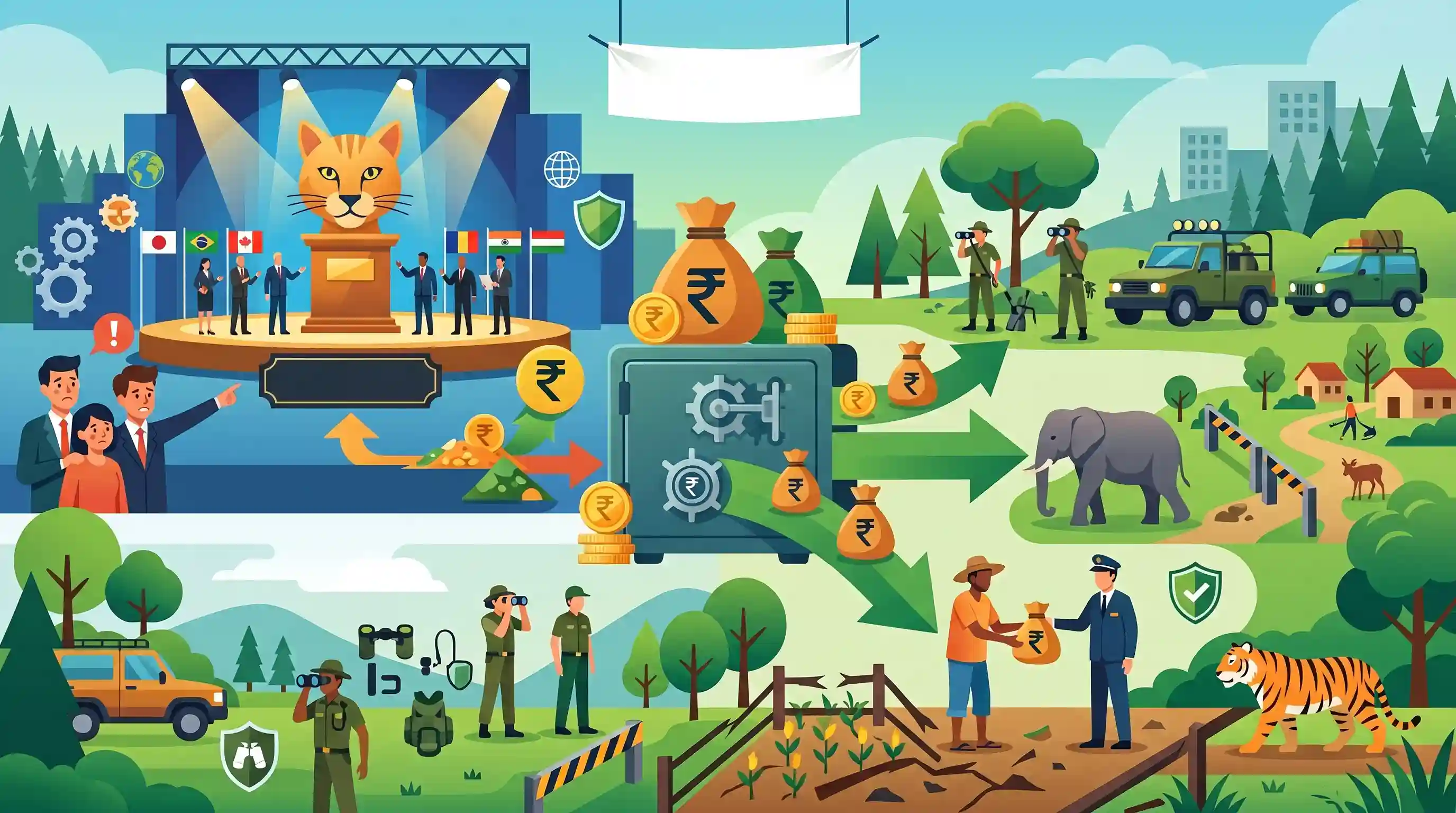
Why It Matters
Highlights the critical debate between government spending on international environmental diplomacy (soft power) versus addressing urgent, practical conservation challenges like human-animal conflict at the grassroots level.
Summary
Wildlife conservation experts have criticized the Union Budget's focus on international diplomacy, specifically the allocation of ₹150 crore for the International Big Cat Alliance (IBCA) and the announcement of a Global Big Cat Summit. Conservationists like K. Ullas Karanth and Sanjay Gubbi argue that the priority for funding should be ground-level issues, notably the growing human-wildlife conflict in India. They contend that resources would be better spent on mitigating these conflicts, providing fair compensation to affected communities for agricultural and livestock losses, and implementing practical wildlife protection measures rather than spending on administrative overheads and summits.
Key Points
- The Union Budget announced that India will host the first-ever Global Big Cat Summit, and the International Big Cat Alliance (IBCA) will be headquartered in India with ₹150 crore support over five years.
- Wildlife conservation experts criticize this allocation, arguing that funding should prioritize practical, ground-level conservation rather than high-profile international summits.
- Experts emphasize that India faces severe human-wildlife conflict issues, and funds are urgently needed for adequate compensation for crop damage, livestock loss, and human casualties.
- There is a call to shift focus from environmental soft diplomacy to addressing the real challenges faced by communities living near wildlife and improving on-ground conservation infrastructure.
Important Terms
Union Budget

Commonly known as the Annual Financial Statement (Article 112), it outlines the Indian government's estimated receipts and expenditures for a specific fiscal year (April 1 to March 31).
UPSC context
GS-III: Government Budgeting. Tests understanding of fiscal policy, constitutional mandates, and national resource allocation strategies.
International Big Cat Alliance (IBCA)
An India-led treaty-based intergovernmental organization launched to conserve seven big cat species—tiger, lion, leopard, snow leopard, cheetah, jaguar, and puma—across 95 range countries.
UPSC context
GS-III: Environment and Biodiversity. Tests knowledge of global conservation frameworks and India’s leadership in wildlife diplomacy.
Human-Wildlife Conflict
Negative interactions between humans and wild animals resulting in loss of life, crops, or livestock, typically caused by habitat fragmentation and competition for resources.
UPSC context
GS-III: Environment and Biodiversity. Tests understanding of conservation challenges, community-led mitigation, and socio-economic impacts of habitat loss.
Global Big Cat Summit
A first-of-its-kind international meeting announced in the 2026-27 Union Budget, bringing together leaders from 95 range countries to deliberate on collective big cat conservation strategies.
UPSC context
GS-III: Environment and International Relations. Tests awareness of recent environmental initiatives and India's role in global wildlife governance.
Prelims Trap
"The IBCA aims to conserve seven big cat species, all of which are naturally found in India."
India naturally hosts only five of these species (Tiger, Lion, Leopard, Snow Leopard, Cheetah). Jaguar and Puma are native to the Americas.
Static Concepts Connected
How do Critical Tiger Habitats differ from Critical Wildlife Habitats?
- CTH legal backing: Declared under the Wild Life (Protection) Act, 1972 by State Governments on the recommendation of the NTCA.
- CWH legal backing: Declared under the Forest Rights Act, 2006 by the MoEFCC to ensure inviolate areas while settling traditional forest rights.
What is the International Big Cat Alliance (IBCA)?
- Target species: Focuses on conserving seven apex cats globally: Tiger, Lion, Leopard, Snow Leopard, Cheetah, Jaguar, and Puma.
- Core mandate: Headquartered in New Delhi, it unites 95 natural range countries to combat wildlife crime, share best practices, and mobilize finance.
Cross-Topic Patterns
Environmental Soft Diplomacy Initiatives
India's IBCA push mirrors its strategy with the ISA and CDRI, positioning New Delhi as an institutional hub for global environmental governance rather than just a participant.
Conservation Finance vs Local HWC
Union budget allocations prioritizing international summits over ground-level conservation can strain State resources, aggravating local human-wildlife conflicts (HWC) and delaying compensation payouts.

Expect a 2026 prelims statement mixing IBCA target species (Jaguar/Puma) with India's native fauna, paired with M-STRIPES application.
Linked PYQs · 3
Linked PYQs · 3
- 2019PrelimsGS1
Consider the following pairs: Wildlife Naturally found in 1. Blue-finned Mahseer : Cauvery River 2. Irrawaddy Dolphin : Chambal River 3. Rusty-spotted Cat : Eastern Ghats Which of the pairs given above are correctly matched?
- 2020PrelimsGS1
Among the following Tiger Reserves, which one has the largest area under "Critical Tiger Habitat"?
- 2017PrelimsGS1
The term 'M-STRIPES' is sometimes seen in the news in the context of
