Primary Healthcare Funding and Budget Allocation Imperatives
Source:Indian Express ↗
Why It Matters
Provides critical arguments and analytical backing on public health financing, grassroots infrastructure, and fiscal priorities for welfare governance questions in GS Paper 2.
Summary
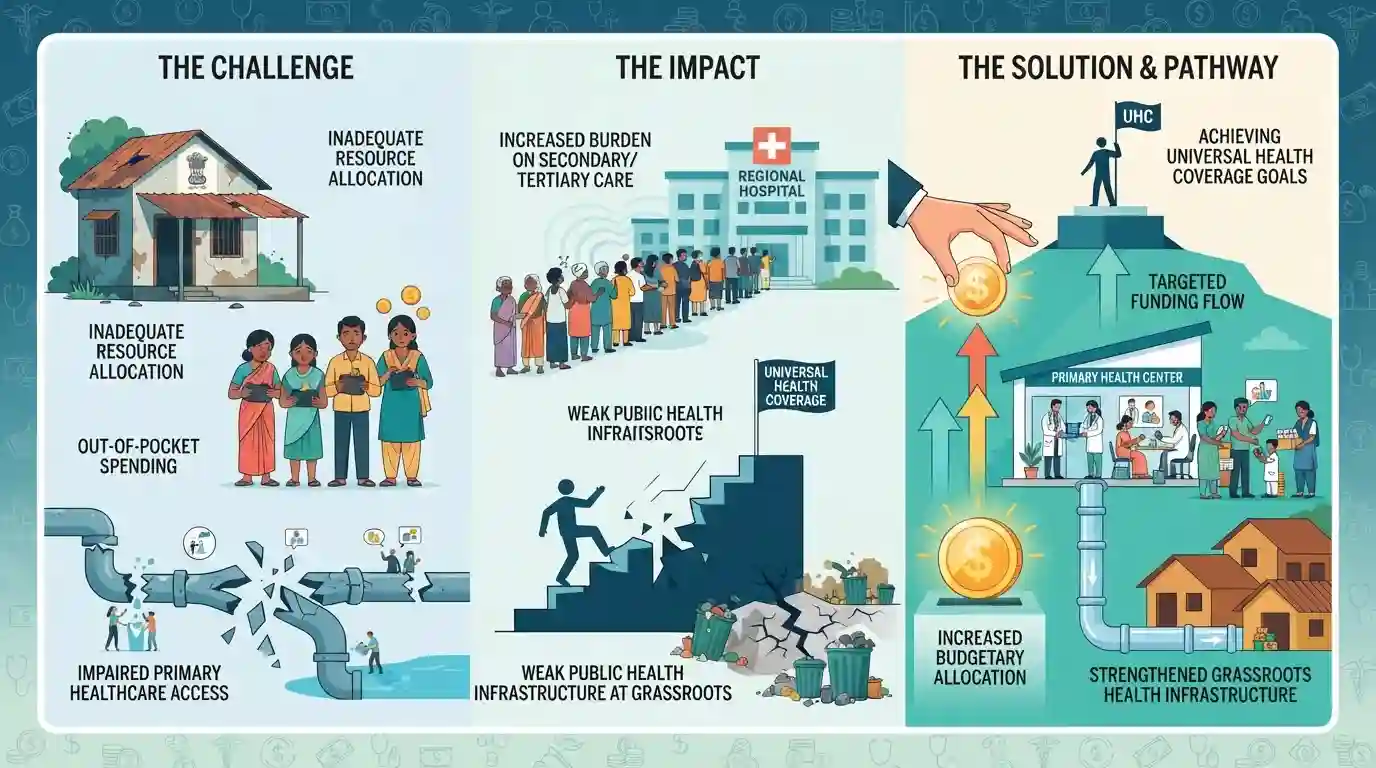
The article highlights the critical need for increased funding towards primary healthcare in the Union Budget. It examines how inadequate resource allocation at the grassroots level impacts public health infrastructure, increases out-of-pocket spending, and impedes universal health coverage objectives in India.
Key Points
- Primary healthcare in India requires enhanced financial resource allocation in the Union Budget to bridge systemic gaps.
- Strengthening grassroots public health infrastructure is essential to reduce out-of-pocket expenditure for vulnerable populations.
- Adequate investment in preventive and primary care acts as a precondition for sustainable human capital and inclusive growth.
- Decentralised healthcare delivery models need sustained funding support to meet universal health coverage goals.
Important Terms
National Health Mission

India's flagship public health program aimed at providing universal access to equitable, affordable, and quality healthcare services, focusing particularly on rural and urban grassroots infrastructure and maternal-child health.
UPSC context
GS Paper 2 (Social Sector - Health). Tests understanding of government interventions, public health delivery, and welfare scheme implementation.
Union Budget
The annual financial statement of the Government of India under Article 112, detailing projected receipts and expenditures to drive economic growth and welfare policy.
UPSC context
GS Paper 3 (Indian Economy and Budgeting). Tests fiscal policy, public finance management, and resource allocation priorities.
Prelims Trap
India's public health expenditure has successfully met the 2.5% of GDP target recommended by NHP 2017.
Aspirants often confuse the National Health Policy (NHP) 2017 target of 2.5% of GDP for public health expenditure with the actual current expenditure, which hovers around 1.5% to 1.8%.
Static Concepts Connected
What are the key financing and structural targets under the National Health Policy (NHP) 2017?
- Expenditure Goal: GDP Target: Incremental increase in public health expenditure to 2.5% of the GDP by 2025.
- Primary Focus: State Allocation: Allocation of major proportion (up to two-thirds or more) of resources to primary care.
- Risk Reduction: Financial Protection: Aspirational goal of reducing proportion of households facing catastrophic health expenditure by 25%.
- Infrastructure: Health Security: Establishment of a nationwide digital health framework and mainstreaming AYUSH systems.
Cross-Topic Patterns
Public Health Expenditure vs Inclusive Growth
Public health expenditure below 2% of GDP strains household finances, directly undermining the social infrastructure pillar required for inclusive growth and poverty reduction goals.
Fiscal Federalism and Healthcare Financing
Sub-centre and PHC strengthening under NHM highlights the critical fiscal federalism challenge of co-financing public health between the Centre and States.

Public health expenditure targets (NHP 2.5% GDP) and OOPE dynamics frequently appear in multi-statement prelims and mains governance questions.
Linked PYQs · 3
Linked PYQs · 3
- 2024MainsGS2
In a crucial domain like the public healthcare system the Indian State should play a vital role to contain the adverse impact of marketisation of the system. Suggest some measures through which the State can enhance the reach of public healthcare at the grassroots level.
- 2021MainsGS2
“Besides being a moral imperative of a Welfare State, primary health structure is a necessary precondition for sustainable development.” Analyze.
- 2018MainsGS2
Appropriate local community-level healthcare intervention is a prerequisite to achieve 'Health for All' in India. Explain.
