Primary Healthcare Funding and Budgetary Allocations in India
Source:Indian Express ↗
Why It Matters
It addresses the perennial policy challenge of public health underfunding, equitable access to primary healthcare at the grassroots, and the role of state policy in mitigating the marketization of healthcare services.
Summary
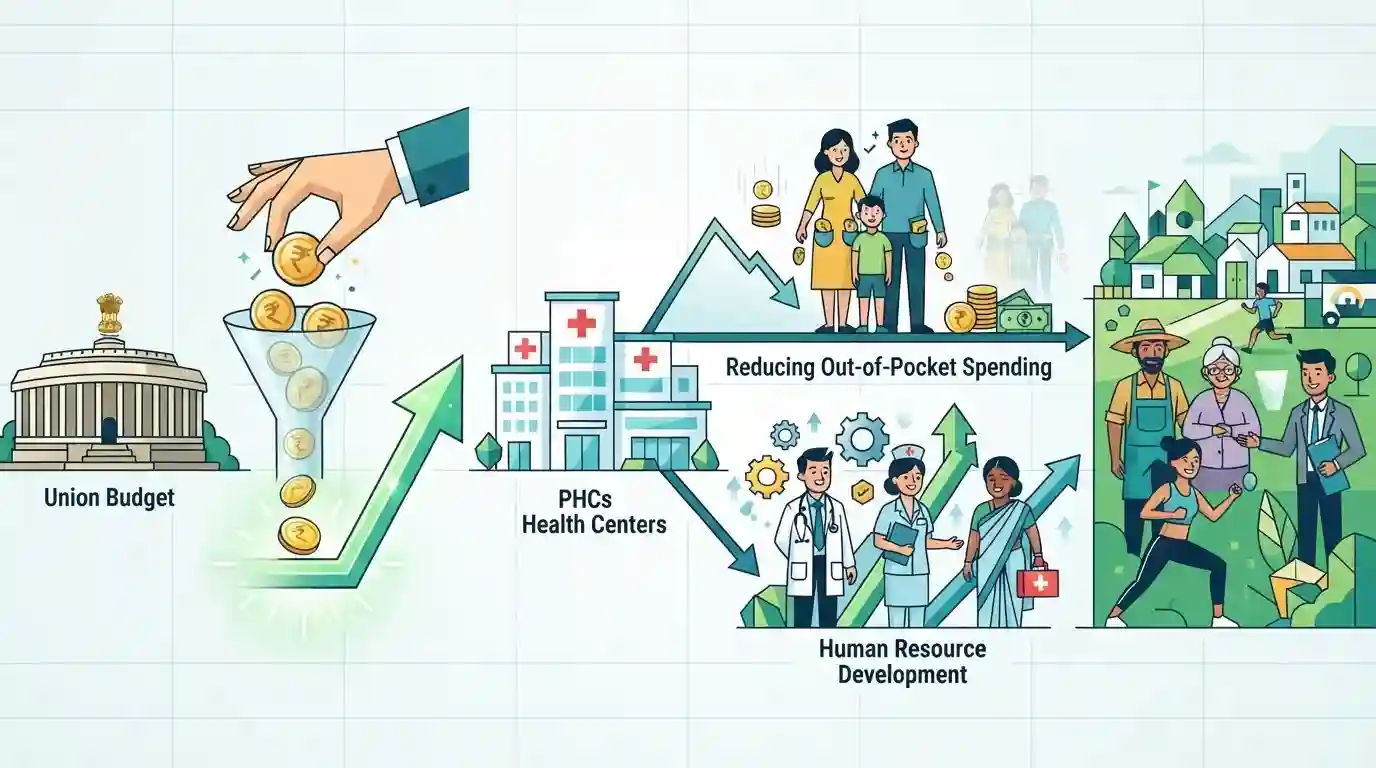
The article emphasizes the critical need for increased financial allocations toward primary healthcare in the Union Budget, arguing that grassroots health infrastructure is foundational for reducing out-of-pocket spending, enhancing human resource development, and ensuring equitable health access in India.
Key Points
- Primary healthcare acts as the bedrock for a robust health system, reducing out-of-pocket expenditure and pressure on tertiary care.
- Budget allocations for healthcare often disproportionately favor tertiary care infrastructure while grassroots primary networks face resource constraints.
- Strengthening public healthcare at the grassroots level requires enhanced funding, better human resource management, and robust community-level interventions.
- Focusing on preventive care through primary health infrastructure is vital to achieve inclusive growth and human resource development.
Important Terms
Union Budget

The annual financial statement of the estimated receipts and expenditure of the Government of India for a financial year, serving as a primary instrument of fiscal policy and socio-economic development.
UPSC context
Relevant to GS Paper III (Indian Economy & Budgeting) and GS Paper II (Government Policies & Social Sector).
Primary Health Centres (PHCs)
State-owned healthcare facilities designed to provide basic, accessible, and preventive healthcare services to rural populations as the first tier of the public health system.
UPSC context
Relevant to GS Paper II (Social Sector, Health, Human Resources) and public health administration in India.
Prelims Trap
India's public health expenditure consistently meets the mandated 2.5% of GDP target under the National Health Policy.
Aspirants often assume India meets the National Health Policy target of allocating 2.5% of GDP to public health, whereas actual central and state combined expenditure remains significantly lower.
Static Concepts Connected
What are the three tiers of India's public healthcare delivery system?
- Primary Tier: Sub-centres and Primary Health Centres act as the foundational grassroots tier providing preventive and basic curative care.
- Secondary Tier: Community Health Centres function as the secondary referral tier, providing specialized care for sub-district populations.
- Tertiary Tier: District hospitals and medical college hospitals constitute the tertiary tier offering advanced super-specialty care.
Cross-Topic Patterns
Health Sector + Rural Poverty Dynamics
High out-of-pocket medical expenditure remains a primary driver of household debt and poverty, directly undermining broader rural livelihood security and inclusive growth goals.
Public Finance + Healthcare Allocation Skew
Over-reliance on tertiary infrastructure highlights a structural flaw in public expenditure management, shifting resources away from preventive grassroots care to reactive urban curation.

Expect a statement-based question linking primary healthcare funding to the reduction of out-of-pocket expenditure and Universal Health Coverage goals.
Linked PYQs · 3
Linked PYQs · 3
- 2024MainsGS2
In a crucial domain like the public healthcare system the Indian State should play a vital role to contain the adverse impact of marketisation of the system. Suggest some measures through which the State can enhance the reach of public healthcare at the grassroots level.
- 2018MainsGS2
Appropriate local community-level healthcare intervention is a prerequisite to achieve 'Health for All' in India. Explain.
- 2023MainsGS2
The crucial aspect of development process has been the inadequate attention paid to Human Resource Development in India. Suggest measures that can address this inadequacy.
