Union Budget framework and external trade strategy for Viksit Bharat
Source:Indian Express ↗
Why It Matters
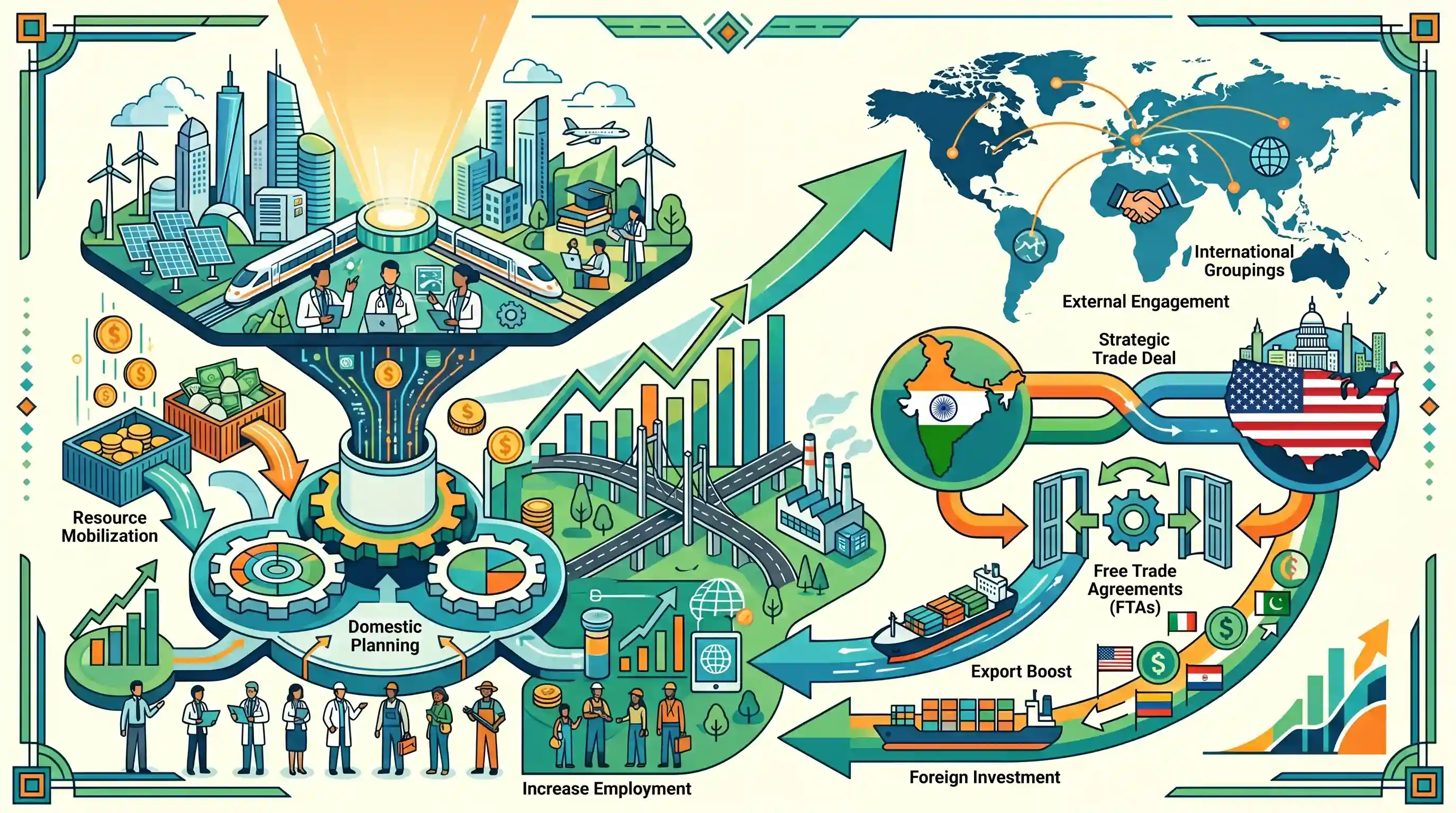
The intersection of domestic fiscal policy (Union Budget) and international trade (FTAs) is critical for UPSC aspirants to understand India's evolving economic strategy. The focus on a potential US-India trade deal underscores the growing importance of economic diplomacy and external integration in achieving the ambitious 'Viksit Bharat' goal.
Summary
The article explores the interplay between domestic economic planning and international trade in realizing India's 'Viksit Bharat' vision by 2047. It emphasizes the role of the Union Budget 2026 in laying the groundwork for sustained economic growth through domestic reforms. Crucially, these reforms must be complemented by strategic external engagement, particularly through securing Free Trade Agreements (FTAs). A comprehensive US-India trade deal is highlighted as a vital step to integrate India deeper into global value chains, enhance exports, and attract foreign investment, ultimately acting as a catalyst for long-term national development.
Key Points
- The Union Budget 2026 sets the foundational framework for India's long-term goal of becoming a developed nation ('Viksit Bharat') by 2047.
- A crucial component of this economic strategy is integration into global value chains through strategic Free Trade Agreements (FTAs).
- A potential US-India trade deal stands out as a significant milestone, aiming to boost bilateral trade and strengthen economic diplomacy between the two nations.
- The alignment of domestic fiscal policies (via the Budget) and external trade strategies is essential for sustained economic growth and job creation.
Important Terms
Viksit Bharat 2047

A long-term roadmap to transform India into a developed nation by 2047, targeting a $30-40 trillion economy, high per-capita income, and improved human development indicators.
UPSC context
Relevant for GS Paper III (Growth and Development); tests understanding of long-term economic planning and inclusive growth strategies.
Free Trade Agreement (FTA)
A pact between two or more countries to reduce or eliminate tariffs and non-tariff barriers, facilitating easier exchange of goods, services, and investment.
UPSC context
GS Paper II (International Relations) and GS Paper III (External Sector); tests knowledge of trade policy and global economic integration.
Union Budget 2026
The Annual Financial Statement (Article 112) for FY 2026-27, focusing on infrastructure (₹12.2 lakh crore CapEx), fiscal consolidation (4.3% deficit target), and structural reforms.
UPSC context
GS Paper III (Government Budgeting); tests ability to analyze fiscal policy, resource allocation, and constitutional provisions.
India-US Trade Deal
A 2026 agreement where the US reduced tariffs on Indian goods from 50% to 18%, while India committed to large-scale imports of US energy and technology.
UPSC context
GS Paper II (Bilateral Relations); crucial for understanding geo-economics and India's strategic alignment with the United States.
Global Value Chains (GVCs)
International production networks where different stages of a product's manufacturing or service delivery are located across multiple countries to maximize efficiency.
UPSC context
GS Paper III (Economy); tests understanding of export competitiveness, manufacturing, and India's integration into the global economy.
Prelims Trap
India currently benefits from the Generalized System of Preferences (GSP) in its bilateral trade with the United States.
The US revoked India's GSP status in 2019. While ongoing bilateral trade negotiations aim to restore it, GSP access is not currently active for Indian exporters.
Static Concepts Connected
What is the Generalized System of Preferences (GSP) in international trade?
- UNCTAD framework: Instituted under UNCTAD, it allows developed nations to grant preferential zero or low-tariff access to imports from developing countries.
- Non-reciprocal basis: Beneficiary developing nations are not required to lower their own tariffs in return for the preferential access granted by developed nations.
- Development objective: The primary goal is to promote economic growth, export diversification, and industrialization in developing countries.
How do Non-Tariff Barriers (NTBs) differ from ordinary customs tariffs?
- Regulatory restrictions: NTBs are non-tax policy measures, unlike direct ad-valorem customs duties, that restrict or complicate imports and exports.
- Common examples: Sanitary and Phytosanitary (SPS) measures, Technical Barriers to Trade (TBT), strict quotas, and complex import licensing rules.
- Disguised protectionism: Frequently used by developed nations to shield domestic industries from developing-country exports without violating WTO bound-tariff ceilings.
Cross-Topic Patterns
FTAs as geopolitical supply-chain tools
FTAs have evolved beyond pure market access. India uses them strategically to operationalize the 'China Plus One' policy and secure resilient supply chains outside the stagnating WTO multilateral order.
Domestic logistics + GVC integration
Budgetary reforms streamlining domestic logistics directly dictate India's ability to plug its MSMEs—which currently drive 45% of national exports—into competitive Global Value Chains (GVCs).

Expect a 2026 Mains question linking domestic fiscal reforms (Budget) with external FTA strategies to integrate India into GVCs.
Linked PYQs · 4
Linked PYQs · 4
- 2017MainsGS3
One of the intended objectives of the Union Budget 2017-18 is to 'transform, energise and clean India'. Analyse the measures proposed in the Budget 2017-18 to achieve the objective.
- 2022MainsGS3
Economic growth in the recent past has been led by increase in labour productivity." Explain this statement. Suggest the growth pattern that will lead to creation of more jobs without compromising labour productivity.
- 2019MainsGS3
The public expenditure management is a challenge to the Government of India in the context of budget making during the post-liberalization period. Clarify it.
- 2023MainsGS2
‘The expansion and strengthening of NATO and a stronger US-Europe strategic partnership works well for India.’ What is your opinion about this statement ? Give reasons and examples to support your answer.
