Union Budget priorities for healthcare and global diplomacy
Source:The Hindu ↗
Why It Matters
Provides a prominent private sector perspective on healthcare financing and policy expectations from the Union Budget. Highly relevant for GS2 questions analyzing the limitations of the public health system, the role of private players in universal health coverage, and India's emerging soft power in global health (medical tourism).
Summary
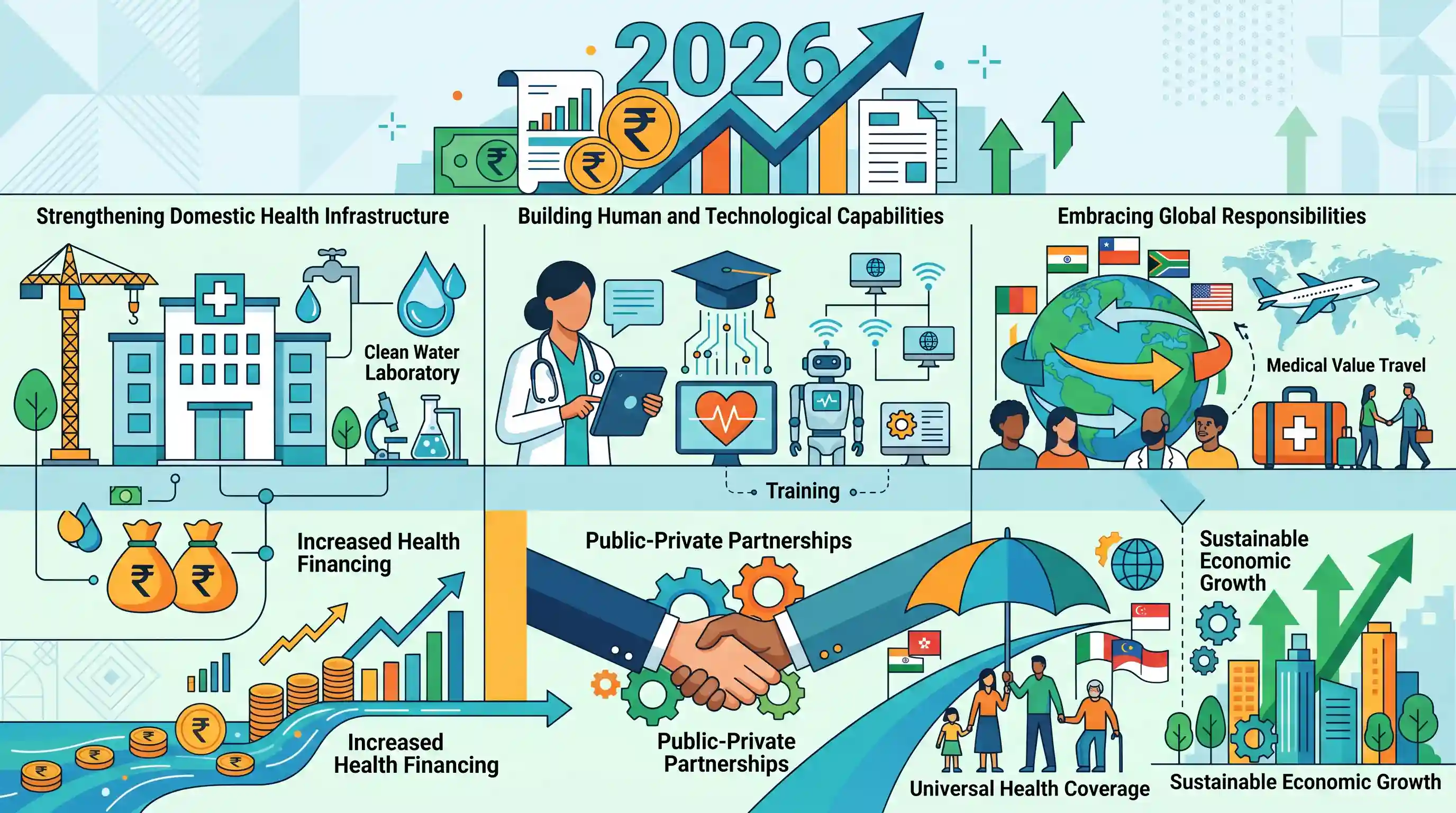
An industry viewpoint by Dr. Preetha Reddy on the Union Budget 2026, focusing on three core pillars: strengthening domestic health infrastructure, building human and technological capabilities, and embracing global responsibilities. The piece argues that increased health financing, skill development, and fostering India's position in Medical Value Travel are crucial for sustainable economic growth and global health diplomacy. It advocates for leveraging public-private partnerships to bridge gaps in universal health coverage.
Key Points
- Highlights the expectation for the Union Budget 2026 to increase public healthcare spending closer to the National Health Policy target of 2.5% of GDP.
- Emphasizes the need for capability building in the health sector through upskilling of medical professionals (doctors, nurses, paramedics) and integration of digital health solutions and AI.
- Underlines India's potential as a global healthcare hub, advocating for policies that promote Medical Value Travel (MVT) and bolster India's role as the 'pharmacy of the world'.
- Stresses that achieving Universal Health Coverage (UHC) requires robust Public-Private Partnerships (PPP) to expand accessibility and quality of healthcare at the grassroots level.
Important Terms
Union Budget 2026-27 (Health Focus)

India's annual financial statement for FY 2026-27, which notably allocated ₹1,06,530 crore to the Health Ministry, emphasizing domestic biopharma manufacturing and high-end medical infrastructure.
UPSC context
GS Paper 3: Government Budgeting. Tests understanding of sector-specific fiscal priorities and infrastructure-led growth strategies.
Ayushman Bharat (PM-JAY)
The world's largest health assurance scheme providing ₹5 lakh per family annually for secondary/tertiary hospitalization, targeting over 12 crore poor families and recently expanded to all seniors 70+.
UPSC context
GS Paper 2: Social Justice. Crucial for questions on universal health coverage, social safety nets, and vulnerable sections.
Heal in India
A government-led initiative to position India as a global medical tourism hub by streamlining medical visas and creating a centralized digital portal for international patients.
UPSC context
GS Paper 2: Government Policies. Tests knowledge of service exports and India's soft power in healthcare.
Medical Value Travel (MVT)
The practice of traveling across international borders to receive medical, dental, or wellness care, utilized by India as a strategic pillar for economic growth and international cooperation.
UPSC context
GS Paper 3: Indian Economy. Relevant for topics on services sector growth and foreign exchange earnings.
Public-Private Partnership (PPP) in Health
A collaborative model where the government and private sector jointly deliver public services, used in Budget 2026 to build Regional Medical Hubs and upgrade medical education infrastructure.
UPSC context
GS Paper 2/3: Governance and Infrastructure. Tests ability to analyze alternative service delivery models and their efficiency.
Global Health Diplomacy
The use of health interventions and cooperation (like vaccine supply or medical travel) as a tool for international relations, trust-building, and strengthening global ties.
UPSC context
GS Paper 2: International Relations. Tests understanding of India's role in the Global South and its 'Vasudhaiva Kutumbakam' ethos.
Universal Health Coverage (UHC)
Ensuring that all people have access to needed health services (prevention, treatment, etc.) of sufficient quality to be effective without experiencing financial hardship.
UPSC context
GS Paper 2: Issues relating to Health. A core objective often tested via health indicators and policy effectiveness.
Biopharma SHAKTI
A Budget 2026 initiative with a ₹10,000 crore outlay to boost domestic production of biologics and biosimilars, strengthening India’s position as a global biopharma manufacturing hub.
UPSC context
GS Paper 3: Science & Technology. Relevant for industrial policy, pharmaceutical self-reliance (Atmanirbharta), and high-end R&D.
Prelims Trap
"The National Health Policy mandates the Union Government alone to spend 2.5% of GDP on health."
Health is a State subject. The 2.5% of GDP target for public health expenditure is a combined target requiring collaborative spending by both the Centre and State governments.
Static Concepts Connected
How are Public-Private Partnerships (PPPs) structured in India's public healthcare sector?
- Management Contracts: Private entities manage public facilities like PHCs for a fixed fee or performance bonus, bringing administrative efficiency to rural setups.
- Build-Operate-Transfer: Private players build specialty care facilities on government-provided land in exchange for offering free or subsidized care to BPL patients.
- Strategic Purchasing: The government buys specific private healthcare services (e.g., diagnostics, dialysis) for citizens, acting as a payer rather than a provider under schemes like PM-JAY.
What are the core drivers of India's Medical Value Travel (MVT) ecosystem?
- Cost Arbitrage: World-class tertiary care procedures cost significantly less in India compared to developed nations, attracting patients globally.
- Heal in India: A targeted government initiative streamlining medical visas, standardizing hospital ratings, and deploying a unified digital portal for international patients.
- AYUSH Integration: Coupling modern allopathic treatments with traditional wellness therapies offers a uniquely Indian, holistic healing value proposition.
Cross-Topic Patterns
Health Diplomacy as Soft Power
India's 'Heal in India' MVT push and 'Pharmacy of the World' status combine to form a crucial soft-power tool, deeply linking domestic health policy with Global South diplomacy.
Digital Health + Privacy Laws
Integrating AI and the Ayushman Bharat Digital Mission (ABDM) introduces complex governance overlaps with the DPDP Act, requiring balance between tech-driven UHC and patient data privacy.

Mains 2026 could feature a 15-marker linking Ayushman Bharat Digital Mission (ABDM), AI in diagnostics, and PPPs in achieving UHC.
Linked PYQs · 4
Linked PYQs · 4
- 2024MainsGS2
In a crucial domain like the public healthcare system the Indian State should play a vital role to contain the adverse impact of marketisation of the system. Suggest some measures through which the State can enhance the reach of public healthcare at the grassroots level.
- 2015MainsGS2
Public health system has limitations in providing universal health coverage. Do you think that the private sector could help in bridging the gap? What other viable alternatives would you suggest?
- 2021MainsGS2
“Besides being a moral imperative of a Welfare State, primary health structure is a necessary precondition for sustainable development.” Analyze.
- 2024MainsGS3
Examine the pattern and trend of public expenditure on social services in the post-reforms period in India. To what extent this has been in consonance with achieving the objective of inclusive growth?
