Union Budget 2026 focuses on experiential and medical tourism growth
Source:Indian Express ↗
Why It Matters
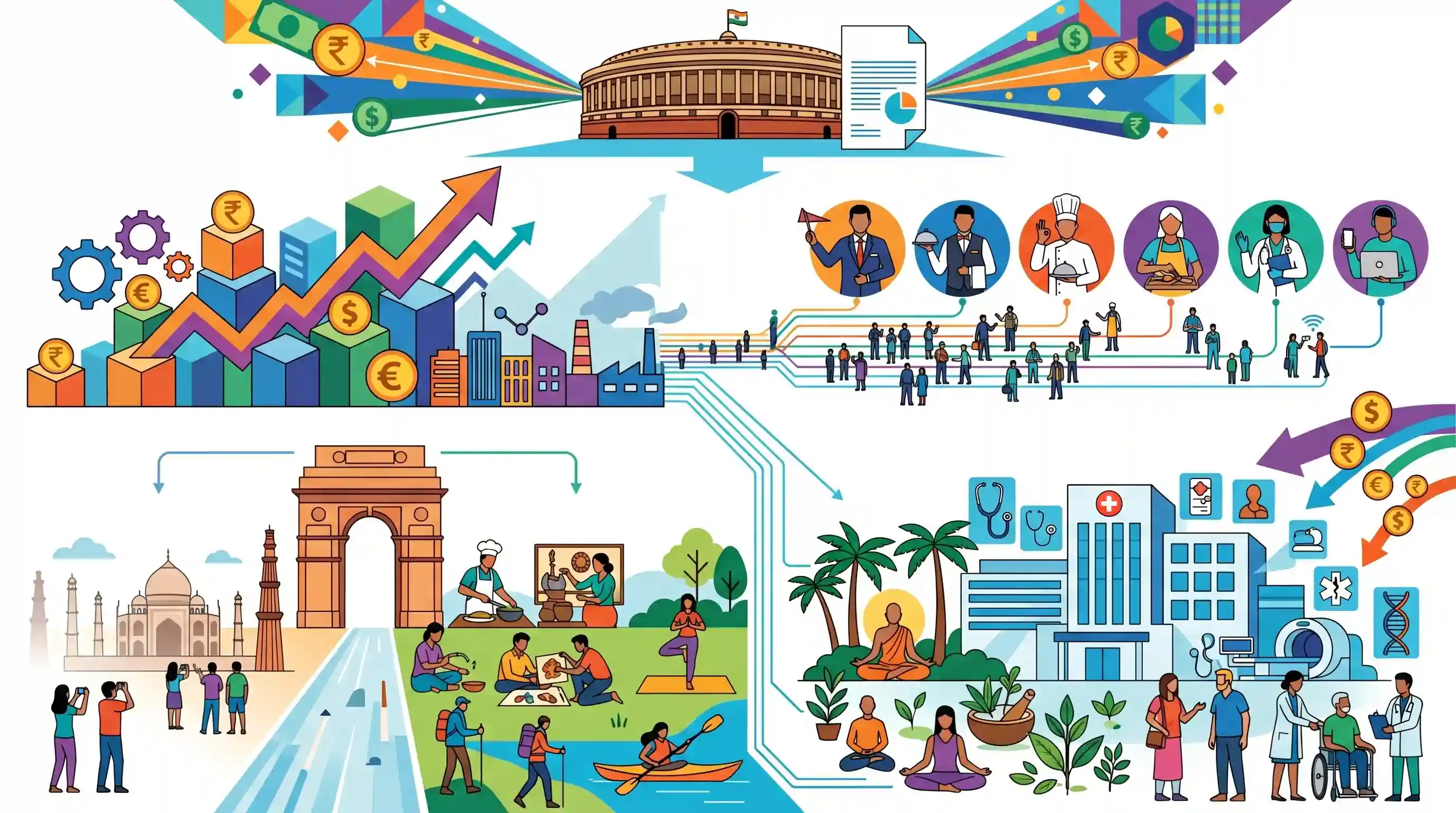
Tourism is a highly labor-intensive sector that provides significant employment opportunities and supports inclusive growth. The focus on medical tourism highlights the intersection of healthcare, services, and foreign exchange, making it a critical area for GS3 (Economy) and GS2 (Health).
Summary
The Union Budget 2026 outlines a comprehensive strategy to boost India's tourism sector, identifying it as a crucial pillar for economic growth and large-scale employment generation. The government plans to shift the focus towards experiential tourism, moving beyond traditional sightseeing, and to aggressively promote medical tourism by capitalizing on India's cost-effective healthcare and AYUSH services. This integrated approach aims to attract international visitors, increase foreign exchange earnings, and create diverse jobs in the service sector.
Key Points
- The Union Budget 2026 focuses heavily on the tourism sector as an engine for job creation and economic growth.
- The budget promotes experiential tourism to attract visitors looking for active engagement with India's diverse heritage.
- Medical tourism is highlighted as a strategic priority to leverage India's cost-effective medical and wellness services for higher foreign exchange earnings.
- Tourism is framed as a key labor-intensive sector crucial for generating employment across various skill levels in allied industries.
Important Terms
Union Budget

Formally known as the Annual Financial Statement under Article 112, it is the government's estimate of receipts and expenditure for the upcoming fiscal year (April 1 to March 31).
UPSC context
GS Paper III (Economy); tests understanding of constitutional provisions, fiscal policy, and resource mobilization.
Medical Tourism
The practice of traveling to another country for medical treatment or wellness services, leveraging India's cost-effective healthcare, skilled professionals, and traditional systems like AYUSH.
UPSC context
GS Paper II & III (Health/Economy); tests knowledge of India's healthcare strengths and service-export potential.
AYUSH
An acronym for traditional Indian healthcare systems: Ayurveda, Yoga & Naturopathy, Unani, Siddha, and Homoeopathy, focused on holistic wellness and preventive health.
UPSC context
GS Paper II (Social Justice - Health); tests understanding of pluralistic healthcare and traditional medicine integration.
Experiential Tourism
A shift in travel focus from passive sightseeing to immersive, meaningful engagement with a destination’s local culture, heritage, environment, and community lifestyle.
UPSC context
GS Paper III (Economic Development); tests awareness of evolving service-sector trends and sustainable tourism models.
Service Sector
The tertiary sector of the economy comprising intangible services like hospitality, healthcare, and IT, contributing over 50% to India's GDP and significant foreign exchange.
UPSC context
GS Paper III (Economy); tests knowledge of GDP composition and employment generation drivers.
Ministry of Tourism
The nodal government agency responsible for formulating national policies for tourism development, international promotion, and the 'Incredible India' branding campaign.
UPSC context
GS Paper II (Governance); tests understanding of executive bodies and sectoral policy implementation.
Prelims Trap
"Manufacturing has a higher employment multiplier per million rupees invested compared to the tourism sector."
Tourism is heavily labor-intensive; it generates roughly 78 jobs per ₹1 million invested, compared to just 18 in manufacturing and 45 in agriculture.
Static Concepts Connected
How is Medical Tourism classified under WTO's GATS framework?
- Mode 2 GATS: Classified as 'Consumption Abroad', where consumers (tourists/patients) travel to the territory of the service supplier to consume the service.
- Current Account Receipts: Receipts from medical tourists are recorded under 'Invisibles' (services) in the Current Account, helping offset India's structural merchandise trade deficits.
What is the 'Employment Multiplier' in macroeconomics?
- Definition: The ratio of total jobs created (direct, indirect, and induced) resulting from an initial direct investment or job creation in a specific sector.
- Sectoral Variance: Sectors like hospitality, construction, and tourism typically exhibit much higher employment multipliers than capital-intensive heavy industries.
Cross-Topic Patterns
Forex Buffer vs. Global Protectionism
Unlike merchandise exports, medical tourism is immune to global tariff barriers, providing a resilient forex stream in the BOP Current Account against rising global trade protectionism.
AYUSH Tourism & IP Protection (TKDL)
Promoting AYUSH-based medical tourism naturally links to the Traditional Knowledge Digital Library (TKDL), highlighting India's dual strategy to monetize and protect indigenous medicinal intellectual property.

Medical Value Travel (GATS Mode 2) combined with India's Ayush Visa scheme is a high-probability multi-statement Prelims question.
Linked PYQs · 2
Linked PYQs · 2
- 2022MainsGS3
Economic growth in the recent past has been led by increase in labour productivity." Explain this statement. Suggest the growth pattern that will lead to creation of more jobs without compromising labour productivity.
- 2024MainsGS3
Examine the pattern and trend of public expenditure on social services in the post-reforms period in India. To what extent this has been in consonance with achieving the objective of inclusive growth?
