Budget tax hikes on derivatives to curb speculative trading
Source:The Hindu ↗
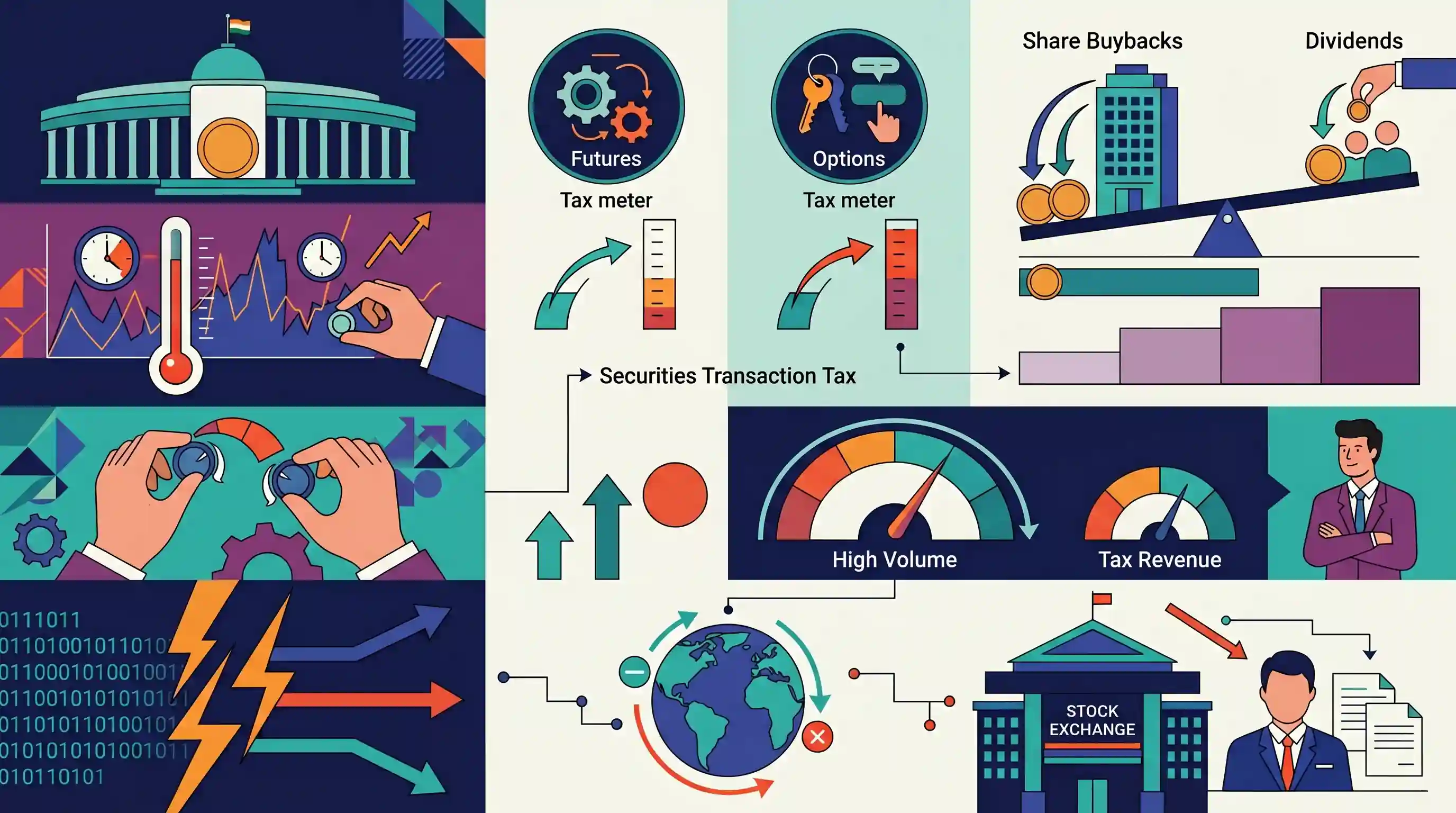
Why It Matters
Illustrates the government's use of taxation as a regulatory tool to stabilize financial markets, curb excessive retail speculation in derivatives, and close tax arbitrage loopholes.
Summary
The Union Budget 2026 proposes a substantial increase in the Securities Transaction Tax (STT) on derivatives to curb speculative trading. The STT on futures will rise to 0.05% and on options to 0.15%. In a move affecting corporate cash payouts, share buybacks will now be taxed as capital gains at applicable slab rates, removing their prior tax arbitrage over dividends. The government aims to protect retail investors from losses in the overheated futures and options (F&O) market, prioritizing volume moderation over revenue maximization. These changes may trigger a decline in algorithmic trading and Foreign Institutional Investor (FII) participation, with cascading impacts on broking companies and stock exchanges.
Key Points
- STT on futures has been increased from 0.02% to 0.05%, and on options from 0.1% to 0.15%.
- Share buybacks will now be taxed as capital gains based on the investor's tax slab, removing the tax arbitrage advantage they previously held over dividends.
- The primary goal of the tax hike is to moderate trading volumes and protect retail investors from speculative losses in the overheated derivatives market.
- The increased transaction costs are expected to moderate algorithmic trading and Foreign Institutional Investor (FII) participation.
- The policy shift may negatively impact the revenues of broking companies, stock exchanges, and Asset Management Companies (AMCs).
Important Terms
Securities Transaction Tax (STT)

A direct tax levied on the purchase and sale of securities (including shares and derivatives) listed on Indian stock exchanges, regardless of whether the transaction results in a profit or loss.
UPSC context
GS-III: Taxation. Tests knowledge of fiscal tools used to regulate speculative trading and generate revenue from capital market activity.
Derivatives (Futures and Options)
Financial derivatives where 'Futures' are binding contracts to trade assets at set future prices, and 'Options' provide the right, but not the obligation, to trade in exchange for a premium.
UPSC context
GS-III: Capital Market. Relevant for understanding market liquidity, price discovery, and SEBI's regulatory measures to protect retail investors from volatility.
Share Buyback
A corporate action where a company repurchases its own shares to reduce outstanding supply; proceeds are now increasingly taxed as capital gains/dividends at the shareholder level to remove tax arbitrage.
UPSC context
GS-III: Mobilization of Resources. Tests understanding of corporate finance, tax parity between dividends and buybacks, and impacts on shareholder wealth.
Capital Gains Tax
A tax on the profit realized from selling non-inventory assets like stocks or real estate, categorized into short-term (STCG) or long-term (LTCG) based on the asset's holding period.
UPSC context
GS-III: Indian Economy. Key to understanding direct tax structures, investment incentives, and the government's efforts to curb short-term speculation.
Foreign Portfolio Investment (FPI)
Investment by non-residents in Indian financial assets like stocks and bonds. It is typically short-term and liquid, lacking the management control characteristic of Foreign Direct Investment (FDI).
UPSC context
GS-III: Investment Models. Vital for tracking capital flows, market sensitivity to global policy changes, and the impact of taxation on foreign capital.
Prelims Trap
Securities Transaction Tax (STT) is an indirect tax levied on all financial market transactions.
Aspirants often confuse transaction-based taxes with indirect taxes (like GST). STT is legally classified as a direct tax levied by the Central Government on the value of securities.
Static Concepts Connected
What is the Securities Transaction Tax (STT) and how is it levied?
- Direct Tax: STT is a direct tax introduced in 2004, levied on the value of taxable securities transactions.
- Scope of Levy: It applies to equities, derivatives (F&O), and equity-oriented mutual funds traded on recognized domestic stock exchanges. It excludes off-market trades and currency/commodity derivatives.
- Collection Mechanism: The tax is collected by the recognized stock exchange or mutual fund at the time of settlement and deposited with the Central Government.
What is the primary difference between Futures and Options in financial derivatives?
- Derivative Nature: Both are financial contracts that derive their value from an underlying asset, such as a stock, index, or commodity.
- Futures (Obligation): A futures contract creates a legally binding obligation for both the buyer and seller to execute the trade at a specified future date and price.
- Options (Right): An option grants the buyer the right, but not the obligation, to buy or sell the underlying asset. The risk is limited to the premium paid.
Cross-Topic Patterns
Retail Financialization & Speculation
The surge in F&O trading links to post-pandemic financialization of domestic savings. UPSC frequently tests regulatory measures designed to curb retail speculative losses and manage systemic risks.
Hot Money vs Long-Term Capital
Curbing FPI algorithmic trading via STT hikes aligns with the broader macroeconomic goal of discouraging volatile "hot money" while incentivizing long-term equity delivery and stable FDI.

A multi-statement question on the classification of financial taxes (STT as a direct tax) and the mechanics of futures vs options is highly likely.
Linked PYQs · 4
Linked PYQs · 4
- 2019PrelimsGS1
Which of the following is issued by registered foreign portfolio investors to overseas investors who want to be part of the Indian stock market without registering themselves directly?
- 2024PrelimsGS1
Consider the following: 1. Exchange-Traded Funds (ETF) 2. Motor vehicles 3. Currency swap Which of the above is/are considered financial instruments?
- 2021PrelimsGS1
Consider the following : 1. Foreign currency convertible bonds 2. Foreign institutional investment with certain conditions 3. Global depository receipts 4. Non-resident external deposits Which of the above can be included in Foreign Direct Investments?
- 2022PrelimsGS1
Which one of the following situations best reflects "Indirect Transfers" often talked about in media recently with reference to India?
