Union Budget fiscal measures to counter US protectionist tariffs
Source:Indian Express ↗
Why It Matters
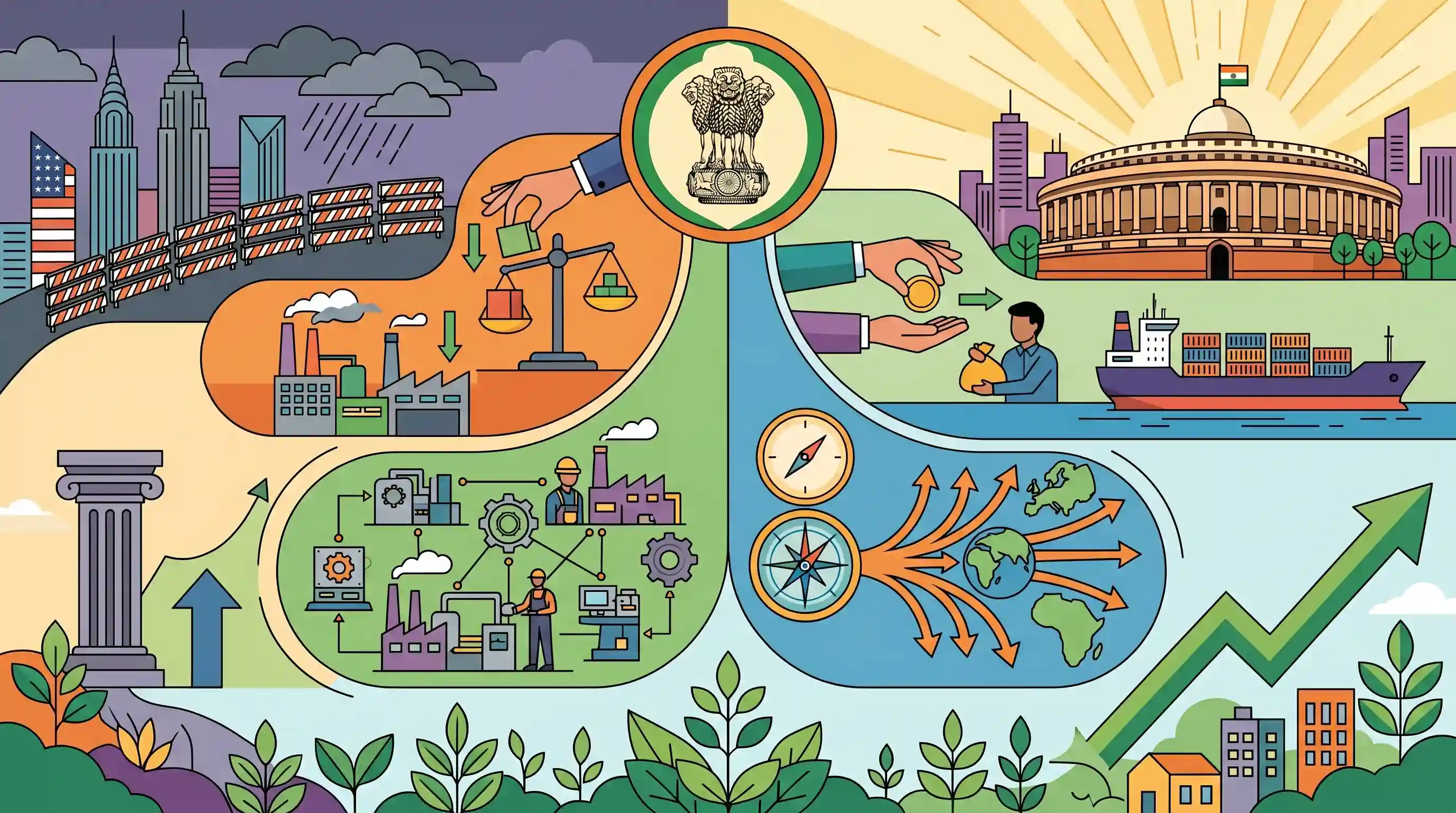
Rising global protectionism, particularly from a major trade partner like the US, threatens India's export growth and current account stability. Understanding how fiscal tools (Union Budget) are deployed to mitigate these external shocks is crucial for analyzing India's macroeconomic resilience and trade strategy in GS Paper 3.
Summary
The Union Budget 2026 addresses the strain of protectionist US tariffs on India by outlining four key economic countermeasures. Amidst a global shift away from free trade, the budget emphasizes tariff rationalization on raw materials to boost export competitiveness and correct inverted duty structures. It enhances support for exporters through schemes like RoDTEP, expands the Production-Linked Incentive (PLI) framework to deepen domestic manufacturing supply chains, and strongly pushes for the diversification of India's export markets. These measures collectively aim to safeguard macroeconomic stability and ensure sustainable economic growth despite bilateral trade frictions with the United States.
Key Points
- The Union Budget 2026 proposes strategic interventions to insulate the Indian economy from the adverse impacts of rising US tariffs and global protectionism.
- Tariff Rationalization: The budget focuses on reducing import duties on critical raw materials to correct inverted duty structures, thereby making Indian domestic manufacturing more cost-competitive globally.
- Export Promotion: Increased budgetary allocations for export-incentivizing schemes like RoDTEP to cushion the margins of exporters facing higher tariff barriers in the US market.
- Deepening Local Supply Chains: Expansion of the Production-Linked Incentive (PLI) scheme is prioritized to build self-reliance (Atmanirbhar Bharat) and reduce vulnerability to external trade shocks.
- Market Diversification: The fiscal framework incentivizes diversifying trade relations and exploring alternative export destinations, reducing over-dependence on the US market amidst bilateral trade friction.
Important Terms
Production-Linked Incentive (PLI) Scheme

A performance-linked scheme providing financial incentives to manufacturers based on incremental sales. It aims to scale domestic production, attract investment, and integrate India into global value chains.
UPSC context
GS3 (Economy/Industry); tests understanding of manufacturing incentives and 'Atmanirbhar Bharat' initiatives.
Remission of Duties and Taxes on Exported Products (RoDTEP)
A WTO-compliant export promotion scheme that rebates embedded taxes and duties (like VAT on fuel) incurred during manufacturing and distribution that are not otherwise refunded through other mechanisms.
UPSC context
GS3 (Trade/Economy); tests knowledge of export competitiveness and compliance with global trade norms.
Inverted Duty Structure
A taxation anomaly where import duties on raw materials or intermediate inputs are higher than those on finished products, discouraging domestic value addition and hurting manufacturing competitiveness.
UPSC context
GS3 (Economy/Taxation); tests ability to analyze trade policy distortions affecting domestic manufacturing and the 'Make in India' goal.
Protectionism
Economic policy of restricting imports through tariffs, quotas, or non-tariff barriers to shield domestic industries from foreign competition, often impacting global supply chain stability.
UPSC context
GS2 (International Relations); tests understanding of global trade dynamics and India's response to bilateral trade frictions.
World Trade Organization (WTO)
The primary global body regulating international trade. It ensures trade flows smoothly, adjudicates disputes, and sets rules against unfair subsidies, influencing India’s export incentive designs.
UPSC context
GS2/GS3 (International Orgs); tests knowledge of global trade governance and its impact on India's sovereign policy.
Union Budget 2026
The annual financial statement presented in February 2026, prioritizing manufacturing resilience, export support (RoDTEP/PLI), and duty rationalization to counter protectionist US tariffs and global trade volatility.
UPSC context
GS3 (Economy); tests knowledge of current fiscal priorities and strategic countermeasures against external economic shocks.
Prelims Trap
"An inverted duty structure means import duties on finished goods are higher than on raw materials."
It is the exact opposite. Import duty on inputs/raw materials is higher than on finished products, which penalizes domestic manufacturing.
Static Concepts Connected
What is an Inverted Duty Structure and why is it detrimental to the economy?
- Definition: A tax regime where import duties on raw materials and intermediates are higher than the duties on finished goods.
- Economic Impact: It discourages domestic manufacturing and value addition, as importing fully assembled finished products becomes cheaper than assembling them locally.
- Resolution: Usually addressed during the Union Budget by lowering input tariffs or modestly raising tariffs on finished goods.
Why was RoDTEP introduced to replace MEIS for export promotion?
- WTO Compliance: MEIS provided direct export subsidies linked to export performance, which violated the WTO's Agreement on Subsidies and Countervailing Measures (ASCM).
- Embedded Taxes: RoDTEP strictly refunds embedded central, state, and local taxes/duties (like VAT on fuel, mandi tax) that are not rebated under GST.
- Mechanism: It utilizes an end-to-end IT environment to issue transferable electronic scrips, ensuring transparency and WTO adherence.
Cross-Topic Patterns
Protectionism & Supply Chain Resilience Initiative
US tariffs highlight the shift from efficiency to resilience. This connects directly to the Indo-Pacific Supply Chain Resilience Initiative (SCRI) and India's 'China Plus One' positioning.
PLI limitations vs. Free Trade Agreements
While PLI boosts production, FTAs (like CEPA/ECTA) ensure market access. Expect mains questions analyzing if domestic subsidies can counter protectionist walls without reciprocal trade pacts.

Expect a multi-statement question on Inverted Duty Structure, linking it directly to PLI limitations and FTAs in the 2026 Prelims.
Linked PYQs · 4
Linked PYQs · 4
- 2025MainsGS3
What are the challenges before the Indian economy when the world is moving away from free trade and multilateralism to protectionism and bilateralism? How can these challenges be met?
- 2018MainsGS3
How would the recent phenomena of protectionism and currency manipulations in world trade affect macroeconomic stability of India?
- 2012MainsGS2
Discuss the likely negative impact of the protectionist measures proposed by the US on India's software industry.
- 2023PrelimsGS1
Consider the following statements: Statement-I: India accounts for 3.2% of global export of goods. Statement-II: Many local companies and some foreign companies operating in India have taken advantage of India's 'Production-linked Incentive' scheme. Which one of the following is correct in respect of the above statements?
