Union Budget Customs Duty Cuts and Fiscal Devolution to States
Source:The Hindu ↗
Why It Matters
The Centre's decision to share a cess with states sets a novel precedent in fiscal federalism, as cesses are typically excluded from the divisible tax pool. It demonstrates flexibility in Centre-State financial relations to accommodate state subjects like public health. Furthermore, the clarification on customs duties underscores India's strategic autonomy in balancing domestic industrial needs against international trade pressures.
Summary
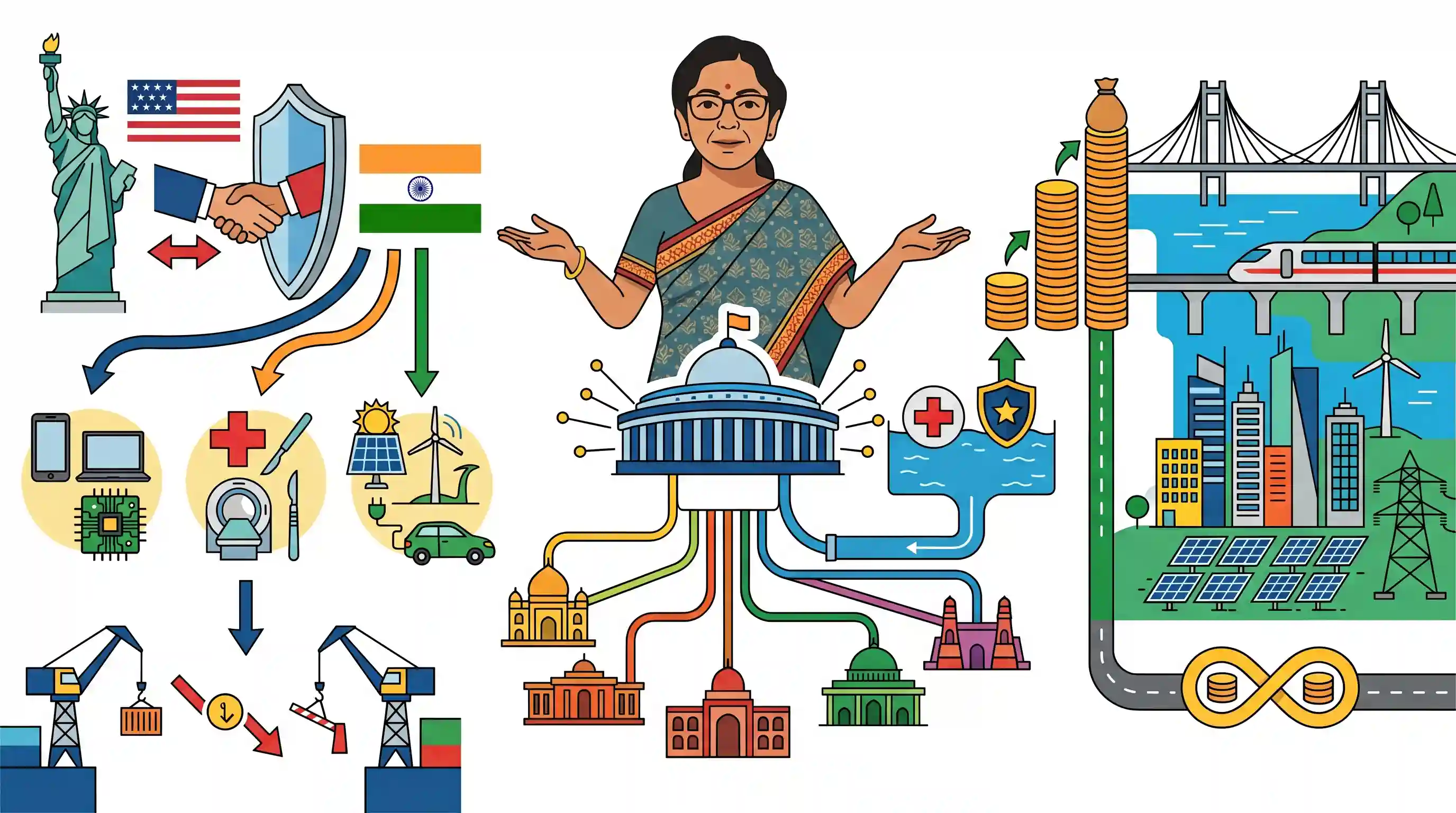
Union Finance Minister Nirmala Sitharaman clarified that the customs duty cuts in Budget 2026 on electronics, medical devices, and clean energy inputs were based strictly on India's domestic needs and not influenced by ongoing trade negotiations with the U.S. Highlighting cooperative federalism, she announced a "grand bargain" wherein the Centre will share proceeds from the Health to National Security Cess with states to support public health, marking a rare instance of a cess being devolved. Additionally, the allocation for 50-year interest-free capital investment loans to states under the SASCI scheme has been increased to ₹2 lakh crore to further bolster state-level infrastructure spending.
Key Points
- Customs duty relaxations in Union Budget 2026 were driven by domestic priorities and were entirely independent of ongoing India-U.S. trade negotiations.
- The Centre has struck a 'grand bargain' with states by agreeing to share the proceeds of the Health to National Security Cess on pan masala, despite cesses typically falling outside the divisible tax pool.
- This devolution decision acknowledges that public health is a State subject, setting a unique precedent for Centre-State financial cooperation.
- The allocation for 50-year interest-free loans to states under the Scheme for Special Assistance to States for Capital Investment (SASCI) was enhanced to ₹2 lakh crore for FY 2026-27 to stimulate regional capital expenditure.
Important Terms
Scheme for Special Assistance to States for Capital Investment (SASCI)

A central scheme providing 50-year interest-free loans to state governments for infrastructure projects. In Budget 2026, its allocation was increased to ₹2 lakh crore to boost regional capital expenditure.
UPSC context
GS Paper-III: Indian Economy and Fiscal Federalism. Tests understanding of Centre-state financial transfers and capital expenditure incentives.
Health to National Security Cess
A capacity-based levy on demerit goods like pan masala, introduced in 2025. Uniquely, its proceeds are shared with states for public health, marking a shift in traditional cess management.
UPSC context
GS Paper-III: Government Budgeting. Important for understanding innovative tax structures and evolving Centre-state revenue-sharing models.
Sixteenth Finance Commission (16th FC)
A constitutional body (Article 280) that recommends the distribution of net tax proceeds between the Centre and states. The 16th FC report was tabled in Parliament in February 2026.
UPSC context
GS Paper-II: Constitutional Bodies. Core topic regarding horizontal and vertical devolution of taxes in India’s federal structure.
Customs Duty Overhaul
A tax imposed on imports and exports of goods. The 2026 overhaul targeted electronics and clean energy to support domestic manufacturing (Aatmanirbhar Bharat) and correct duty inversions.
UPSC context
GS Paper-III: International Trade and Industrial Policy. Relates to trade competitiveness, protectionism, and global value chain integration.
Cooperative Federalism
A concept where the Centre and states work together to solve common problems. Devolution of cess proceeds in Budget 2026 is cited as a key example of this partnership.
UPSC context
GS Paper-II: Federal Structure. Tests the ability to link fiscal measures with broader political and constitutional principles.
Prelims Trap
"Cesses and surcharges collected by the Union form part of the mandatory divisible pool shared with States."
Article 270 explicitly excludes cesses and surcharges from the divisible pool. The Centre sharing the Health Cess is a rare, voluntary policy exception, not a constitutional mandate.
Static Concepts Connected
How do cesses and surcharges function within India's constitutional fiscal framework?
- Article 270 exclusion: Under Article 270, both cesses and surcharges are explicitly excluded from the mandatory divisible pool of taxes shared with State governments.
- Specific vs General: A cess is collected for a predefined specific purpose (e.g., health or education), whereas a surcharge is a 'tax on tax' for general Union government use.
- Finance Commission limit: The Finance Commission recommends the distribution of net tax proceeds, but it has no jurisdiction over the devolution of cesses and surcharges.
What are the core parameters of the SASCI scheme?
- Interest-free loans: Provides State governments with 50-year interest-free loans directly from the Central government.
- Capex only: Funds are strictly earmarked for capital investment projects (infrastructure, asset creation) and cannot be utilized to cover everyday revenue expenditures.
Cross-Topic Patterns
Fiscal federalism meets State subjects
Public health is a State subject (Schedule VII, Entry 6). Sharing this cess bridges the mismatch between the Centre's revenue-raising capacity and the States' expenditure obligations for grassroots health infrastructure.
Tariff policy enabling PLI schemes
Customs duty cuts on intermediate goods (electronics, clean energy) directly complement PLI schemes by lowering input costs for domestic manufacturers, acting as an industrial lever rather than a trade concession.

A 2026 Prelims statement will likely test the constitutional exclusion of cesses under Article 270 against this rare voluntary sharing.
Linked PYQs · 3
Linked PYQs · 3
- 2025MainsGS2
Examine the evolving pattern of Centre-State financial relations in the context of planned development in India. How far have the recent reforms impacted the fiscal federalism in India?
- 2024MainsGS2
What changes has the Union Government recently introduced in the domain of Centre-State relations ? Suggest measures to be adopted to build the trust between the Centre and the States and for strengthening federalism.
- 2018MainsGS2
How is the Finance Commission of India constituted? What do you know about the terms of reference of the recently constituted Finance Commission? Discuss.
