Fiscal Deficit Targets and Capital Expenditure Priorities
Source:Indian Express ↗
Why It Matters
The Union Budget is the most crucial annual macroeconomic document for UPSC. Its priorities—such as capex vs revenue expenditure, job creation vs fiscal consolidation, and taxation changes (STT)—directly relate to the GS3 syllabus. Furthermore, responding to US protectionism highlights the intersection of international relations (GS2) and economy (GS3).
Summary
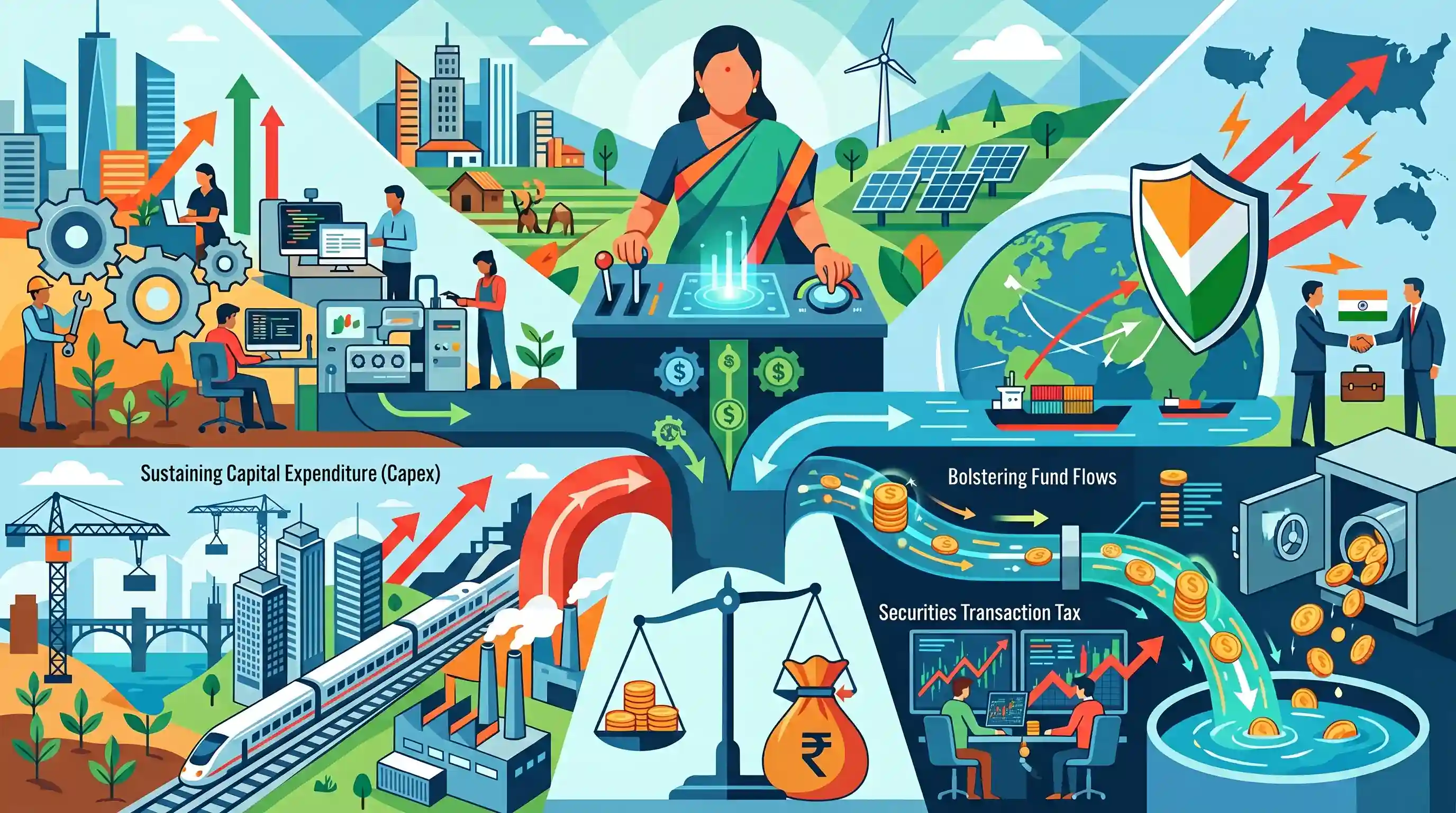
The Union Budget 2026-27, presented by Finance Minister Nirmala Sitharaman, highlights five key areas of focus: driving job creation, sustaining capital expenditure (capex), adhering to fiscal deficit targets, easing the economic distress from US tariffs, and bolstering fund flows. A notable policy shift includes the hike in the Securities Transaction Tax (STT) affecting capital markets. The budget attempts to balance fiscal prudence with growth-oriented policies and strategic economic diplomacy to counter global trade frictions.
Key Points
- Job Creation Push: The budget emphasizes generating employment to harness India's demographic dividend and boost economic growth.
- Capex and Fiscal Consolidation: Focus continues on capital expenditure for infrastructure development while adhering to fiscal deficit targets.
- Securities Transaction Tax (STT): The hike in STT represents a significant shift in capital market taxation.
- Mitigating US Tariff Impact: The budget introduces measures to protect domestic industries and exports from the distress caused by protectionist US tariffs.
- Bolstering Fund Flows: Strategic steps have been outlined to attract and sustain capital inflows into the economy.
Important Terms
Fiscal Deficit

The difference between the government's total expenditure and its non-debt receipts, representing the total borrowing required by the government to fund its operations.
UPSC context
GS Paper 3: Government Budgeting. It is a critical indicator of fiscal health and a frequently tested concept in Prelims/Mains.
Capital Expenditure (Capex)
Funds spent by the government on creating or upgrading physical assets like infrastructure, which improves productive capacity and generates long-term economic returns.
UPSC context
GS Paper 3: Indian Economy. Significant for understanding growth multipliers and infrastructure-led development strategies.
Securities Transaction Tax (STT)
A direct tax levied on the purchase and sale of securities (like shares and derivatives) traded on recognized stock exchanges in India.
UPSC context
GS Paper 3: Mobilization of Resources. Tests knowledge of capital market taxation and government measures to curb speculation.
Union Budget
The Annual Financial Statement (under Article 112) presented to Parliament, detailing the estimated receipts and expenditures of the Union Government for a financial year.
UPSC context
GS Paper 3: Government Budgeting. Essential for understanding constitutional provisions and fiscal policy priorities.
Economic Diplomacy
The use of a nation's economic resources and diplomatic influence to achieve its geopolitical and economic goals, particularly in trade negotiations.
UPSC context
GS Paper 2: International Relations. Relevant for India's response to global trade wars and protectionist policies.
Protectionist Tariffs
Duties imposed by a country on imported goods, often used as a protectionist tool to support domestic industries or as leverage in trade negotiations.
UPSC context
GS Paper 3: Effects of Liberalization on the Economy. Important for discussing global trade frictions and their impact on Indian exports.
Prelims Trap
"Securities Transaction Tax (STT) is an indirect tax levied only on the profits made from stock market transactions."
STT is actually a direct tax levied on the total transaction value, irrespective of profit or loss, and strictly excludes off-market transactions.
Static Concepts Connected
How does Securities Transaction Tax (STT) differ from Capital Gains Tax?
- Tax Base: Both are direct taxes, but STT is levied upfront on the total transaction value regardless of profit or loss, whereas CGT is levied solely on the realized profit.
- Applicability: STT applies strictly to trades executed on recognized stock exchanges, explicitly excluding off-market transfers and private deals.
What is the Fiscal Consolidation glide path in the post-pandemic era?
- Revised Target: The Union Government aims to reduce the fiscal deficit to below 4.5% of GDP by FY 2025-26, deviating from the pre-pandemic 3% FRBM target.
- Quality of Deficit: Elevated deficits are currently justified by shifting the expenditure mix heavily towards Capital Expenditure (Capex) for long-term infrastructure, rather than recurrent Revenue Expenditure.
Cross-Topic Patterns
Protectionism vs Domestic Fiscal Policy
The budget's measures to buffer domestic industries from US tariffs directly link India's internal macro-fiscal strategy to changing global trade regimes and supply chain fragmentation.
STT hikes and Retail Financialization
The STT hike reflects macroeconomic concerns over the retail derivatives (F&O) trading boom, intertwining Ministry of Finance revenue measures with SEBI's capital market stability regulations.

Expect a 2026 Prelims question pairing STT's direct tax nature and exemptions with the FRBM 4.5% fiscal glide path and Capex basics.
Linked PYQs · 5
Linked PYQs · 5
- 2021MainsGS3
Distinguish between Capital Budget and Revenue Budget. Explain the components of both these Budgets.
- 2019MainsGS3
The public expenditure management is a challenge to the Government of India in the context of budget making during the post-liberalization period. Clarify it.
- 2022MainsGS3
Economic growth in the recent past has been led by increase in labour productivity." Explain this statement. Suggest the growth pattern that will lead to creation of more jobs without compromising labour productivity.
- 2014MainsGS3
While we flaunt India's demographic dividend, we ignore the dropping rates of employability. What are we missing while doing so? Where will the jobs that India desperately needs come from? Explain.
- 2023PrelimsGS1
Consider the following markets: 1. Government Bond Market 2. Call Money Market 3. Treasury Bill Market 4. Stock Market How many of the above are included in capital markets?
