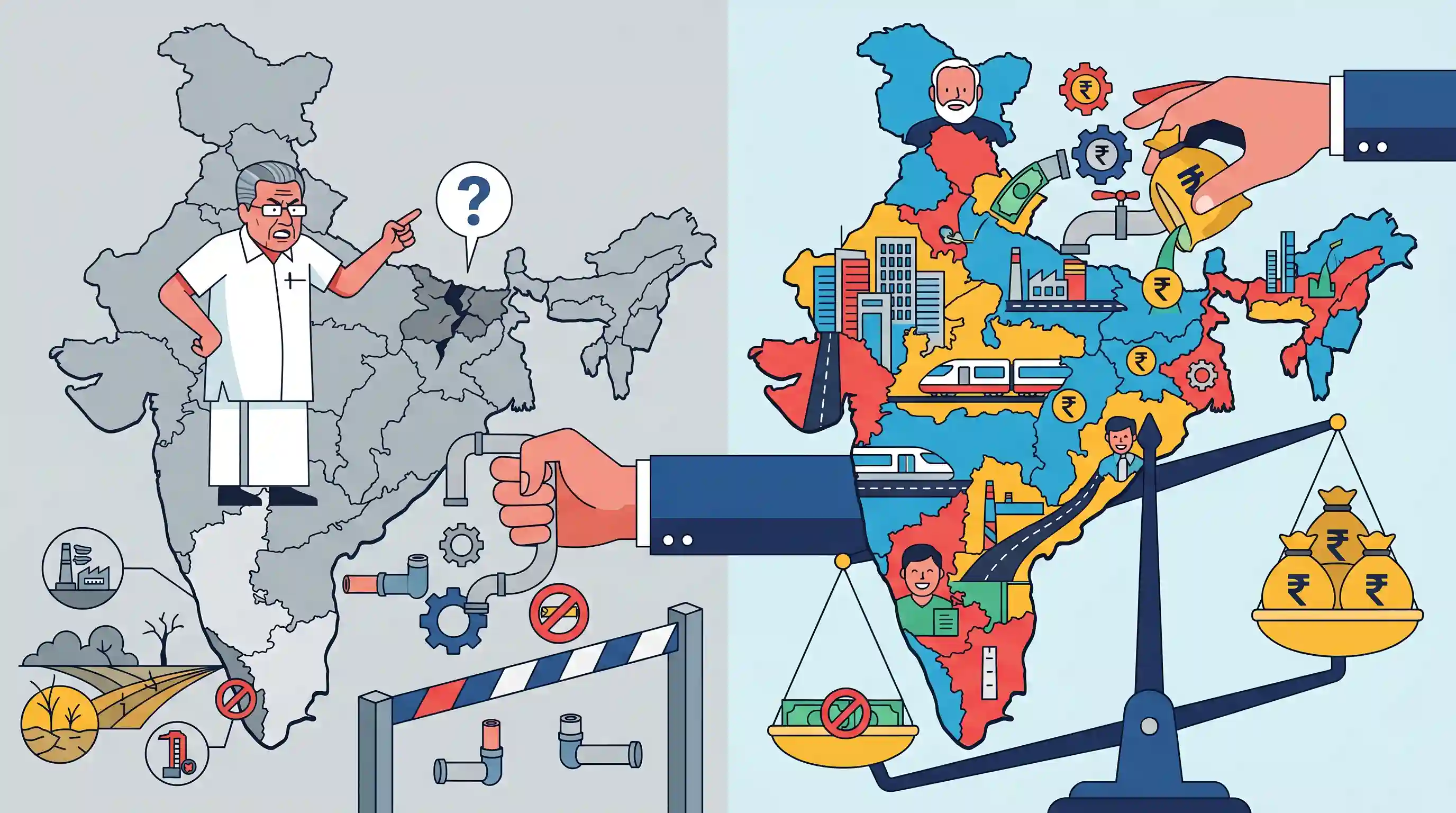
Kerala Chief Minister condemns Union Budget over missing state demands
Source:Indian Express ↗
Why It Matters
Highlights the practical challenges and political controversies surrounding fiscal federalism and resource allocation in India, which is directly relevant to GS2 topics on issues and challenges pertaining to the federal structure.
Summary
Kerala Chief Minister Pinarayi Vijayan condemned the Union Budget 2026 for ignoring the state's major demands, rhetorically asking if Kerala had been removed from the map of India. The criticism points to escalating tensions in India's fiscal federalism, wherein opposition-ruled states frequently accuse the Union Government of political bias and discrimination in resource allocation, grants, and infrastructure funding.
Key Points
- Kerala Chief Minister Pinarayi Vijayan strongly criticized the Union Budget 2026 for allegedly omitting all key developmental demands of the state.
- He questioned if Kerala was "not on India's map," highlighting the perceived systemic neglect of the state by the central government.
- The ongoing dispute underscores growing friction in Centre-State relations, particularly concerning fiscal federalism and the equitable distribution of resources to opposition-ruled states.
Important Terms
Fiscal Federalism

The financial architecture governing revenue sharing and expenditure responsibilities between central, state, and local governments in a federal system.
UPSC context
GS Papers II & III; crucial for understanding Centre-State financial relations and federal tensions.
Finance Commission
A constitutional body (Article 280) appointed every five years to recommend the distribution of net tax proceeds between the Union and States.
UPSC context
GS Paper II; tests knowledge of constitutional bodies and equitable resource distribution mechanisms.
Divisible Pool
The portion of central tax revenue (excluding cesses and surcharges) that must be shared with states based on Finance Commission recommendations.
UPSC context
GS Paper III; key to analyzing the shrinking fiscal space for states and tax devolution.
Cesses and Surcharges
Additional transfers provided to states (Article 271) for specific purposes that do not enter the divisible pool, reducing the states' total share of central taxes.
UPSC context
GS Paper III; highlights contemporary challenges in fiscal federalism and state revenue autonomy.
Revenue Deficit Grant
Grants-in-aid provided under Article 275 to states facing a gap between their revenue receipts and essential expenditures after tax devolution.
UPSC context
GS Paper III; tests understanding of fiscal consolidation and support for resource-stressed states.
Vertical Devolution
The percentage-based allocation of the divisible pool of taxes from the Union government to the states collectively (currently 41%).
UPSC context
GS Paper II; core concept in federal financial relations and resource partitioning.
Centrally Sponsored Schemes (CSS)
Schemes funded primarily by the Centre but implemented by states, often requiring matching grants from state budgets.
UPSC context
GS Paper II; relevant for discussing administrative federalism and state expenditure flexibility.
Prelims Trap
"States have absolute autonomy to borrow from domestic markets as long as the debt remains within FRBM limits."
Under Article 293(3), states cannot raise any new loan without the Union Government's consent if they have any outstanding central loan or guarantee. It is not an absolute right.
Static Concepts Connected
What constitutes the Divisible Pool of taxes, and what is excluded?
- Divisible Pool: Comprises all central taxes and duties (like Income Tax, GST share) under Article 270, distributed vertically and horizontally.
- Constitutional Exclusions: Cesses levied for specific purposes and surcharges under Article 271 are retained entirely by the Centre and excluded from states' shares.
- Finance Commission: Recommends the ratio of distribution between the Union and States, currently set at 41% for the states.
What are the constitutional provisions governing State borrowing powers?
- Domestic Boundaries: Under Article 293(1), states can borrow within India upon the security of the Consolidated Fund of the State.
- Foreign Borrowing: Unlike the Union Government, states lack the constitutional power to raise loans from foreign governments or international institutions directly.
- Union Consent: Under Article 293(3), a state cannot raise a new loan without Centre's consent if a previous GoI loan/guarantee remains outstanding.
Cross-Topic Patterns
Demographic penalty & Finance Commission sharing
Southern states like Kerala argue that utilizing the 2011 census for 15th/16th Finance Commission horizontal devolution punishes their successful population control measures, severely squeezing their resource allocation.
Off-budget borrowing vs. FRBM compliance
State entities (like KIIFB) raise funds bypassing legislatures. The Centre now actively loops these "off-budget borrowings" into the state's Net Borrowing Ceiling to enforce FRBM discipline.

Expect a multi-statement Prelims question in 2026 combining Article 293(3) borrowing constraints with the exclusions of cesses/surcharges.
Linked PYQs · 4
Linked PYQs · 4
- 2025MainsGS2
Examine the evolving pattern of Centre-State financial relations in the context of planned development in India. How far have the recent reforms impacted the fiscal federalism in India?
- 2022MainsGS2
“While the national political parties in India favour centralisation, the regional parties are in favour of State autonomy.” Comment.
- 2015PrelimsGS1
With reference to the Fourteenth Finance Commission, which of the following statements is/are correct? 1. It has increased the share of States in the central divisible pool from 32 percent to 42 percent. 2. It has made recommendations concerning sector-specific grants. Select the correct answer using the code given below.
- 2002PrelimsGS1
Which one of the following authorities recommends the principles governing the grants-in-aid of the revenues to the states out of the Consolidated Fund of India?
