Union Budget 2026 projects fiscal deficit at 4.3 percent of GDP
Source:The Hindu ↗
Why It Matters
The Union Budget is central to understanding the macroeconomic management of the Indian economy. It is a recurring theme in UPSC examinations across Prelims and Mains, requiring aspirants to master concepts like fiscal deficit, capital vs revenue receipts, and the dynamics of fiscal federalism.
Summary
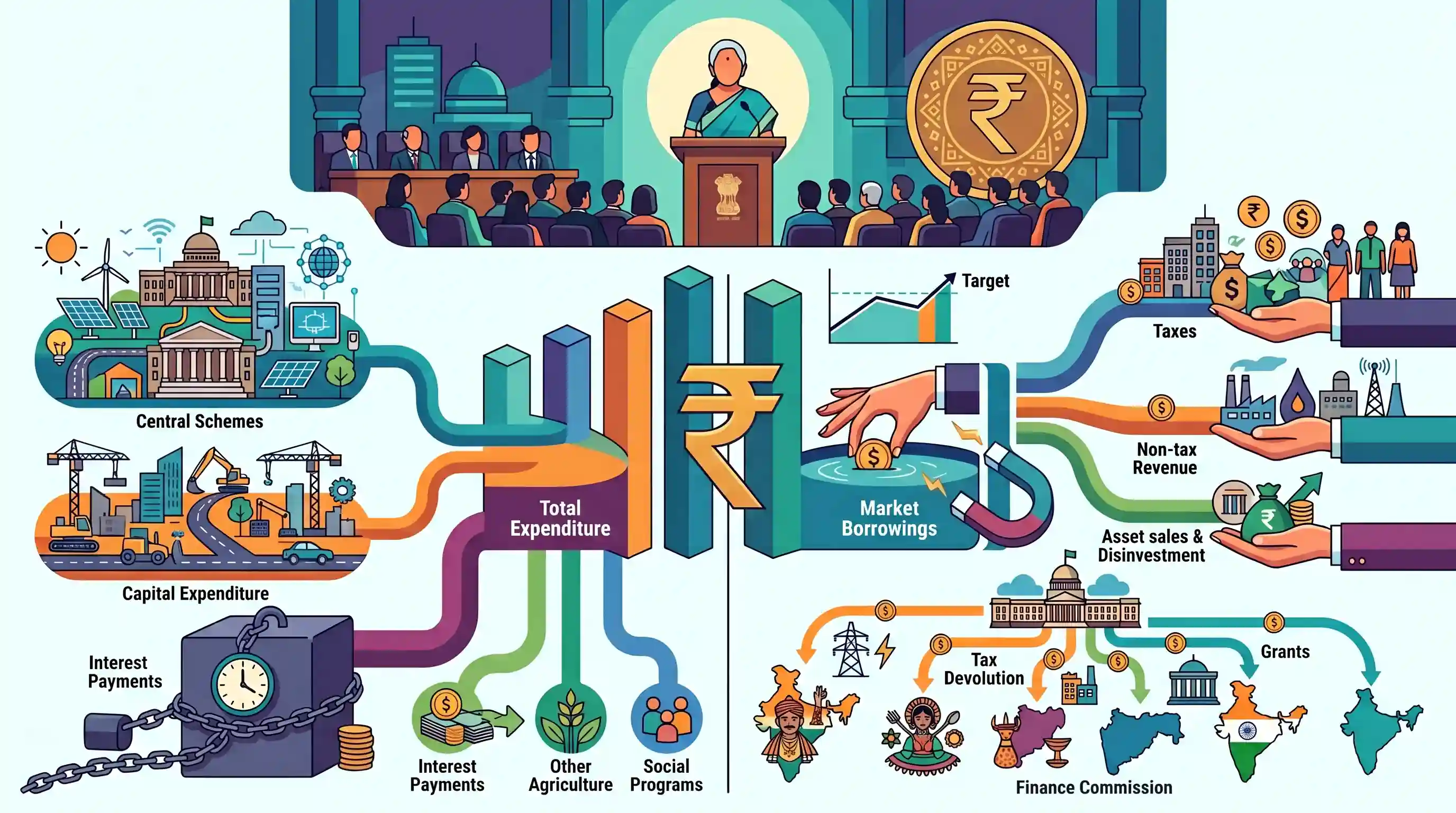
The Union Budget 2026-27, presented by Finance Minister Nirmala Sitharaman, outlines the government's revenue sources and expenditure priorities. It projects a total expenditure of ₹53.5 lakh crore against non-debt receipts of ₹36.5 lakh crore. The fiscal deficit is targeted at 4.3% of GDP, to be managed largely through market borrowings. Significant allocations have been made for central schemes, capital expenditure, and interest payments, alongside substantial tax devolutions and grants to states under the Finance Commission's framework.
Key Points
- For 2026-27, non-debt receipts are projected at ₹36.5 lakh crore, net tax receipts at ₹28.7 lakh crore, and total expenditure at ₹53.5 lakh crore.
- Major tax revenue sources include Income Tax (₹14.66 lakh crore), Corporate Tax (₹12.31 lakh crore), and GST (₹10.19 lakh crore).
- Key expenditure areas are Central schemes (₹17.7 lakh crore), Interest payments (₹14 lakh crore), and Capital expenditure (₹12.2 lakh crore).
- The fiscal deficit is estimated at 4.3% of GDP, with gross market borrowings projected at ₹17.2 lakh crore to bridge the gap.
- Transfers to States include ₹15.26 lakh crore through devolution of taxes and ₹1.29 lakh crore as Finance Commission grants.
Important Terms
Fiscal Deficit

The gap between the government's total expenditure and its total non-debt receipts. For FY 2026-27, it is targeted at 4.3% of GDP.
UPSC context
GS Paper III (Budgeting); tests understanding of fiscal consolidation, debt sustainability, and macroeconomic stability.
16th Finance Commission
A constitutional body (Article 280) that recommends the sharing of financial resources between the Centre and States. The 16th FC (2026-31) recommended 41% vertical devolution.
UPSC context
GS Paper II (Constitutional Bodies); critical for topics on fiscal federalism and inter-state equity.
Tax Devolution
The transfer of a share of central taxes (divisible pool) to state governments, determined by Finance Commission criteria like income distance and demographic performance.
UPSC context
GS Paper II (Centre-State Financial Relations); tests knowledge of horizontal and vertical fiscal imbalances.
Capital Expenditure (CapEx)
Government spending on the creation of physical assets like roads, railways, and power plants. In Budget 2026-27, it reached a record ₹12.2 lakh crore.
UPSC context
GS Paper III (Infrastructure/Growth); important for understanding economic multipliers and long-term asset creation.
Goods and Services Tax (GST)
A comprehensive destination-based indirect tax that unified numerous central and state levies under the 101st Constitutional Amendment Act, 2016.
UPSC context
GS Paper III (Taxation/Economy); central to discussions on cooperative federalism and indirect tax reforms.
PM-POSHAN
A flagship scheme providing hot cooked meals to school children (classes I-VIII) to enhance nutrition and enrollment, replacing the Mid-Day Meal Scheme.
UPSC context
GS Paper II (Social Justice/Welfare Schemes); relevant for questions on malnutrition, education, and human development.
Pradhan Mantri Awas Yojana (PMAY)
A national mission aiming to provide affordable "pucca" houses to all eligible beneficiaries. PMAY 2.0 (2024-29) targets 3 crore additional houses.
UPSC context
GS Paper II (Welfare Schemes/Governance); key for topics on housing, urban development, and social security.
Prelims Trap
"Goods and Services Tax (GST) is the single largest source of tax revenue for the Union Government."
In recent budgets, Income Tax has outpaced Corporate Tax and GST to become the single largest contributor to the Union Government's gross tax revenue pool.
Static Concepts Connected
What is the exact formula and significance of the Fiscal Deficit?
- Definition: Total Expenditure minus Total Receipts (excluding borrowings). It demonstrates the shortfall bridging amount needed.
- Significance: It reflects the total borrowing requirements of the government from all internal and external sources to fund its operations.
- Financing: In India, it is financed primarily through internal market borrowings (dated securities, T-bills) rather than external debt or printing money.
How do Revenue and Capital Expenditures differ in the Union Budget?
- Revenue Expenditure: It neither creates physical/financial assets nor reduces liabilities (e.g., interest payments, salaries, subsidies, grants to states).
- Capital Expenditure: It results in the creation of physical/financial assets or reduces financial liabilities (e.g., infrastructure development, loan repayments).
- Quality metric: A higher Capex-to-Revenue expenditure ratio indicates productive fiscal management with strong multiplier effects on the economy.
Cross-Topic Patterns
FRBM Act + Capex Multiplier
The steady reduction of the fiscal deficit to 4.3% alongside high capital expenditure highlights the government's transition from revenue-led welfarism to capex-led growth, reflecting the broader FRBM glide path.
Finance Commission + Fiscal Federalism
Budgeted devolutions (₹15.26 lakh crore) link directly to debates around the 16th Finance Commission's mandate, specifically regarding the exclusion of growing cesses and surcharges from the divisible pool.

Expect a 2026 prelims question testing the exact hierarchy of tax revenues (Income>Corp>GST) paired with definitions of capital receipts.
Linked PYQs · 4
Linked PYQs · 4
- 2025PrelimsGS1
Suppose the revenue expenditure is ₹ 80,000 crores and the revenue receipts of the Government are ₹60,000 crores. The Government budget also shows borrowings of ₹ 10,000 crores and interest payments of ₹ 6,000 crores. Which of the following statements are correct? I. Revenue deficit is ₹ 20,000 crores. II. Fiscal deficit is ₹ 10,000 crores. III. Primary deficit is ₹ 4,000 crores. Select the correct answer using the code given below.
- 2025PrelimsGS1
Consider the following statements : I. Capital receipts create a liability or cause a reduction in the assets of the Government. II. Borrowings and disinvestment are capital receipts. III. Interest received on loans creates a liability of the Government. Which of the statements given above are correct?
- 2025MainsGS2
Examine the evolving pattern of Centre-State financial relations in the context of planned development in India. How far have the recent reforms impacted the fiscal federalism in India?
- 2021MainsGS2
How have the recommendations of the 14th Finance Commission of India enabled the States to improve their fiscal position?
