Tamil Nadu Chief Minister criticises Union Budget for ignoring state
Source:The Hindu ↗
Why It Matters
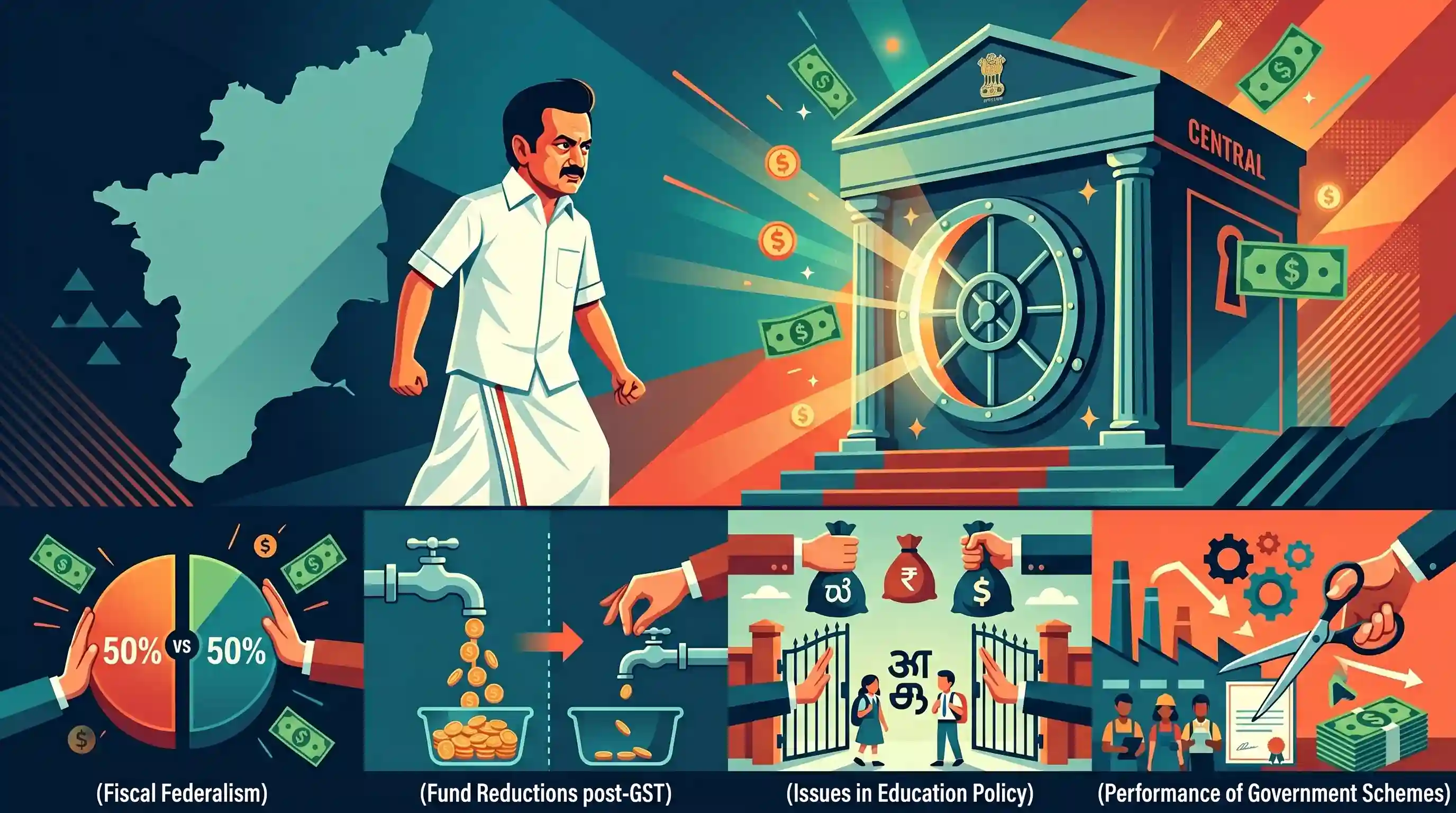
The article provides practical examples of the growing friction in Centre-State financial relations (fiscal federalism), touching on contentious topics like tax devolution formulas, the long-term impact of GST on state revenues, and the controversial tying of central grants to states' adoption of central policies (like the NEP's language formula).
Summary
Tamil Nadu Chief Minister M.K. Stalin strongly criticized the Union Budget 2026-27, alleging that it ignores the State's interests and displays a "step-motherly attitude." He highlighted the state's demand for a 50% share in central tax revenue via the Finance Commission, pointed out severe fund reductions post-GST implementation, and accused the Centre of withholding education funds over Tamil Nadu's refusal to adopt the National Education Policy's three-language formula. Stalin also cited the drastic budget cuts in the PM Internship Scheme as proof of failing central initiatives.
Key Points
- Fiscal Devolution Disparities: Tamil Nadu urged the 16th Finance Commission to increase the States' share of central taxes to 50% from the current 41%, noting its allocation remains low (4.097%) despite substantial revenue contributions.
- Conditional Grants and Federal Friction: The Union government allegedly withheld ₹3,548 crore meant for state education because Tamil Nadu refused to implement the three-language formula mandated by the National Education Policy (NEP).
- Underperformance of Central Schemes: CM Stalin pointed out massive shortfalls in central scheme implementation, such as the PM Internship Scheme being slashed to a revised estimate of ₹526 crore from an initially announced ₹10,831 crore.
- GST Revenue Impact: The state's tax revenue witnessed a structural drop of ₹1,200 crore, reflecting the continued resource constraints state governments face concerning revenue streams following GST implementation.
Important Terms
Finance Commission

A constitutional body (Article 280) recommending the distribution of tax revenue between the Union and States. The 16th FC maintained vertical devolution at 41% for 2026-31.
UPSC context
GS II/III: Centre-State financial relations, fiscal federalism, and the role of constitutional bodies in resource allocation.
National Education Policy (NEP)
A 2020 framework promoting a three-language formula. Tamil Nadu opposes this, favoring a two-language policy (Tamil/English), leading to the withholding of central Samagra Shiksha funds.
UPSC context
GS II: Issues relating to development and management of Social Sector/Services relating to Education and federal disputes.
Goods and Services Tax (GST)
India's unified indirect tax system. States like Tamil Nadu report fiscal stress following the 2022 termination of the GST compensation regime and 2025-26 rate rationalizations.
UPSC context
GS III: Indian Economy and issues relating to planning, mobilization of resources, and fiscal federalism.
Prime Minister's Internship Scheme
A scheme targeting youth employability via corporate placements. Budget 2026-27 slashed its allocation by 55% to ₹4,788 crore due to poor uptake and unspent funds.
UPSC context
GS III: Employment and government initiatives for skill development and youth empowerment.
Jal Jeevan Mission
A Centrally Sponsored Scheme aiming for universal rural tap water. Funding has become a flashpoint as the Centre attaches performance-linked conditions for releasing state shares.
UPSC context
GS II/III: Government schemes for vulnerable sections, welfare, and sustainable infrastructure development.
Prelims Trap
Grants given for Centrally Sponsored Schemes are statutory grants bound by Finance Commission recommendations.
Funds for Centrally Sponsored Schemes are discretionary grants (Article 282), giving the Centre leverage to attach policy conditions, unlike statutory grants (Article 275).
Static Concepts Connected
What is the constitutional difference between Statutory and Discretionary Grants?
- Statutory Grants (Art 275): Provided by Parliament out of the Consolidated Fund of India to states needing assistance, based on Finance Commission recommendations.
- Discretionary Grants (Art 282): The Centre or states can make these grants for any public purpose. They form the basis for funding Centrally Sponsored Schemes and come with conditions attached.
What is the historical origin and structure of the Three-Language Formula?
- Origin: First formulated by the Kothari Commission (1964-66) and formally adopted in the 1968 National Education Policy.
- Structure: Requires teaching of Mother tongue/regional language, Hindi in non-Hindi states (or another regional language in Hindi states), and English or a modern Indian language.
Cross-Topic Patterns
Concurrent List friction via CSS
Education is in the Concurrent List, but the Centre often dictates policy by tying discretionary grants (like Samagra Shiksha) to state compliance with central mandates like the NEP.
Co-funding welfare via Corporate CSR
The PM Internship Scheme structurally links corporate CSR obligations with the government exchequer to address youth unemployment, marking an innovative but complex shift in scheme financing and implementation.
GST and shrinking State tax autonomy
Post-GST, States surrendered significant indirect tax powers. This structural shift makes them heavily reliant on Finance Commission devolution, amplifying political friction over revenue sharing formulas.

Expect a 2026 Mains question on how linking discretionary grants (Art 282) to central policies alters the balance of fiscal federalism.
Linked PYQs · 5
Linked PYQs · 5
- 2025MainsGS2
Examine the evolving pattern of Centre-State financial relations in the context of planned development in India. How far have the recent reforms impacted the fiscal federalism in India?
- 2018MainsGS2
How is the Finance Commission of India constituted? What do you know about the terms of reference of the recently constituted Finance Commission? Discuss.
- 2020MainsGS2
National Education Policy 2020 is in conformity with the Sustainable Development Goal-4 (2030). It intends to restructure and reorient education system in India. Critically examine the statement.
- 2021MainsGS2
“Earn while you learn' scheme needs to be strengthened to make vocational education and skill training meaningful.” Comment.
- 2020MainsGS3
Explain the rationale behind the Goods and Services Tax (Compensation to States) Act of 2017. How has COVID-19 impacted the GST compensation fund and created new federal tensions?
