Fiscal Deficit Capital Expenditure and Sectoral Outlays in Budget
Source:The Hindu ↗
Why It Matters
Budgetary allocations are fundamental to India's fiscal policy and economic trajectory. For UPSC aspirants, data on capital expenditure, internal security funding (like the IB), and sector-specific incentives (e.g., IT, healthcare, defence) provide essential factual backing for answers on GS3 (Economy, Security) and GS2 (Social Sector/Health).
Summary
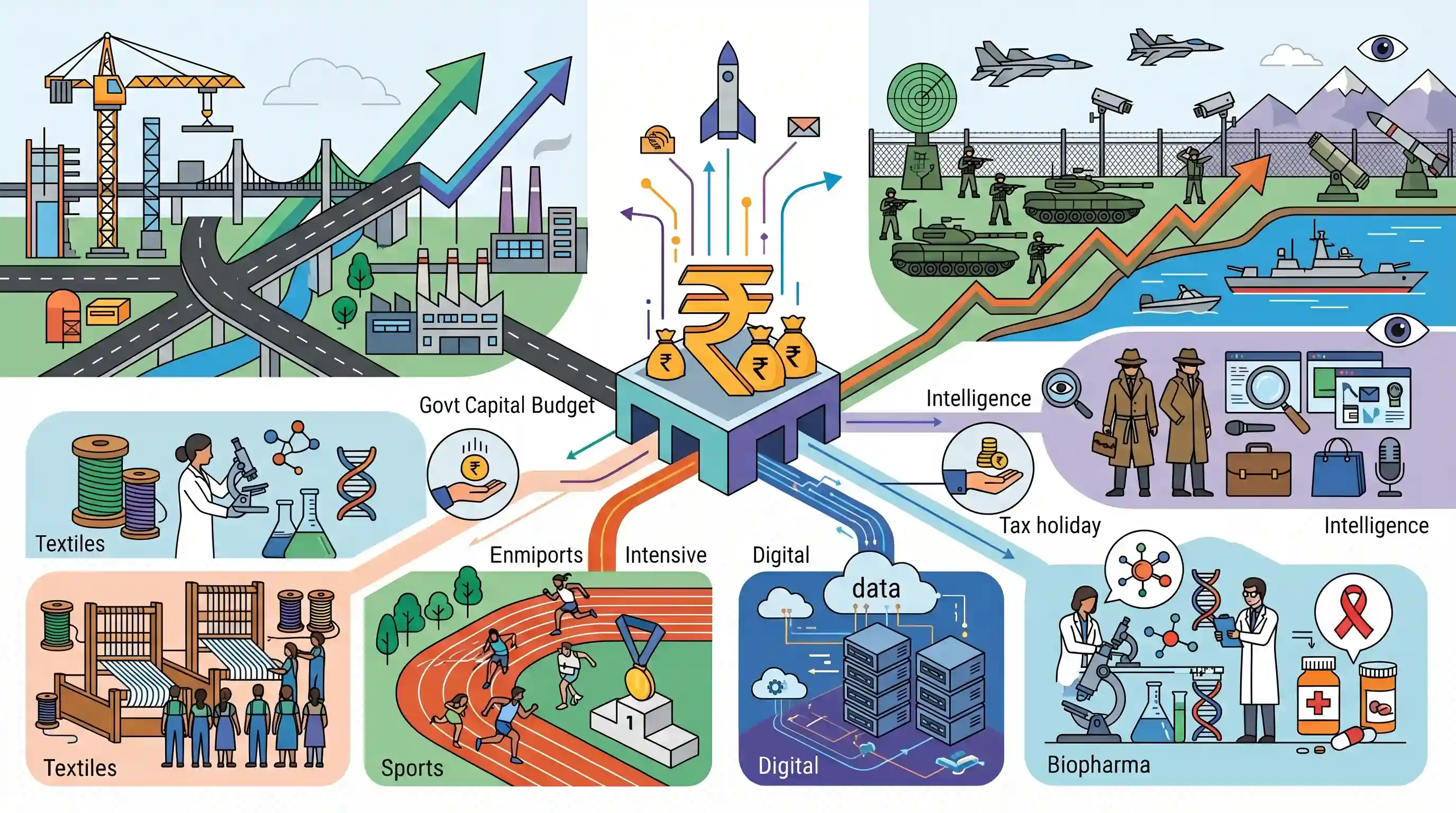
The Union Budget 2026-27 outlines significant financial allocations across key sectors to stimulate economic growth and enhance national security. Capital expenditure has been increased to ₹12.2 lakh crore to drive infrastructure development. Strategic measures include a 15% hike in the defence budget to ₹7.85 lakh crore following 'Operation Sindoor', and increased funding for the Intelligence Bureau. The budget also emphasizes digital infrastructure with tax holidays for data centres, whilst supporting healthcare through customs duty exemptions on critical cancer drugs and substantial biopharma investments. Furthermore, employment-intensive sectors like textiles and sports have received notable financial boosts.
Key Points
- Capital expenditure for 2026-27 has been pegged at ₹12.2 lakh crore, up from the revised estimate of ₹10.9 lakh crore for 2025-26.
- The defence sector received a record allocation of ₹7.85 lakh crore, marking a 15% increase, driven by post-Operation Sindoor modernization requirements.
- The IT sector will benefit from a tax holiday for data centres and relaxed safe harbour norms.
- Customs duty has been removed for 17 imported cancer medications, providing relief for rare diseases drugs alongside a ₹10,000 crore outlay for biopharma over five years.
- The Home Ministry budget increased by over 9%, with a specific enhancement in funds for the Intelligence Bureau to bolster internal security.
- Labour-intensive sectors such as textiles saw a near 25% jump in funding, while the sports goods sector received a ₹500 crore boost alongside high allocations for Khelo India.
Important Terms
Capital Expenditure (Capex)

Funds used by the government to acquire or maintain physical assets like infrastructure, machinery, and weapon systems, aimed at boosting long-term economic productivity.
UPSC context
GS Paper 3 (Economy); tests understanding of fiscal policy, investment multipliers, and the shift from revenue to capital-intensive budgeting.
Operation Sindoor
A 2025 military response to the Pahalgam terror attack, targeting terror infrastructure; its success triggered significant hikes in India's 2026-27 defence and intelligence budgets.
UPSC context
GS Paper 3 (Internal Security); relevant for managing border security challenges and the role of state actors in counter-terrorism.
Intelligence Bureau (IB)
India's premier internal intelligence agency under the Ministry of Home Affairs, responsible for gathering domestic intelligence and maintaining internal security.
UPSC context
GS Paper 3 (Internal Security); tests knowledge of the national security architecture and agencies managing internal threats.
Khelo India
A flagship central sector scheme launched in 2018 to revive India's sports culture and identify talent at the grassroots level through infrastructure and financial support.
UPSC context
GS Paper 2 (Social Justice/Development); relevant for issues relating to the social sector, youth development, and human resource management.
Ministry of Home Affairs (MHA)
The central ministry responsible for internal security, border management, center-state relations, and the administration of Union Territories and Central Armed Police Forces.
UPSC context
GS Paper 2 (Governance) & GS Paper 3 (Security); central to the administrative framework for internal stability and disaster management.
Customs Duty
An indirect tax imposed on the import or export of goods; the 2026 budget included exemptions for critical drugs and aviation components to lower costs.
UPSC context
GS Paper 3 (Economy/Trade); important for understanding fiscal tools used to regulate trade, protect domestic industry, and support public health.
Tax Holiday
A government-granted temporary reduction or elimination of taxes for businesses in specific sectors, such as data centres, to encourage investment and growth.
UPSC context
GS Paper 3 (Investment Models); tests knowledge of fiscal incentives designed to attract private investment and develop strategic digital infrastructure.
Prelims Trap
Customs duty has been completely abolished on all imported rare disease and life-saving medications.
The budget only removed customs duty for 17 specific imported cancer medications, not a blanket abolition for all life-saving or rare disease drugs.
Static Concepts Connected
What distinguishes Capital Expenditure from Revenue Expenditure in the Union Budget?
- Asset Creation: CapEx creates physical or financial assets or reduces government liabilities, unlike revenue expenditure.
- Nature of spending: Revenue expenditure is recurring (salaries, pensions, subsidies), whereas CapEx is long-term and non-recurring (infrastructure).
- Multiplier Effect: CapEx yields a higher economic multiplier effect, spurring long-term GDP growth and crowding in private investment.
What are 'Safe Harbour' norms in the context of corporate taxation?
- Definition: Legal provisions that reduce or eliminate liability if specific conditions are met, often defining acceptable transfer prices for MNEs.
- Litigation Reduction: They provide certainty to multinational enterprises about acceptable minimum profit margins, minimizing transfer-pricing disputes with tax authorities.
- Ease of Doing Business: By easing compliance and guaranteeing predictable taxation, these norms significantly improve the ease of doing business for foreign tech firms.
Cross-Topic Patterns
CapEx multiplier vs Employment elasticity
The ₹12.2 lakh crore CapEx aims for macroeconomic growth, while simultaneous funding spikes for textiles and sports target the historic lag in employment elasticity within India's manufacturing sector.
Data Centres and Digital Sovereignty
Offering tax holidays for data centres ties economic fiscal incentives directly to India's strategic push for data localization, cyber security, and robust digital public infrastructure.
Dual-front security and budget allocations
The 15% defence hike post-Operation Sindoor paired with increased Intelligence Bureau funds highlights the blurring lines between external border modernization and internal security intelligence.

CapEx multiplier effects and Safe Harbour tax norms are prime candidates for a conceptual multi-statement Economy question in 2026.
Linked PYQs · 3
Linked PYQs · 3
- 2021MainsGS3
Distinguish between Capital Budget and Revenue Budget. Explain the components of both these Budgets.
- 2023MainsGS3
What are the internal security challenges being faced by India? Give out the role of Central Intelligence and Investigative Agencies tasked to counter such threats.
- 2018PrelimsGS1
Consider the following statements: 1. The quantity of imported edible oils is more than the domestic production of edible oils in the last five years. 2. The Government does not impose any customs duty on all the imported edible oils as a special case. Which of the statements given above is/are correct?
