Macroeconomic Strategy and Capital Expenditure in Budget
Source:The Hindu ↗
Why It Matters
The Union Budget is the cornerstone of India's macroeconomic management. Its analysis is critical for UPSC aspirants to understand the government's fiscal policy direction, the distinction between capital and revenue budgets, and how targeted public expenditure influences national security, healthcare, and economic growth.
Summary
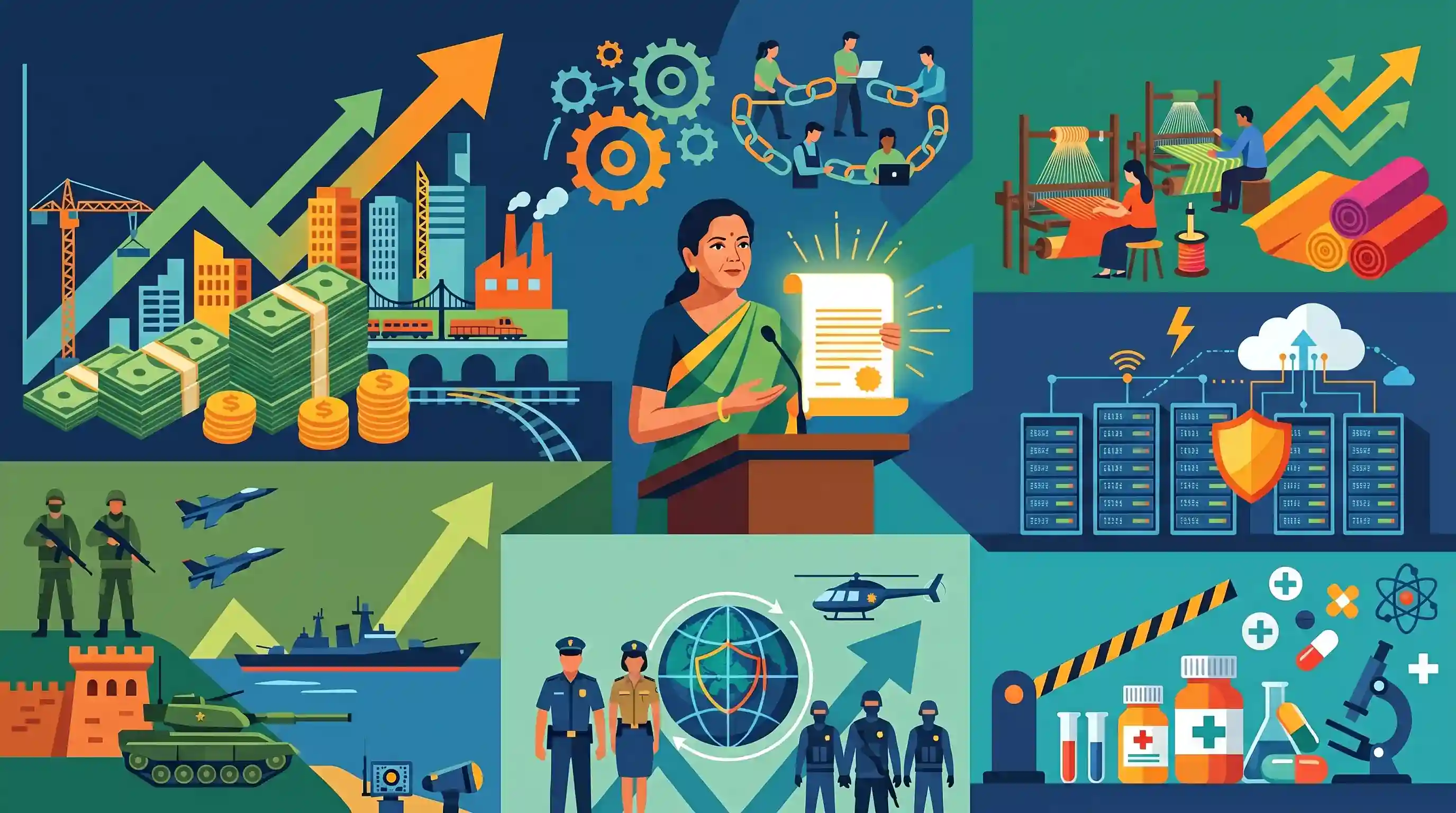
The article provides a comprehensive overview of the Union Budget 2026's economic roadmap. It highlights the government's continued reliance on capital expenditure to drive infrastructure development and sustain economic growth, while navigating fiscal consolidation. Key aspects include strategic allocations for defense and healthcare, targeted tax exemptions (such as for data centers and rare disease medications), and policies aimed at boosting labor-intensive sectors. The budget balances the dual objectives of macroeconomic stability and targeted sectoral investments.
Key Points
- The article outlines the fundamental economic policies, fiscal targets, and sectoral allocations introduced in the Union Budget 2026.
- A major focus remains on bolstering capital expenditure to stimulate long-term infrastructure development and economic growth.
- Sector-specific policy changes include adjustments to taxation, such as tax holidays and safe harbour norms for emerging sectors like IT and data centres.
- It covers strategic funding enhancements for critical areas including defence (border security), healthcare (rare diseases and biopharma), and labour-intensive industries.
Important Terms
Union Budget

The 'Annual Financial Statement' (Article 112), detailing the government's estimated receipts and expenditure for a fiscal year. It sets the nation's economic and developmental trajectory.
UPSC context
GS Paper 3 (Economy: Budgeting) and GS Paper 2 (Polity: Legislative procedures). Essential for understanding fiscal priorities and constitutional mandates.
Finance Bill
A legislative proposal introduced with the Budget (Articles 110/117) to operationalize taxation changes, including new taxes, exemptions, or amendments to existing tax laws.
UPSC context
GS Paper 2 (Polity). Tests knowledge of Money Bills vs. Financial Bills and the Speaker's certification powers.
Capital Expenditure (Capex)
Government spending on long-term physical or economic assets like infrastructure (roads, railways). It creates a 'multiplier effect,' stimulating growth, jobs, and private investment.
UPSC context
GS Paper 3 (Economic Development/Infrastructure). Tests ability to distinguish asset-creating expenditure from recurring revenue expenditure.
Fiscal Consolidation
A policy strategy aimed at reducing the fiscal deficit and public debt accumulation through increased revenue collection (taxation) and optimized, targeted expenditure.
UPSC context
GS Paper 3 (Fiscal Policy). Tests understanding of macroeconomic stability, debt-to-GDP ratios, and long-term fiscal health.
FRBM Act (2003)
A 2003 legislative framework mandating fiscal discipline in India. It sets specific targets for reducing fiscal and revenue deficits to ensure intergenerational equity and stability.
UPSC context
GS Paper 3 (Economy). Crucial for questions on fiscal management, deficit targets, and the role of the Finance Commission.
Tax Holiday
A temporary government incentive offering total or partial tax exemption to specific industries or projects to encourage investment and economic activity in targeted sectors.
UPSC context
GS Paper 3 (Economy: Taxation/Investment Models). Relevant for analyzing sectoral growth drivers like data centers or renewable energy.
Prelims Trap
Tax expenditure represents the direct financial outlay by the government to modernize tax collection infrastructure.
Tax expenditure is not a physical cash outflow; it is the 'revenue foregone' by the government through tax exemptions, deductions, and rebates to promote specific goals.
Static Concepts Connected
How does Capital Expenditure differ from Revenue Expenditure in the Union Budget?
- Asset creation: Capex creates physical or financial assets (or reduces liabilities), whereas revenue expenditure is consumed in day-to-day administration.
- Fiscal multiplier: Capex typically has a much higher fiscal multiplier effect, crowding-in private investment and spurring long-term GDP growth.
- Grants exception: Grants given to states for creating capital assets are classified as Revenue Expenditure, not Capex, in the Centre's budget.
What is 'Tax Expenditure' (Revenue Foregone) in government finance?
- Revenue foregone: It refers to the indirect subsidy the government provides by foregoing tax revenue via exemptions, deductions, and rebates.
- Policy tool: It serves as an alternative to direct budgetary allocations to incentivize specific sectors, like data centers or biopharma.
- Budget reporting: It is officially detailed in the 'Statement of Revenue Impact of Tax Incentives' under the Receipt Budget.
Cross-Topic Patterns
Jobless growth & demographic dividend
The budget's focus on labor-intensive sectors addresses the structural flaw of India's capital-intensive manufacturing growth, a crucial pivot needed to reap the closing demographic dividend.
Rare diseases & intellectual property
Tax exemptions for 'orphan drugs' intersect with the National Policy for Rare Diseases, healthcare equity, and the broader WTO TRIPS debate on medicine affordability.

Expect a multi-statement Prelims question distinguishing between Effective Capital Expenditure, Revenue Deficit, and Tax Expenditure.
Linked PYQs · 4
Linked PYQs · 4
- 2021MainsGS3
Distinguish between Capital Budget and Revenue Budget. Explain the components of both these Budgets.
- 2020MainsGS3
Explain the meaning of investment in an economy in terms of capital formation. Discuss the factors to be considered while designing a concession agreement between a public entity and a private entity.
- 2013MainsGS3
What is the meaning of the term 'tax expenditure'? Taking housing sector as an example, discuss how it influences the budgetary policies of the government.
- 2024MainsGS3
India has a long and troubled border with China and Pakistan fraught with contentious issues. Examine the conflicting issues and security challenges along the border. Also give out the development being undertaken in these areas under the Border Area Development Programme (BADP) and Border Infrastructure and Management (BIM) Scheme.
